

How to Optimize Your HubSpot Setup for Sales, Marketing, and Customer Success
Modern B2B organizations are increasingly relying on unified revenue operations to drive predictable growth. According to recent industry data, companies that align their sales and marketing technology stacks see a significant increase in operational efficiency and revenue attribution. HubSpot serves as the central nervous system for these efforts, but a default setup rarely delivers maximum value. To truly scale, you must move beyond basic configuration and implement a strategic architecture that connects every touchpoint from lead generation to customer retention. (Revenue Operations Agency About)
1. Building a Robust CRM Foundation
The core of any successful HubSpot implementation is a clean, governed data structure. CRM Architecture is the blueprint for how your customer data is stored, linked, and accessed. Without a solid foundation, downstream automation and reporting will fail. Many organizations struggle with data silos because they treat HubSpot as a simple contact list rather than a relational database.
Standardizing Data Properties
Start by auditing your custom properties. You must eliminate redundant fields and ensure that every property has a clear definition and source of truth. For example, the "Deal Stage" property should map directly to your sales methodology. If your sales team uses a specific qualification framework, your HubSpot pipeline must reflect those exact stages. This alignment ensures that Sales Pipeline Modeling accurately reflects reality.
Implementing Governance Rules
Data hygiene is not optional. You need automated workflows that prevent duplicate contacts and enforce mandatory fields before a record can be created. This process is known as CRM Architecture & Governance. By restricting manual entry and forcing data through standardized intake forms, you maintain the integrity of your revenue attribution models.
2. Streamlining Marketing Operations
Marketing operations often suffer from complexity when campaigns are managed in isolation. To fix this, you must integrate your marketing efforts directly with your sales processes. This requires a shift from campaign-centric thinking to account-centric thinking.
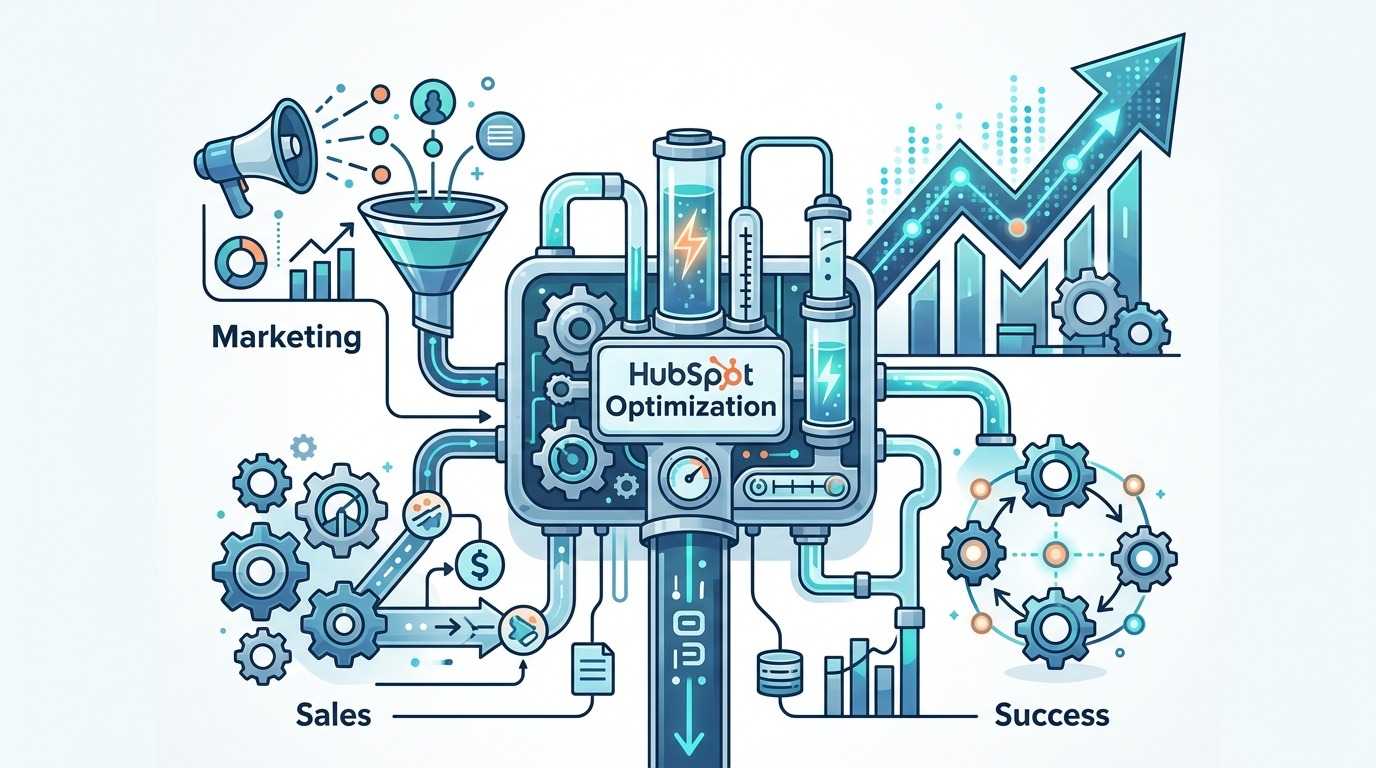
Aligning Sales and Marketing
The gap between marketing qualified leads (MQLs) and sales accepted opportunities is often where revenue leaks occur. You can close this gap by implementing Sales Marketing Alignment protocols. This involves defining clear Service Level Agreements (SLAs) between departments. For instance, marketing agrees to deliver a certain volume of SQLs, while sales agrees to follow up within a specific timeframe.
Optimizing Lead Routing
Speed to lead is critical. Use HubSpot’s workflow tools to create dynamic lead routing rules. When a high-value prospect engages with your content, the system should automatically assign them to the most appropriate sales representative based on territory, industry, or deal size. This Lead intake and Routing mechanism ensures that no opportunity falls through the cracks.
3. Empowering Sales Teams with RevTech
Revenue technology, or RevTech, is the intersection of sales, marketing, and customer success tools. Your HubSpot setup must act as the hub that connects these disparate functions. RevTech is the strategic integration of sales technology, data, and processes to drive revenue growth.
Automating the Quoting Process
Manual quoting slows down the sales cycle. By integrating your product catalog into HubSpot, you can generate quotes directly within the deal record. This feature reduces administrative overhead and allows sales reps to focus on selling. Furthermore, linking quotes to revenue forecasts provides leadership with real-time visibility into Sales Projection & Analytics.
Enhancing Pipeline Visibility
Sales leaders need accurate forecasts. This requires rigorous Funnel Reporting Management. You must configure dashboards that track key metrics such as conversion rates by stage, average deal size, and sales cycle length. These reports should be automated and distributed to stakeholders weekly to ensure accountability and rapid decision-making.
4. Integrating Customer Success Workflows
Customer success is not a post-sale activity; it begins at the point of conversion. Your HubSpot Service Hub should be configured to support proactive customer engagement rather than reactive ticketing.
Supporting Ticketing System Design
Design your ticketing system to capture context. When a customer submits a request, the system should automatically pull their deal history, subscription status, and previous interactions. This Supporting Ticketing System design empowers support agents to resolve issues faster without switching between applications.
Driving Expansion Revenue
Customer success teams can identify upsell opportunities by monitoring usage data. By integrating product usage metrics into HubSpot, you can trigger alerts when a customer reaches a threshold that suggests they are ready for an upgrade. This proactive approach turns customer success into a revenue-generating function.
5. Leveraging AI for Data Enrichment
Artificial Intelligence is no longer a futuristic concept; it is a present-day necessity for efficient revenue operations. HubSpot’s AI capabilities can automate tedious tasks and provide predictive insights that human analysts might miss.
Automated Data Enrichment
Manually updating contact records is inefficient. AI agents can automatically enrich contact profiles with firmographic data, social profiles, and recent news events. This Automated data enrichment ensures that your sales team always has the most current information at their fingertips. For example, if a prospect’s company announces a new funding round, the AI can update their record and alert the sales team.
Predictive Lead Scoring
Not all leads are created equal. Use HubSpot’s predictive lead scoring to prioritize outreach. This model analyzes historical conversion data to predict which prospects are most likely to buy. By focusing efforts on high-probability leads, your team improves its Lead Scoring Mechanism efficiency and shortens the sales cycle.
Key Takeaways
- Unified Data Structure: A clean CRM architecture is the prerequisite for all other optimizations.
- SLA Alignment: Formal agreements between marketing and sales reduce lead leakage.
- Automated Routing: Dynamic lead assignment improves speed to lead and conversion rates.
- RevTech Integration: Connecting sales, marketing, and service tools creates a seamless customer journey.
- AI Efficiency: Leveraging AI for data enrichment and lead scoring reduces manual administrative work.
- Proactive Success: Integrating usage data into Service Hub drives expansion revenue.
- Continuous Governance: Regular audits of data properties and workflows maintain system health.
Frequently Asked Questions
What is the difference between CRM Development and a standard HubSpot implementation?
Standard implementation focuses on initial setup and basic configuration. CRM Development involves custom build-outs, complex integrations, and tailored workflows designed to meet specific business logic requirements.
How long does it take to optimize a HubSpot setup?
Typically, a comprehensive optimization project ranges from 3 to 6 months. This timeline allows for proper data migration, workflow automation, and team training.
Can HubSpot integrate with non-HubSpot tools?
Yes, HubSpot offers extensive Product & 3rd Party integration capabilities. You can connect it with ERP systems, custom databases, and specialized sales tools via APIs or native integrations.
What is Fractional Revenue Operations?
Fractional Revenue Operations is a service model where experienced RevOps professionals provide strategic oversight and technical implementation support on a part-time or project basis, offering high-level expertise without the cost of a full-time executive.
How do AI Agents help with prospect research?
AI Agents can aggregate data from various sources to build detailed prospect profiles. They identify key decision-makers, track company news, and update CRM records automatically, saving hours of manual research.
Why is Sales Marketing Alignment critical?
Alignment ensures that marketing campaigns generate leads that sales is prepared to close. It eliminates friction between departments and creates a unified revenue engine.
What is the role of Account Based Marketing in HubSpot?
Account Based Marketing (ABM) in HubSpot involves targeting specific high-value accounts with personalized content and campaigns. It requires precise list segmentation and coordinated outreach across sales and marketing.
Ready to Scale Your Revenue Engine?
Optimizing your HubSpot setup is not a one-time task but a continuous process of refinement and alignment. Whether you need help with HubSpot Implementations, Fractional Revenue Operations, or advanced AI Agents integration, Set2Close provides the expertise to unlock your business's full potential. Contact Us Now to start your engine and build predictable revenue systems.