

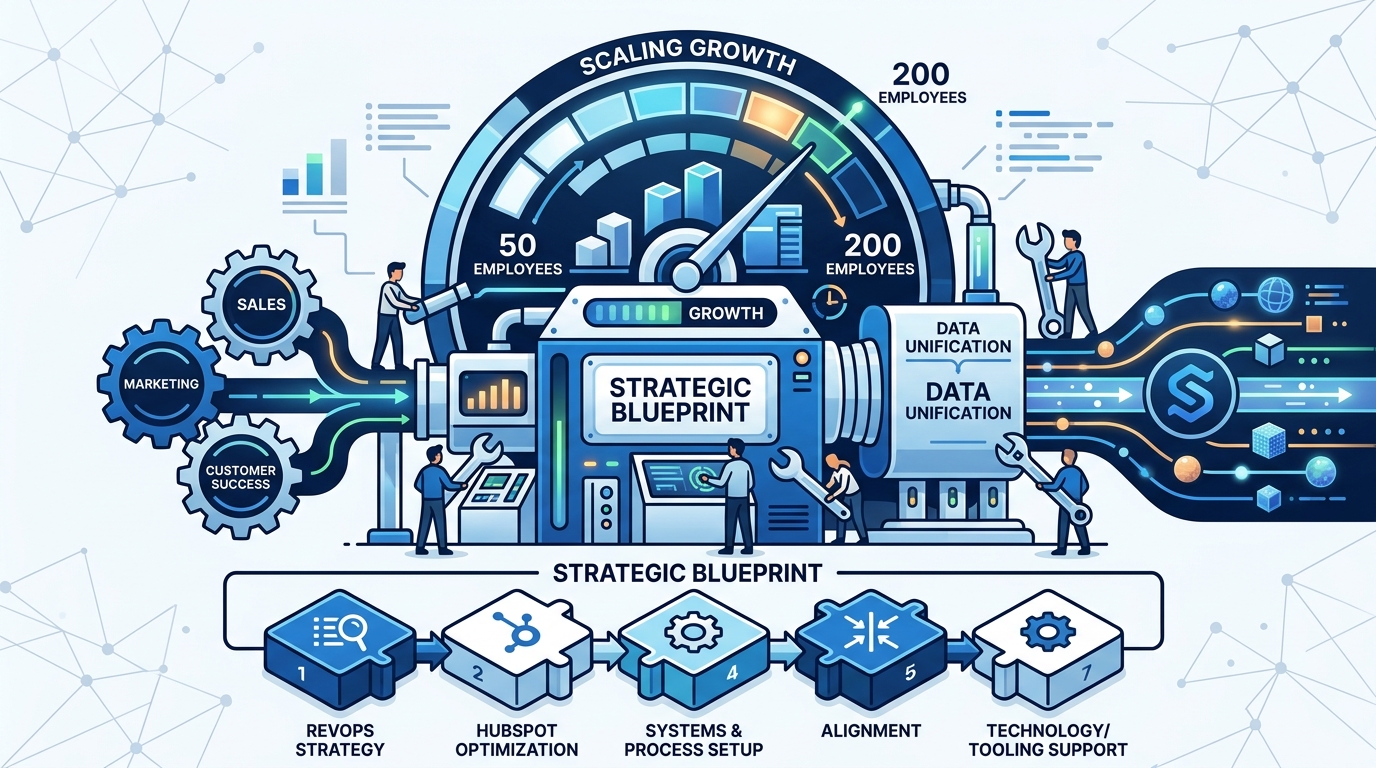
Scaling a B2B company from 50 to 200 employees represents a critical inflection point where intuitive sales processes inevitably collapse under the weight of complexity. According to recent industry analyses, revenue operations have become the primary driver of predictable growth for mid-market firms, with organizations that align sales and marketing seeing 19% faster revenue growth than their peers. At this specific stage, the lack of unified data architecture creates silos that stifle velocity. This guide outlines the exact operational, technical, and strategic interventions required to stabilize and scale your revenue engine. (Revenue Operations Agency About)
The Scaling Paradox: Why Intuition Fails
When a B2B company reaches 50 employees, the founder-led sales model breaks down. The transition to 200 employees requires a shift from personality-driven sales to process-driven revenue generation. Revenue operations is the discipline that bridges this gap by unifying technology, data, and process across sales, marketing, and customer success. (Set2Close Revenue Ops Consultants)
Without a centralized source of truth, data integrity degrades rapidly. Lead leakage increases, forecasting becomes inaccurate, and customer experience suffers due to disjointed handoffs. A revenue operations agency must first diagnose these friction points before implementing solutions. The goal is to create a seamless flow of information that allows every team member to work efficiently without manual data entry or guesswork. (Blog amp Resources)
CRM Architecture & Data Governance
The Customer Relationship Management (CRM) system is the backbone of any scaling B2B organization. For companies in the 50–200 employee range, HubSpot often serves as the optimal platform due to its scalability and robust ecosystem. However, simply installing the software is insufficient. Proper implementation requires a custom-built architecture that mirrors your unique sales methodology.
Custom Object & Pipeline Design
Standard pipelines rarely fit complex B2B sales cycles. A revenue operations partner must design custom objects and pipeline stages that reflect your actual buyer journey. This includes defining specific properties for lead scoring, account hierarchy, and deal forecasting. Accurate data entry is enforced through required fields and automated validation rules, ensuring that the data you rely on for decision-making is clean and reliable.
Integration & Tech Stack Unification
Your CRM must speak to every other tool in your stack. This includes marketing automation platforms, sales engagement tools, and customer support systems. Revenue operations strategies emphasize the importance of a unified tech stack to eliminate data silos. When your marketing automation tool syncs seamlessly with your CRM, lead attribution becomes accurate, allowing you to measure the true return on investment for every campaign.
Process Documentation & Standardization
Technology alone cannot fix broken processes. A critical function of a revenue operations agency is the creation and enforcement of process documentation. This involves mapping out every step of the sales cycle, from initial prospecting to closed-won handoff to customer success.
Sales Playbooks & Methodologies
Developing comprehensive sales playbooks ensures that every sales representative follows a consistent, proven methodology. These documents should include objection handling scripts, email templates, and competitive battle cards. Standardization reduces the ramp time for new hires and ensures that high performers can be replicated across the team.
Lead Routing & SLA Enforcement
One of the most common failure points in scaling B2B companies is the handoff between marketing and sales. Clear Service Level Agreements (SLAs) must be established, defining how quickly sales must respond to new leads and what constitutes a qualified opportunity. Automated lead routing ensures that prospects are assigned to the right representative based on territory, industry, or deal size, preventing leads from falling through the cracks.
AI Agents & Automated Workflows
As headcount grows, manual administrative tasks become a significant drag on productivity. Artificial Intelligence (AI) agents are no longer a luxury but a necessity for maintaining efficiency in a 200-person organization. These tools automate repetitive tasks, allowing your revenue team to focus on high-value activities like building relationships and closing deals.
Automated Data Enrichment
AI agents can automatically enrich CRM records with data from external sources, such as social media profiles and company news. This ensures that your sales team always has the most up-to-date information at their fingertips. For example, AI agents in HubSpot can extract critical prospect information in minutes, building comprehensive profiles that inform personalized outreach strategies.
Predictive Lead Scoring
Traditional lead scoring relies on static rules. AI-driven lead scoring analyzes historical data to predict which prospects are most likely to convert. This dynamic approach allows sales teams to prioritize their efforts on high-intent leads, significantly improving conversion rates and reducing time spent on unqualified prospects.
Fractional RevOps vs. Full-Time Hires
For many B2B companies in the 50–200 employee range, hiring a full-time Head of Revenue Operations is premature or financially inefficient. The scope of work often fluctuates, requiring specialized expertise in CRM development, marketing automation, and sales strategy that a single generalist may not possess.
The Fractional Advantage
Fractional Revenue Operations services provide access to senior-level expertise on a flexible basis. This model allows companies to implement complex systems and strategies without the long-term commitment of a full-time executive. It also brings an outside perspective, free from internal politics, which is crucial for driving organizational change.
Cost Efficiency & Scalability
By engaging a specialized agency, you gain a team of experts rather than a single individual. This ensures that all aspects of your revenue engine, from technical implementation to strategic planning, are handled by specialists. As your company grows, the scope of work can be easily scaled up or down, providing financial predictability and operational agility.
Key Takeaways
- Unified Data Architecture: A single source of truth in your CRM is non-negotiable for accurate forecasting and reporting.
- Process Standardization: Documented sales playbooks and SLAs reduce ramp time and improve consistency.
- AI Automation: Leveraging AI agents for data enrichment and lead scoring increases sales team productivity.
- Fractional Expertise: Access to senior RevOps talent without the overhead of full-time hires is ideal for mid-market scaling.
- HubSpot Optimization: Custom CRM configurations and integrations drive maximum ROI from your technology stack.
- Continuous Alignment: Regular sales and marketing alignment meetings prevent silos and ensure shared goals.
- Scalable Infrastructure: Build systems today that can handle 2x or 3x growth tomorrow.
Frequently Asked Questions
What is the primary role of a revenue operations agency?
A revenue operations agency unifies your sales, marketing, and customer success teams by optimizing technology, data, and processes. They ensure that your revenue engine runs efficiently and scales with your business growth.
Why is HubSpot recommended for 50–200 employee B2B companies?
HubSpot offers a scalable, all-in-one platform that integrates marketing, sales, and service hubs. Its robust API ecosystem allows for deep customization, making it ideal for complex B2B sales cycles.
How do AI agents improve sales efficiency?
AI agents automate manual tasks such as data entry, lead scoring, and prospect research. This allows sales representatives to spend more time engaging with high-value prospects and less time on administrative work.
What is fractional RevOps?
Fractional RevOps involves hiring senior revenue operations experts on a part-time or project basis. This provides access to high-level strategic and technical expertise without the cost of a full-time executive.
How long does a typical CRM implementation take?
A standard CRM implementation and optimization project typically ranges from 3 to 6 months, depending on the complexity of your data, integrations, and custom requirements.
What is the difference between RevOps and Sales Ops?
Sales Operations focuses primarily on the sales team's tools and processes. Revenue Operations takes a broader view, aligning sales, marketing, and customer success to drive overall company revenue.
How do you measure the success of RevOps initiatives?
Success is measured by key metrics such as revenue growth, sales cycle length, customer acquisition cost (CAC), and forecast accuracy. Improved data integrity and process efficiency are also critical indicators.
Start Your Engine
Scaling your B2B company requires more than just hiring more salespeople. It demands a robust, data-driven infrastructure that supports growth. Set2Close specializes in helping mid-market companies build predictable revenue systems through HubSpot optimization, AI integration, and strategic RevOps consulting. Contact us today to schedule a consultation and discover how we can help you unlock your business's full potential.