

How to Align Sales, Marketing, and Customer Success KPIs in Your B2B Company
Revenue operations is the strategic discipline that unifies disparate business functions into a single, predictable growth engine. According to recent industry benchmarks, companies with aligned revenue teams experience 19% faster revenue growth than those with siloed operations. This statistic highlights the critical need for a unified approach to performance measurement. Without shared metrics, departments often compete for resources rather than collaborating for outcomes. This guide details the exact framework for aligning sales, marketing, and customer success around shared KPIs. (Revenue Operations Agency About)
Why Revenue Alignment Matters
Most B2B companies suffer from the "silo effect." Marketing generates leads based on volume. Sales closes deals based on personal relationships. Customer success manages renewals based on satisfaction scores. These goals rarely intersect. When KPIs are misaligned, you get a leaky revenue bucket. Leads are handed off without context. Sales ignores marketing qualified leads because they are not "ready." Customer success is blamed for churn because the product was overpromised. (B2B Sales Strategy Services)
Alignment is not just about monthly meetings. It is about shared data, shared language, and shared financial outcomes. When every department owns a piece of the final revenue number, collaboration becomes automatic. This shift requires a fundamental change in how you define success. You must move from departmental vanity metrics to pipeline health metrics.
Defining the Revenue Trifecta
To align your teams, you must first understand the distinct roles within the revenue engine. Each function plays a critical part in the customer journey. However, their individual definitions of "success" often conflict. Here is how we define the core components of a unified revenue strategy.
Revenue Operations is the central nervous system that connects these functions. It provides the infrastructure, data, and processes that allow sales, marketing, and customer success to work as one unit. Without RevOps, alignment is just a buzzword. With RevOps, alignment is a measurable reality.
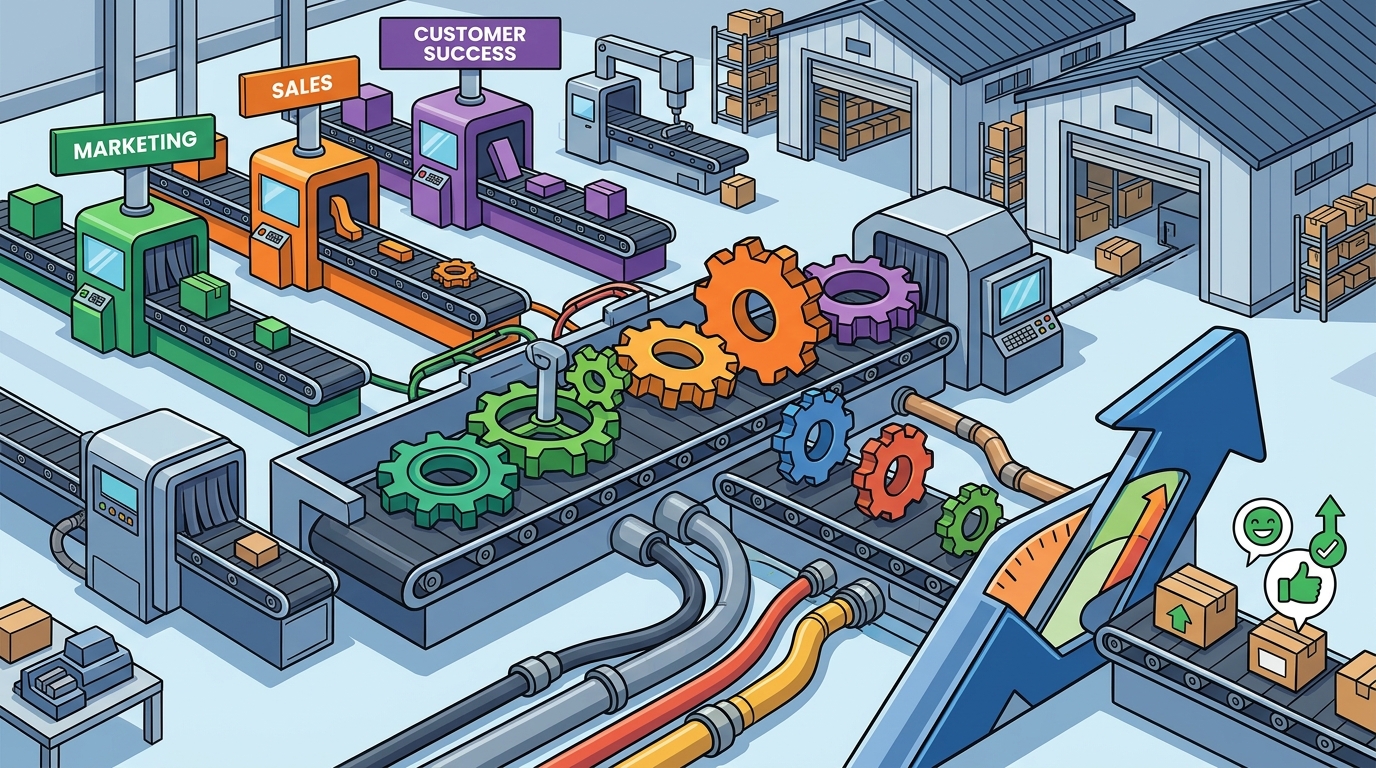
Marketing is responsible for demand generation. Their goal is to fill the top of the funnel with high-quality prospects. Sales is responsible for conversion. Their goal is to move those prospects through the pipeline efficiently. Customer success is responsible for retention and expansion. Their goal is to ensure the customer achieves their desired outcomes. When these three groups share KPIs, the entire funnel becomes transparent.
The Shared KPI Framework
Implementing shared KPIs requires selecting metrics that reflect the entire customer lifecycle. You cannot measure success if you only look at the end of the funnel. The following table outlines the critical shared KPIs that bridge the gap between departments.
| KPI Category | Marketing Focus | Sales Focus | Customer Success Focus | Shared Impact |
|---|---|---|---|---|
| Revenue Growth | Cost Per Acquisition | Win Rate | Net Revenue Retention | Total Revenue |
| Pipeline Health | MQL to SQL Rate | Sales Cycle Length | Time to Value | Pipeline Velocity |
| Customer Quality | Lead Source Quality | Deal Size | Churn Rate | Customer Lifetime Value |
| Operational Efficiency | Content Engagement | Activity Volume | Support Ticket Volume | Revenue Per Employee |
Notice how each department contributes to the shared impact column. For example, Marketing cannot claim success if the leads they generate have a low Customer Lifetime Value. Sales cannot claim success if the deals they close have a long Time to Value. Customer Success cannot claim success if the Churn Rate is high due to poor onboarding. This framework forces accountability across the board.
HubSpot Implementation for Alignment
Technology is the enabler of alignment. You cannot align teams if they are using different data sources. HubSpot provides a unified platform that connects marketing, sales, and service hubs. This integration is critical for maintaining a single source of truth. When data flows seamlessly between departments, KPIs become accurate and actionable.
At Set2Close, we specialize in HubSpot Implementations that are designed specifically for revenue alignment. We do not just install software. We configure your CRM to reflect your shared KPIs. This includes custom reporting dashboards, automated workflow triggers, and data hygiene protocols. Our approach ensures that every team member sees the same data in real time.
One of our key services is Marketing Operations as a Service. This service ensures that your marketing data is clean, tracked, and ready for sales consumption. We also offer CRM Development & Build Outs to tailor your system to your specific workflow. By centralizing your data, you eliminate the friction that causes misalignment.
Leveraging AI for Data Integrity
Data quality is the foundation of any KPI framework. If your data is inaccurate, your KPIs are meaningless. This is where Artificial Intelligence becomes a strategic asset. AI agents can automate data enrichment, lead scoring, and predictive analytics. This reduces manual entry errors and provides deeper insights into customer behavior.
Our AI Agents, such as Astro and Nebula, are designed to supercharge your sales pipeline. Astro provides rapid data extraction and comprehensive prospect profiles. Nebula offers real-time data updates and automated data enrichment. These tools ensure that your CRM is always up to date. This accuracy allows your teams to trust the KPIs they are measuring.
When you combine AI-driven data integrity with a unified HubSpot platform, you create a self-correcting revenue engine. The system identifies bottlenecks in real time. It alerts teams to deals that are stalling. It highlights leads that are showing high engagement. This proactive approach replaces reactive firefighting with strategic growth.
Key Takeaways
- Unified Revenue Growth: Aligned teams experience 19% faster revenue growth compared to siloed operations.
- Shared KPIs: Metrics like Pipeline Velocity and Customer Lifetime Value must be owned by all three departments.
- HubSpot Integration: A unified CRM is essential for maintaining a single source of truth across marketing, sales, and service.
- AI Data Enrichment: Tools like Astro and Nebula ensure data accuracy, which is critical for reliable KPI tracking.
- RevOps Leadership: Revenue Operations acts as the central nervous system, connecting strategy with execution.
- Customer Success Impact: Retention and expansion metrics must be tied to initial sales and marketing efforts.
- Continuous Optimization: Alignment is not a one-time project. It requires ongoing monitoring and adjustment.
Frequently Asked Questions
What is the most important shared KPI for B2B companies?
Pipeline Velocity is often considered the most critical shared KPI. It measures how quickly leads move through the funnel and converts to revenue. It forces marketing to generate quality leads, sales to close efficiently, and customer success to reduce time to value.
How does HubSpot help align sales and marketing?
HubSpot provides a unified platform where marketing automation, sales CRM, and service tools share the same database. This eliminates data silos and ensures that both teams are working with the same customer information and performance metrics.
What role does RevOps play in KPI alignment?
Revenue Operations defines the metrics, builds the reporting infrastructure, and enforces the processes that keep teams aligned. They act as the neutral party that ensures data integrity and strategic focus.
Can AI agents replace human RevOps professionals?
No. AI agents like Astro and Nebula automate data tasks and provide insights. However, human RevOps professionals are needed to interpret that data, design strategy, and manage organizational change.
How long does it take to align KPIs across departments?
Implementation typically takes 3 to 6 months. This includes auditing current processes, configuring the CRM, training teams, and establishing new reporting rhythms.
What is the difference between MQL and SQL?
A Marketing Qualified Lead (MQL) has shown interest in content but may not be ready to buy. A Sales Qualified Lead (SQL) has been vetted by sales and is ready for a direct conversation. Alignment requires a clear definition of both.
Why is customer success included in revenue alignment?
Customer success drives retention and expansion. If the initial sales and marketing efforts do not set the right expectations, churn increases. Therefore, customer success metrics directly impact the validity of earlier funnel stages.
Start Your Engine
Alignment does not happen by accident. It requires a strategic partner who understands the complexities of B2B revenue operations. Contact Set2Close today to discuss your goals. We offer Fractional Revenue Operations to help you build predictable revenue systems. Let us help you optimize your HubSpot implementation and align your teams for growth. Start Your Engine with our fast track onboarding process.