

Modern B2B organizations face a critical operational challenge: aligning revenue operations with strategic growth. Predictable revenue systems are no longer optional but essential for scaling. According to recent industry benchmarks, companies with aligned sales and marketing teams see a 208% higher frequency of customer visits. This statistic highlights the urgent need for unified data flows and automated processes. Without a cohesive strategy, revenue teams operate in silos, leading to lost leads and inefficient resource allocation. This guide outlines the exact systems and processes required to bridge that gap. (Revenue Operations Agency About)
Defining Revenue Operations
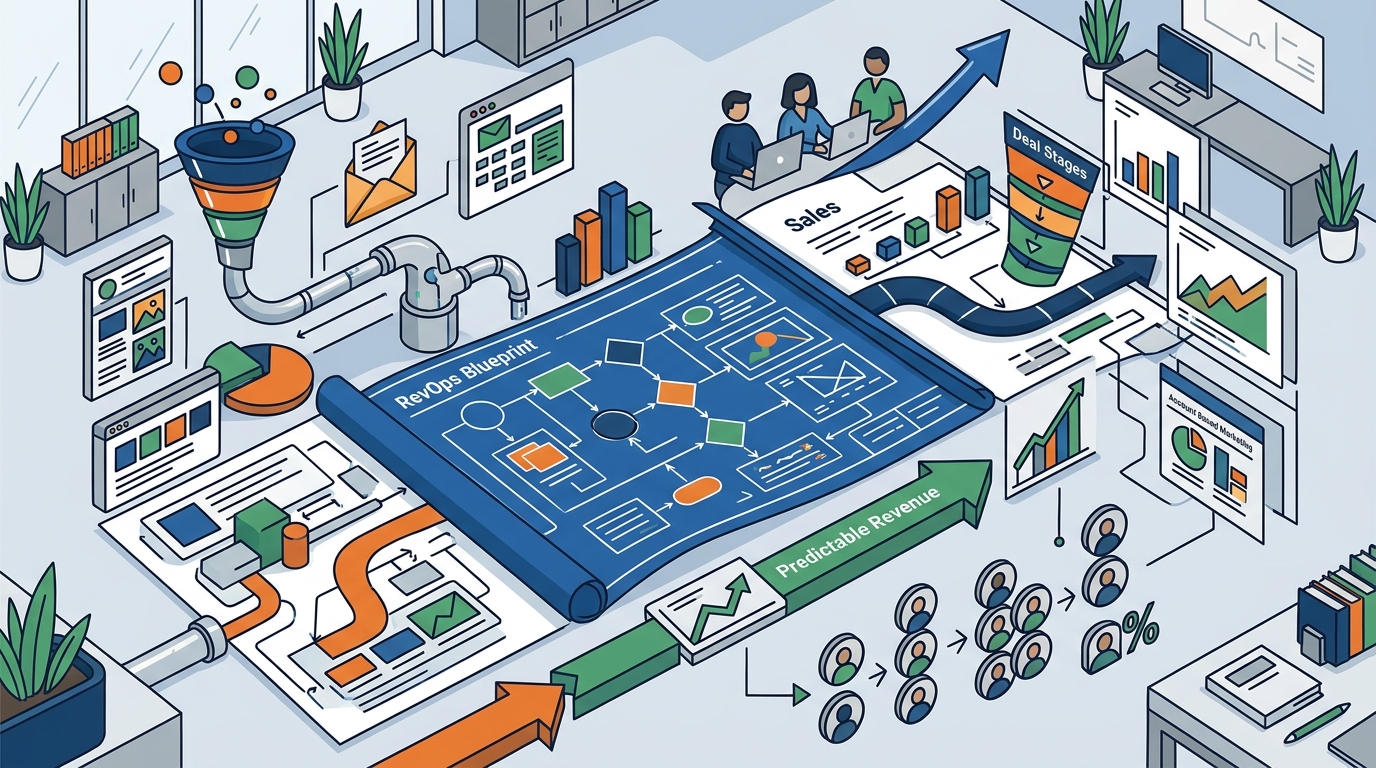
Revenue Operations, often abbreviated as RevOps, is the strategic business practice of aligning sales, marketing, and customer success under one unified roof. Revenue Operations is the central nervous system of a B2B company. It ensures that data flows seamlessly between departments, eliminating the friction that typically slows down deal cycles. By unifying customer relationship management tools, RevOps provides a real-time flow of data across your sales and marketing teams. (B2B Sales Strategy Services)
Many organizations struggle because their technology stack is fragmented. Marketing uses one platform for lead generation, while sales relies on a separate tool for outreach. This disconnect creates data silos. RevOps eliminates these silos by integrating these tools into a single source of truth. This integration allows for accurate attribution modeling, where every dollar spent can be traced back to revenue generated. According to a 2024 report on revenue alignment, companies that integrate their tech stack see a 19% increase in overall revenue growth. This growth is driven by the efficiency of automated processes and the clarity of shared data. (Set2Close Revenue Ops Consultants)
CRM Architecture & Governance
The foundation of any high-performing B2B engine is a robust Customer Relationship Management (CRM) system. CRM Architecture is the structural blueprint of your customer data. It defines how leads are captured, scored, and routed to the appropriate sales representatives. Without proper governance, a CRM becomes a graveyard of outdated contacts and incomplete records. (Blog amp Resources)
HubSpot Implementation Best Practices
For many B2B companies, HubSpot serves as the primary CRM platform. Effective implementation requires more than just installing software. It demands a custom build-out tailored to your specific sales motion. This includes setting up custom properties, defining pipeline stages, and configuring automated workflows. A well-configured HubSpot environment supports advanced features like lead scoring and revenue attribution models. (AI Agents)
According to data from HubSpot’s own ecosystem, businesses that utilize advanced CRM features report a 30% improvement in sales productivity. This improvement stems from the reduction of manual data entry and the automation of routine tasks. When your CRM is configured correctly, it acts as an active participant in your sales process rather than a passive database.
Process Documentation & Governance
Governance ensures that data remains clean and actionable over time. This involves establishing clear protocols for data entry, contact ownership, and pipeline hygiene. Regular audits of your CRM data help identify duplicates, outdated information, and stalled deals. By maintaining strict governance, you ensure that your sales team is always working with accurate, up-to-date information.
Sales & Marketing Automation
Automation is the engine that drives scalability in B2B sales and marketing. Sales Automation is the use of technology to perform repetitive tasks without human intervention. This includes email sequencing, lead routing, and follow-up reminders. By automating these tasks, your team can focus on high-value activities like negotiating deals and building relationships.
Lead Intake and Routing
One of the most critical automation workflows is lead intake and routing. When a marketing campaign generates a lead, it must be instantly captured and assigned to the right salesperson. This process involves lead scoring, which ranks prospects based on their likelihood to convert. High-scoring leads are routed immediately to senior sales reps, while lower-scoring leads enter a nurturing sequence.
According to a 2025 study on lead response times, companies that respond to leads within five minutes are nine times more likely to convert them. Automation ensures that this response time is consistently met, regardless of the volume of incoming leads. This speed-to-lead advantage is a key differentiator in competitive B2B markets.
Revenue Attribution Modeling
Understanding which marketing efforts drive revenue is essential for optimizing spend. Revenue attribution modeling tracks the customer journey from first touch to closed deal. This model assigns credit to various touchpoints, such as blog posts, webinars, and sales calls. By analyzing this data, you can identify high-performing channels and reallocate budget accordingly.
Data shows that accurate attribution can increase marketing ROI by up to 25%. This insight allows marketing leaders to justify their spend to executive teams and secure funding for future initiatives. Without attribution, marketing efforts are often based on intuition rather than evidence.
Data Enrichment & AI Agents
In the modern B2B landscape, data quality is paramount. Data Enrichment is the process of enhancing existing customer records with additional information. This includes adding job titles, company size, industry verticals, and social media profiles. Enriched data provides a 360-degree view of the prospect, enabling more personalized outreach.
AI Agents in Sales
Artificial Intelligence (AI) agents are transforming how sales teams conduct prospect research. These advanced tools automate the collection of critical information, building detailed profiles of prospects and accounts in minutes. AI agents can identify market trends and competitor activities, providing sales reps with competitive intelligence.
For example, AI agents can automatically update CRM data by pulling relevant information from emails and forms. This reduces manual data entry and minimizes errors. According to recent reports on AI adoption in sales, companies using AI agents see a 40% increase in sales efficiency. This efficiency is driven by the ability to process vast amounts of data quickly and accurately.
Real-Time Data Updates
Keeping data fresh is crucial for effective outreach. AI agents provide real-time data updates, ensuring that your team is always working with the latest information. This includes changes in job titles, company funding rounds, and executive hires. By leveraging real-time data, sales teams can time their outreach perfectly, increasing the likelihood of engagement.
B2B Sales Strategy Framework
A successful B2B sales strategy requires a structured approach to market research, persona development, and team training. B2B Sales Strategy is the comprehensive plan that guides your team from prospecting to closing. It defines your target market, value proposition, and sales methodology.
Buyer-Centric Sales Approach
Buyer-centric sales is an approach to selling that focuses on understanding and meeting the needs of the buyer. It involves shifting the focus from simply pitching products to creating a personalized experience for each buyer. This approach requires deep empathy and a thorough understanding of the buyer's pain points.
Traditional sales often focuses on the seller's goals, such as meeting quotas. In contrast, buyer-centric sales places the buyer at the center of the process. This shift builds trust and rapport, leading to longer-term relationships. According to a 2024 survey on sales effectiveness, buyer-centric strategies result in a 23% increase in customer retention rates.
Tech Stack for Sales Success
Your technology stack should support your sales strategy, not hinder it. This includes CRM platforms, email automation tools, and prospecting software. Integrating these tools ensures a seamless workflow for your sales team. For instance, integrating your CRM with your email platform allows for automated follow-ups and tracking of email engagement.
According to data on tech stack integration, companies with integrated tools see a 15% reduction in sales cycle length. This reduction is due to the elimination of manual data transfers and the automation of administrative tasks. A well-integrated tech stack is a force multiplier for your sales team.
Key Takeaways
- Unified RevOps: Aligning sales, marketing, and customer success under one revenue operations umbrella increases revenue growth by up to 208% in frequency of customer visits.
- CRM Governance: Strict data governance and HubSpot implementation best practices are essential for maintaining a clean, actionable database.
- Automation Speed: Responding to leads within five minutes increases conversion likelihood by nine times, a feat made possible by automated lead routing.
- AI Efficiency: Leveraging AI agents for data enrichment and prospect research can increase sales efficiency by 40%.
- Attribution Accuracy: Accurate revenue attribution modeling can boost marketing ROI by up to 25% by identifying high-performing channels.
- Buyer-Centricity: Shifting to a buyer-centric sales approach improves customer retention rates by 23%.
- Tech Integration: Integrated tech stacks reduce sales cycle length by 15% through automated workflows.
Frequently Asked Questions
What is the primary benefit of implementing RevOps?
The primary benefit is the creation of predictable revenue systems. By aligning sales and marketing, you eliminate silos and ensure a real-time flow of data, which leads to more efficient scaling and higher revenue growth.
How does HubSpot support B2B sales strategies?
HubSpot supports B2B sales through advanced CRM configurations, lead scoring, and automated workflows. It allows for seamless integration with other tools, providing a comprehensive view of the customer journey.
What role do AI Agents play in sales?
AI Agents automate prospect research and data enrichment. They collect critical information rapidly, build detailed prospect profiles, and update CRM data in real-time, significantly reducing manual effort.
Why is data governance important in a CRM?
Data governance ensures that your CRM remains accurate and actionable. Without it, data becomes outdated and unreliable, leading to poor decision-making and lost sales opportunities.
How can I measure the success of my sales automation?
You can measure success through revenue attribution modeling. This tracks the customer journey and assigns credit to various touchpoints, allowing you to calculate ROI and optimize your tech stack.
What is a B2B Sales Strategy Framework?
A B2B Sales Strategy Framework is a structured guide that includes market research, persona development, and team training. It helps organizations go from ad-hoc selling to a powerful, scalable sales program.
How long does a typical HubSpot implementation take?
Typical projects range from 3 to 6 months, depending on the complexity of the tech stack and the level of customization required. Fast track onboarding options are available for quicker deployment.
Start Your Engine
Ready to transform your B2B sales and marketing performance? Set2Close specializes in Revenue Operations, HubSpot implementations, and AI-driven sales strategies. We help companies build predictable revenue systems and scale their growth. Contact us today to schedule a consultation and start your journey toward revenue excellence.