

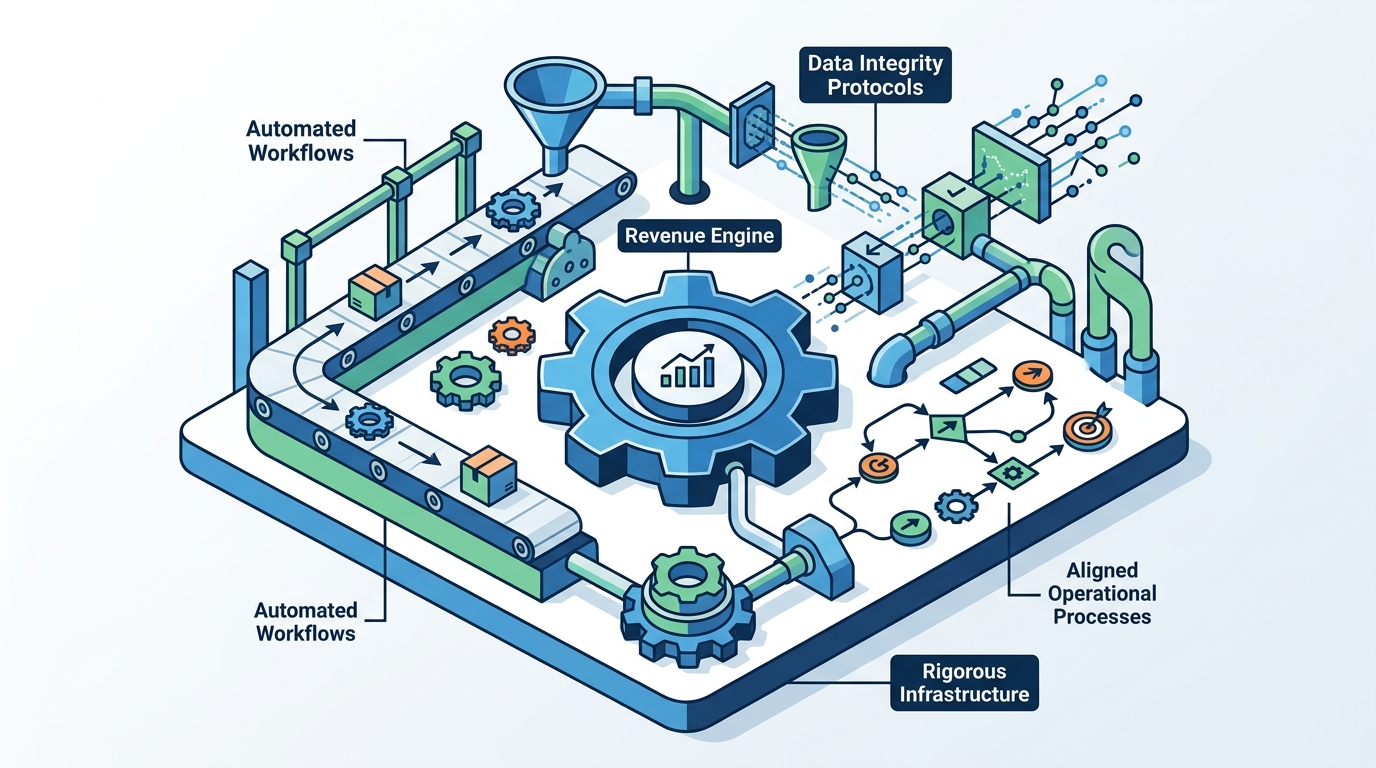
Building a predictable revenue engine requires more than just hiring aggressive salespeople. It demands a rigorous infrastructure of automated workflows, data integrity protocols, and aligned operational processes. According to recent industry benchmarks, companies with mature revenue operations practices achieve significantly higher growth rates than those relying on manual coordination. This guide outlines the critical systems and processes every B2B company must implement to scale effectively. (Revenue Operations Agency About)
The CRM Foundation: Data Integrity and Structure
The Customer Relationship Management (CRM) system is the central nervous system of any B2B organization. Without a clean, well-structured database, all other marketing and sales efforts will falter. HubSpot is a leading platform for managing these complex relationships due to its scalability and integration capabilities. A robust CRM implementation ensures that every interaction is tracked, analyzed, and acted upon.
Standardizing Data Entry and Hygiene
Data hygiene is not optional. It is a prerequisite for accurate forecasting. You must enforce strict validation rules for contact and company records. This includes mandatory fields for industry, company size, and source of acquisition. Regular audits should be conducted to remove duplicates and outdated information. Poor data quality leads to wasted marketing spend and frustrated sales teams.
Segmentation and Lifecycle Management
Effective segmentation allows for personalized communication at scale. You must define clear stages for leads, from initial awareness to closed-won. This lifecycle management ensures that marketing nurtures prospects appropriately before they are handed off to sales. Marketing Hub Implementation services often focus on establishing these automated nurturing paths.
Marketing Operations: Automation and Attribution
Marketing operations serve as the bridge between creative strategy and technical execution. This function is responsible for ensuring that campaigns are delivered efficiently and that their impact is measurable. Sales Hub Implementation complements this by ensuring that the handoff from marketing to sales is seamless.
Multi-Touch Attribution Models
Understanding which channels drive revenue is critical for budget allocation. You must implement multi-touch attribution models that credit all touchpoints in the customer journey. This prevents the common pitfall of overvaluing last-click interactions. By analyzing the full path to conversion, you can optimize spend across content, paid ads, and events.
Automated Workflow Integration
Automation reduces manual error and accelerates response times. Workflows should trigger automatically based on user behavior, such as downloading a whitepaper or visiting the pricing page. These triggers can initiate personalized email sequences or alert sales representatives to engage immediately. Marketing Operations As A Service provides the expertise to build and maintain these complex automations.
Sales Process Standardization and Enablement
A standardized sales process ensures consistency in how prospects are treated. It reduces the reliance on individual heroics and creates a replicable model for success. This process must be documented, trained, and continuously refined based on performance data.
Defining the Buyer-Centric Journey
Buyer-centric sales is an approach to selling that focuses on understanding and meeting the needs of the buyer. It involves shifting the focus from simply pitching products or services to creating a personalized experience for each buyer. This methodology requires deep market research and persona development. B2B Sales Strategy Framework resources can help define these critical steps.
Sales Enablement and Training
Enablement goes beyond training. It involves providing the right content, tools, and insights at the right time. Sales teams need access to case studies, competitive battle cards, and proposal templates. Regular coaching sessions should focus on skill development and process adherence. This ensures that every rep is equipped to close deals efficiently.
Revenue Alignment: Bridging the Gap
The traditional silo between marketing and sales is a major barrier to growth. Revenue alignment ensures that both teams are working toward the same goals with shared metrics. This collaboration is essential for creating a unified customer experience.
Shared KPIs and SLAs
Define clear Service Level Agreements (SLAs) between marketing and sales. Marketing must agree to deliver a certain number of qualified leads, while sales must commit to contacting them within a specific timeframe. Shared KPIs, such as revenue growth and customer acquisition cost, align incentives and foster cooperation.
Fractional Revenue Operations Support
For many B2B companies, hiring a full-time Chief Revenue Officer is not feasible. Fractional Revenue Operations provides high-level strategic oversight without the full-time cost. This approach allows companies to access expert guidance on process optimization and team alignment.
Leveraging AI for Efficiency and Insight
Artificial Intelligence is transforming B2B sales and marketing by automating routine tasks and providing predictive insights. Companies that adopt AI early gain a significant competitive advantage in speed and accuracy.
AI-Driven Prospecting and Enrichment
AI agents can automate the initial stages of prospecting by identifying ideal customer profiles and enriching contact data. This reduces the time sales teams spend on manual research. AI Agents like Astro and Nebula can extract critical information and build comprehensive profiles rapidly.
Predictive Analytics for Forecasting
Predictive analytics uses historical data to forecast future outcomes. This helps sales leaders identify deals that are likely to close and those that require additional attention. By leveraging data-driven insights, organizations can make more informed decisions about resource allocation and strategy.
Key Takeaways
- CRM Integrity: A clean, structured CRM is the foundation of all revenue operations.
- Marketing Automation: Automated workflows accelerate lead nurturing and improve response times.
- Sales Standardization: A defined, buyer-centric sales process ensures consistency and scalability.
- Revenue Alignment: Shared KPIs and SLAs break down silos between marketing and sales.
- AI Adoption: AI agents and predictive analytics provide critical efficiency and insight.
- Fractional Expertise: Fractional RevOps offers high-level strategy without full-time overhead.
- Continuous Optimization: Regular audits and data analysis are essential for long-term growth.
Frequently Asked Questions
What is the first step in building a B2B revenue engine?
The first step is implementing a robust CRM system and ensuring data integrity. Without accurate data, no other process can function effectively.
How does marketing automation improve sales performance?
Marketing automation nurtures leads automatically, ensuring they are ready for sales contact when the time is right. This increases conversion rates and reduces manual workload.
What is the role of a Fractional Revenue Operations consultant?
A Fractional RevOps consultant provides strategic oversight, process optimization, and team alignment without the cost of a full-time executive.
Why is buyer-centric sales important?
Buyer-centric sales focuses on the needs of the buyer, creating a personalized experience that builds trust and accelerates the decision-making process.
How can AI agents help B2B sales teams?
AI agents automate data extraction, profile building, and competitive intelligence, allowing sales teams to focus on high-value interactions.
What are SLAs in the context of sales and marketing?
SLAs are agreements that define the responsibilities of each team, such as lead quality and response times, ensuring accountability and alignment.
How do you measure the success of a B2B sales strategy?
Success is measured through KPIs such as revenue growth, customer acquisition cost, sales cycle length, and lead conversion rates.
What is the benefit of a Fast Track Onboarding process?
A Fast Track Onboarding process reduces the time to value for new clients, ensuring they see results quickly and remain engaged.
Start Your Engine
Ready to transform your B2B sales and marketing performance? Implementing the right systems and processes is the key to predictable growth. Contact Set2Close today to discuss how our Revenue Ops Consultants can help you build a scalable, efficient revenue engine. Let us help you Fast Track Onboarding and achieve your growth targets.