

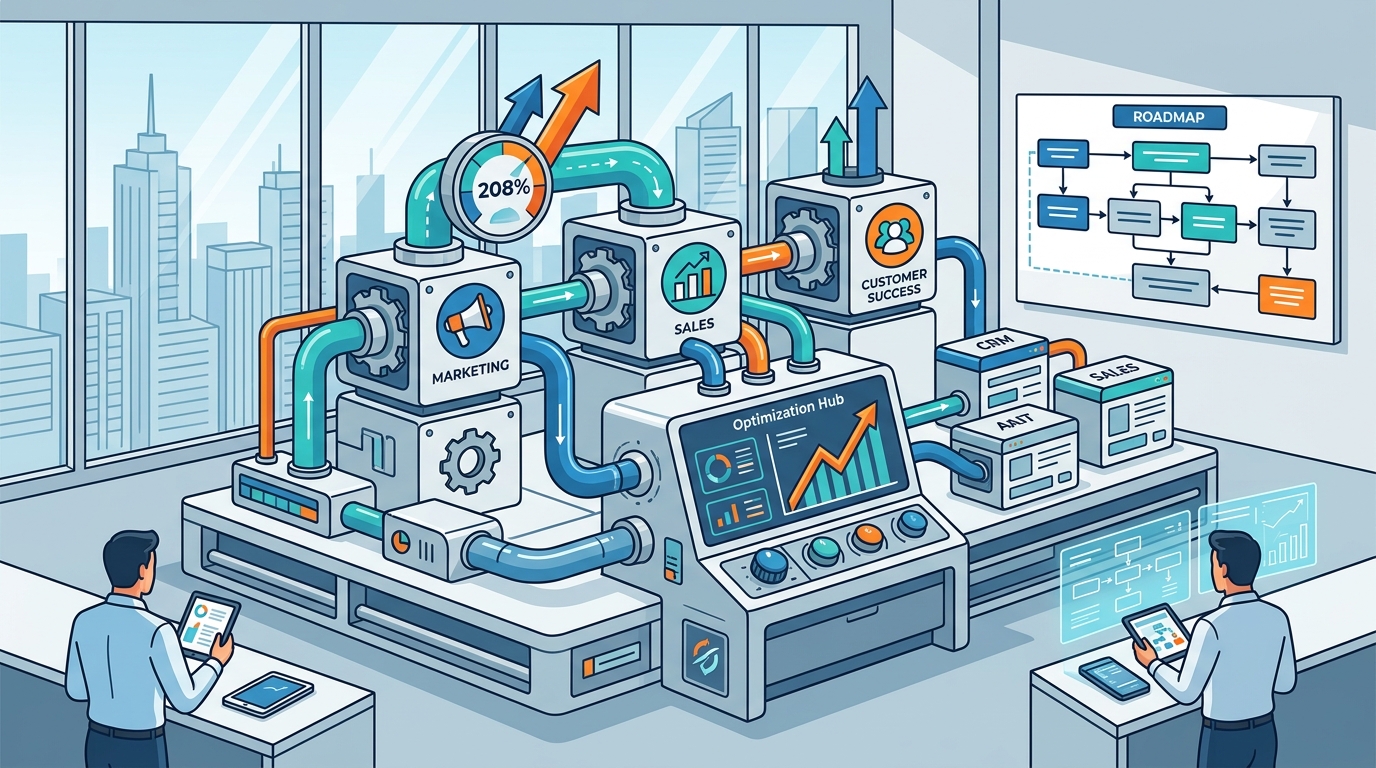
Modern B2B organizations face a critical operational challenge: aligning disparate revenue engines into a single, predictable growth machine. According to recent industry benchmarks, companies with tightly aligned sales and marketing operations experience 208% higher revenue growth compared to those with siloed teams. This statistic highlights the urgent need for robust Revenue Operations (RevOps) frameworks that unify data, processes, and technology. Without a centralized system, B2B companies leak leads, misattribute revenue, and struggle to scale efficiently. This guide details the essential systems and processes required to build a high-performance revenue engine. (Revenue Operations Agency About)
1. Centralized CRM Architecture and Data Governance
The foundation of any high-performing B2B organization is a robust Customer Relationship Management (CRM) system. HubSpot is [a leading revenue platform that unifies marketing, sales, and service data into a single source of truth]. However, simply installing software is insufficient. You must implement strict data governance protocols to ensure data integrity across the organization.
Data governance involves defining who owns specific data fields, how records are created, and when they are archived. Poor data hygiene leads to inaccurate forecasting and wasted sales effort. A well-architected CRM includes custom object structures for complex B2B entities, such as multi-tier account hierarchies and contract line items. This structure allows for granular reporting and accurate pipeline visibility.
Effective CRM architecture also requires seamless integration with third-party tools. Whether you use Salesforce, Microsoft Dynamics, or HubSpot, the system must act as the central hub for all customer interactions. This includes email communications, meeting notes, support tickets, and billing history. By unifying these touchpoints, sales teams gain a 360-degree view of the customer journey.
Key Components of CRM Governance
- Standardized Naming Conventions: Ensure consistent tagging for campaigns, sources, and deal stages.
- Validation Rules: Prevent incomplete records from entering the pipeline by enforcing mandatory fields.
- Role-Based Access: Restrict data visibility to protect sensitive customer information and comply with regulations like GDPR.
2. Automated Lead Intake and Routing Mechanisms
In the B2B landscape, speed to lead is a critical competitive advantage. Lead routing is [the automated process of directing incoming prospects to the most appropriate sales representative based on predefined criteria]. Manual assignment of leads leads to delays, human error, and missed opportunities. Implementing an automated routing system ensures that every inquiry is addressed within minutes, not hours.
Effective lead routing relies on dynamic criteria such as geographic region, company size, industry vertical, and product interest. For example, a large enterprise account should be routed to senior account executives, while small business leads might go to a inside sales team or a marketing automation nurture stream. This ensures that sales resources are allocated efficiently and that prospects receive relevant engagement.
Furthermore, integrating AI-driven prospecting tools can enhance this process. AI agents can analyze inbound lead behavior and score them based on their likelihood to convert. This allows sales teams to prioritize high-intent prospects first, maximizing their daily productivity. The integration of these tools into the CRM ensures that data flows seamlessly from marketing campaigns to sales follow-up.
Benefits of Automated Routing
- Reduced response time to inbound inquiries.
- Improved lead quality through intelligent scoring.
- Enhanced sales team morale by eliminating low-value tasks.
3. Sales Process Automation and AI Integration
Manual administrative tasks consume a significant portion of a B2B salesperson's day. Sales automation is [the use of software to execute repetitive tasks such as data entry, email follow-ups, and scheduling without human intervention]. By automating these workflows, sales teams can focus on high-value activities like relationship building and negotiation.
Modern RevOps strategies leverage AI agents to supercharge sales efficiency. These agents can conduct rapid data extraction, build comprehensive prospect profiles, and provide competitive intelligence in real-time. For instance, an AI agent can monitor competitor activities and alert sales teams to market shifts, allowing for proactive strategy adjustments. This level of insight is impossible to achieve through manual research alone.
Automation extends beyond prospecting. It includes automated email sequences for nurturing leads, automated meeting scheduling to reduce back-and-forth friction, and automated contract generation for faster deal closure. These systems ensure consistency in communication and reduce the risk of human error in critical processes.
Implementing AI in Sales Workflows
- Data Enrichment: Automatically fill in missing contact details from public databases.
- Predictive Scoring: Use machine learning to predict which deals are most likely to close.
- Content Recommendations: Suggest relevant case studies or whitepapers based on prospect behavior.
4. Revenue Attribution and Funnel Reporting
Understanding which marketing efforts drive revenue is essential for optimizing budget allocation. Revenue attribution is [the process of identifying and assigning credit to specific marketing touchpoints that contribute to a closed deal]. Without accurate attribution, B2B companies risk investing in low-performing channels and neglecting high-impact strategies.
First-touch and last-touch attribution models are often insufficient for complex B2B sales cycles. Instead, multi-touch attribution models provide a more nuanced view of the customer journey. These models assign fractional credit to each interaction, from initial ad click to final contract signature. This data allows marketing leaders to refine their strategies and demonstrate clear ROI to stakeholders.
Funnel reporting management is another critical component. By tracking key metrics such as conversion rates at each stage, average deal size, and sales cycle length, organizations can identify bottlenecks and optimize performance. Regular reporting ensures that leadership has visibility into pipeline health and can make data-driven decisions to meet revenue targets.
Essential Metrics for RevOps
- Customer Acquisition Cost (CAC)
- Customer Lifetime Value (LTV)
- Lead-to-Customer Conversion Rate
- Sales Cycle Duration
5. Sales and Marketing Alignment (Smarketing)
The traditional silo between sales and marketing is a major barrier to B2B growth. Buyer-centric sales is [an approach to selling that focuses on understanding and meeting the needs of the buyer rather than simply pitching products]. Achieving this requires deep alignment between marketing and sales teams on goals, processes, and technology.
Alignment begins with a shared definition of a qualified lead. Marketing must understand the sales team's criteria for a Sales Qualified Lead (SQL) and adjust campaign targeting accordingly. Conversely, sales must provide feedback on lead quality to help marketing refine their messaging and segmentation. This continuous feedback loop ensures that both teams are working toward the same revenue goals.
Regular cross-functional meetings are essential for maintaining alignment. These meetings should review pipeline performance, discuss market trends, and align on upcoming campaigns. By fostering a culture of collaboration, B2B companies can create a seamless experience for prospects, moving them smoothly from awareness to consideration to decision.
Strategies for Alignment
- Joint goal setting for revenue targets.
- Shared technology stack for visibility.
- Regular lead quality reviews and feedback sessions.
Key Takeaways
- Companies with aligned sales and marketing operations see up to 208% higher revenue growth.
- HubSpot serves as a central platform for unifying customer data and automating workflows.
- Automated lead routing reduces response time and improves conversion rates.
- AI agents can automate data enrichment and provide real-time competitive intelligence.
- Multi-touch attribution models offer a more accurate view of marketing ROI than single-touch models.
- Buyer-centric sales requires deep alignment between marketing and sales teams.
- Strict data governance is essential for maintaining CRM integrity and accurate forecasting.
Frequently Asked Questions
What is the primary benefit of implementing RevOps?
RevOps breaks down silos between sales, marketing, and customer success, creating a unified revenue engine that drives predictable growth and operational efficiency.
How does AI improve B2B sales processes?
AI automates repetitive tasks like data entry and prospecting, provides predictive lead scoring, and offers real-time insights that help sales teams prioritize high-value opportunities.
What is the difference between first-touch and multi-touch attribution?
First-touch attribution gives 100% credit to the initial interaction, while multi-touch attribution distributes credit across all touchpoints in the customer journey, providing a more accurate picture of marketing impact.
Why is data governance critical for CRM success?
Data governance ensures data accuracy, consistency, and security, which are essential for reliable reporting, forecasting, and effective sales operations.
How can sales and marketing teams align their goals?
Teams can align by establishing shared revenue targets, defining common lead qualification criteria, and holding regular cross-functional reviews to discuss performance and feedback.
What are AI Agents in the context of HubSpot?
AI Agents in HubSpot are advanced tools that automate tasks such as prospect research, data enrichment, and workflow management using machine learning and natural language processing.
How long does a typical CRM implementation take?
While timelines vary, standard projects often range from 3 to 6 months, depending on the complexity of the tech stack and the level of customization required.
Start Your Engine
Building a high-performance B2B revenue engine requires more than just software; it demands a strategic approach to operations, alignment, and automation. Set2Close specializes in helping B2B companies optimize their HubSpot implementations, streamline sales processes, and drive predictable growth. Whether you need CRM development, fractional RevOps support, or AI agent integration, our team is ready to help you scale.
Contact Set2Close today to schedule your consultation and start transforming your revenue operations.