

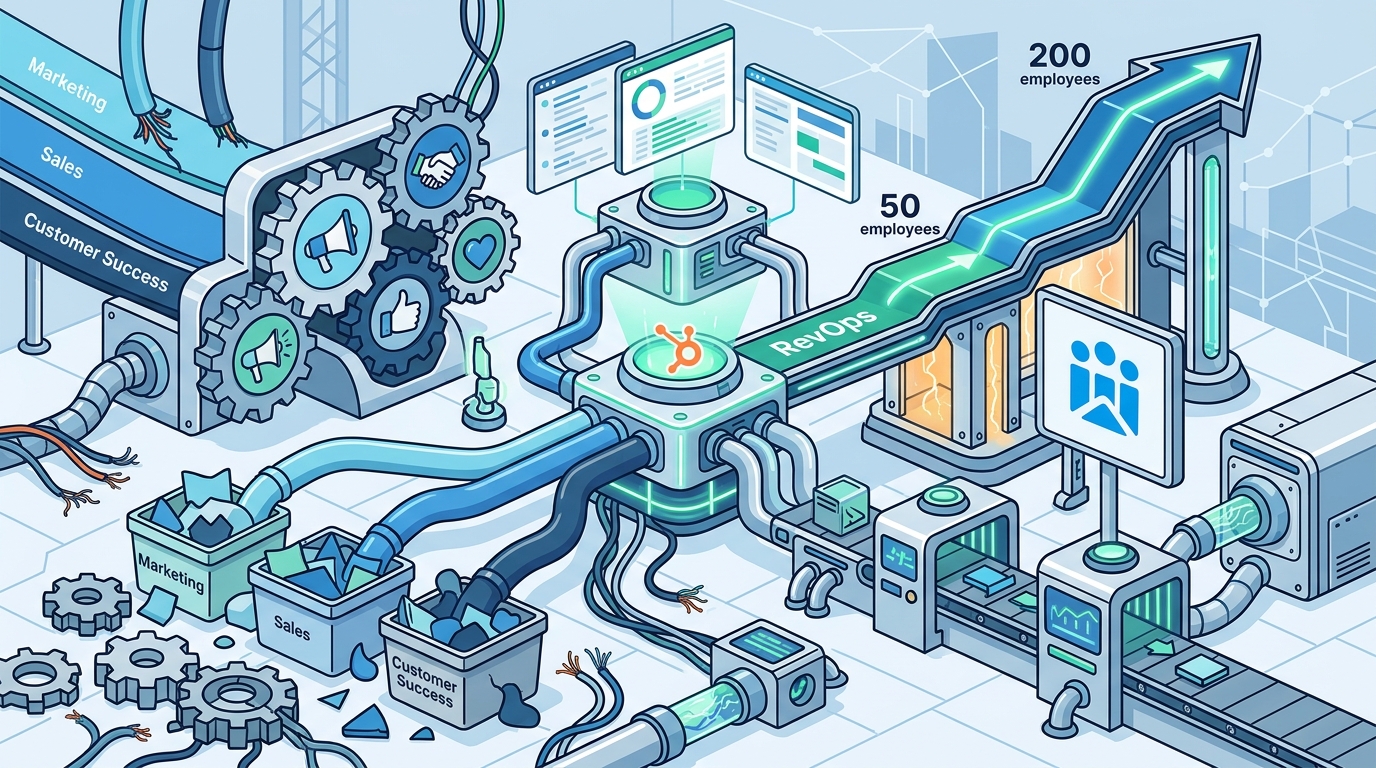
Scaling a B2B organization from 50 to 200 employees represents a critical inflection point where informal processes collapse under the weight of complexity. According to recent industry analyses, HubSpot research indicates that companies exceeding 100 employees experience a 30% drop in sales efficiency if revenue operations are not formally centralized. This decline occurs because data silos form between marketing, sales, and customer success teams, leading to inaccurate forecasting and lost opportunities. For leaders in this growth phase, implementing a structured Revenue Operations (RevOps) framework is not merely an administrative upgrade; it is a survival mechanism for maintaining predictable growth. (Revenue Operations Agency About)
The Scaling Crisis: Why Informal Ops Fail
At the 50-employee mark, a B2B company typically has outgrown its initial startup agility. Sales teams operate on tribal knowledge rather than documented playbooks. Marketing campaigns generate leads that are poorly qualified because there is no unified lead scoring mechanism. Customer success teams struggle to access historical context because the CRM is treated as a contact database rather than a revenue engine. (Set2Close Revenue Ops Consultants)
Revenue Operations is the discipline that unifies these disparate functions. It ensures that sales, marketing, and customer success share a single source of truth. Without this alignment, companies face Gartner reports that show up to 20% of revenue leakage due to poor data hygiene and process gaps. The goal of RevOps is to eliminate these silos, creating a seamless flow of data from prospect to renewal. (Blog amp Resources)
Core Pillars of Mid-Market RevOps
For a company with 50 to 200 employees, RevOps must address three specific operational needs: process standardization, technology integration, and data governance.
Process Documentation and Standardization
First, RevOps must document the sales process. This includes defining clear stages in the sales pipeline, establishing criteria for moving deals forward, and creating standardized email sequences. A documented process allows for accurate sales projection and analytics. When every rep follows the same methodology, forecasting becomes reliable rather than speculative.
Technology Stack Integration
Second, the technology stack must be integrated. This involves connecting the CRM with marketing automation tools, customer support ticketing systems, and billing platforms. Integrated systems enable real-time data flow, ensuring that marketing knows when a lead becomes a customer, and support knows when a customer was last engaged by sales. This integration is critical for maintaining a Forbes analysis on revenue tech trends that highlights automation as a key driver of efficiency.
Data Governance and Lead Scoring
Third, data governance ensures that the information within the CRM is accurate and actionable. This includes implementing lead scoring mechanisms to prioritize high-intent prospects. By assigning scores based on demographic and behavioral data, sales teams can focus their efforts on prospects most likely to convert. This approach directly impacts revenue attribution and overall pipeline health.
HubSpot Implementation & CRM Architecture
For most B2B companies in this size range, HubSpot serves as the central nervous system of revenue operations. A proper HubSpot implementation goes beyond basic contact management. It requires a custom architecture that aligns with the company's specific sales motion.
CRM Build Outs and Migrations
Many companies in this growth phase migrate from Salesforce or legacy CRMs to HubSpot. This migration must be handled with precision to ensure no data is lost. A successful migration involves mapping custom fields, transferring historical deal data, and reconfiguring reporting dashboards. Set2Close specializes in these complex CRM development and build outs, ensuring that the new system supports immediate operational needs.
Sales and Marketing Alignment
HubSpot facilitates sales and marketing alignment through shared lists and automated workflows. Marketing can segment audiences based on sales feedback, while sales can view the entire customer journey within the CRM. This alignment is crucial for Account Based Marketing (ABM) strategies, where personalized outreach to high-value accounts requires coordinated effort across teams.
Fast Track Onboarding
Speed to value is critical. A fast track onboarding process ensures that the CRM is operational within weeks, not months. This includes configuring user permissions, setting up automated email campaigns, and training teams on best practices. Rapid deployment allows the company to start realizing ROI from its RevOps investment sooner.
Leveraging AI Agents for Efficiency
As headcount grows, manual tasks become bottlenecks. AI agents offer a solution by automating repetitive data entry and research tasks. These agents can extract critical information from prospect websites, update CRM records in real time, and even assist in scheduling meetings.
Data Extraction and Enrichment
AI agents like Astro and Nebula can collect data points that are difficult to gather manually. They build comprehensive profiles of prospects, including recent funding rounds, leadership changes, and technology stack updates. This enriched data allows sales reps to tailor their outreach with high relevance, increasing engagement rates.
Automated Lead Routing
Another critical application of AI is lead routing. When a new lead enters the system, AI can analyze their profile and route them to the most appropriate sales rep based on territory, industry, or deal size. This ensures that no lead falls through the cracks and that reps are working on the right opportunities. According to Salesforce data on AI adoption, companies using AI for lead routing see a significant increase in conversion rates due to faster response times.
Competitive Intelligence
AI agents also monitor competitor activities. They can identify when prospects are engaging with competitor content or when market trends shift. This intelligence allows the sales team to adjust their messaging proactively, positioning their solution as the superior choice.
Fractional RevOps vs. Full-Time Hires
One of the most common dilemmas for 50–200 employee companies is whether to hire a full-time RevOps leader or engage a fractional service. Each option has distinct advantages depending on the company's maturity and budget.
| Feature | Fractional RevOps | Full-Time RevOps Hire |
|---|---|---|
| Cost Structure | Project-based or monthly retainer | High salary, benefits, and equity |
| Expertise Level | Multi-industry best practices | Deep company-specific knowledge |
| Implementation Speed | Rapid deployment | Slower ramp-up time |
| Strategic Vision | Objective, external perspective | Internal cultural alignment |
| Scalability | Easily adjustable scope | Fixed capacity |
Fractional RevOps is often the superior choice for companies in the 50–200 employee range. It provides access to senior-level expertise without the high cost of a full-time executive. Set2Close offers fractional revenue operations services that allow companies to scale their RevOps efforts up or down based on current needs. This flexibility is essential for navigating the unpredictable growth patterns of mid-market B2B companies.
Key Takeaways
- Centralize Data: Unify sales, marketing, and customer success data to eliminate silos and improve forecasting accuracy.
- Implement HubSpot: Use HubSpot as the central CRM, ensuring custom architecture that supports your specific sales motion.
- Automate with AI: Deploy AI agents for data enrichment, lead routing, and competitive intelligence to boost rep productivity.
- Document Processes: Create standardized sales playbooks and lead scoring models to ensure consistency across the team.
- Consider Fractional RevOps: Leverage fractional experts for rapid implementation and strategic guidance without full-time overhead.
- Focus on Alignment: Ensure sales and marketing are aligned on lead definitions and handoff processes to maximize conversion.
- Monitor Metrics: Track key RevOps metrics such as sales cycle length, lead response time, and revenue attribution.
Frequently Asked Questions
What is Revenue Operations (RevOps)?
Revenue Operations is a strategic discipline that aligns sales, marketing, and customer success teams under a unified set of processes, data, and technology to drive predictable revenue growth.
Why is RevOps critical for 50–200 employee companies?
At this scale, informal processes break down. RevOps provides the structure needed to manage increased complexity, maintain data integrity, and scale sales efforts efficiently.
How does HubSpot support RevOps?
HubSpot provides a centralized CRM that integrates marketing, sales, and service tools. It enables automated workflows, detailed reporting, and seamless data flow across the revenue engine.
What are AI Agents in RevOps?
AI Agents are automated tools that handle tasks like data entry, lead scoring, and prospect research. They free up sales reps to focus on high-value activities and improve data accuracy.
When should a company hire a fractional RevOps expert?
Companies should consider fractional RevOps when they need rapid implementation, specialized expertise, or flexible scaling without the long-term commitment of a full-time hire.
How long does a HubSpot implementation take?
A standard implementation can take 3 to 6 months, depending on the complexity of the tech stack and the level of customization required. Fast track onboarding can accelerate this timeline.
What is the ROI of RevOps?
RevOps improves sales efficiency, reduces customer churn, and increases forecast accuracy. Companies often see a significant increase in ARR within the first year of implementing structured RevOps.
Start Your Engine
Scaling your B2B company from 50 to 200 employees requires more than just hiring more sales reps. It requires a robust operational foundation that supports growth. Set2Close provides the expertise, technology, and strategy needed to build a scalable revenue engine. Whether you need a full CRM implementation, AI agent integration, or fractional RevOps support, we are here to help you unlock your business's full potential. Contact us today to schedule a consultation and start your journey toward predictable revenue growth.