

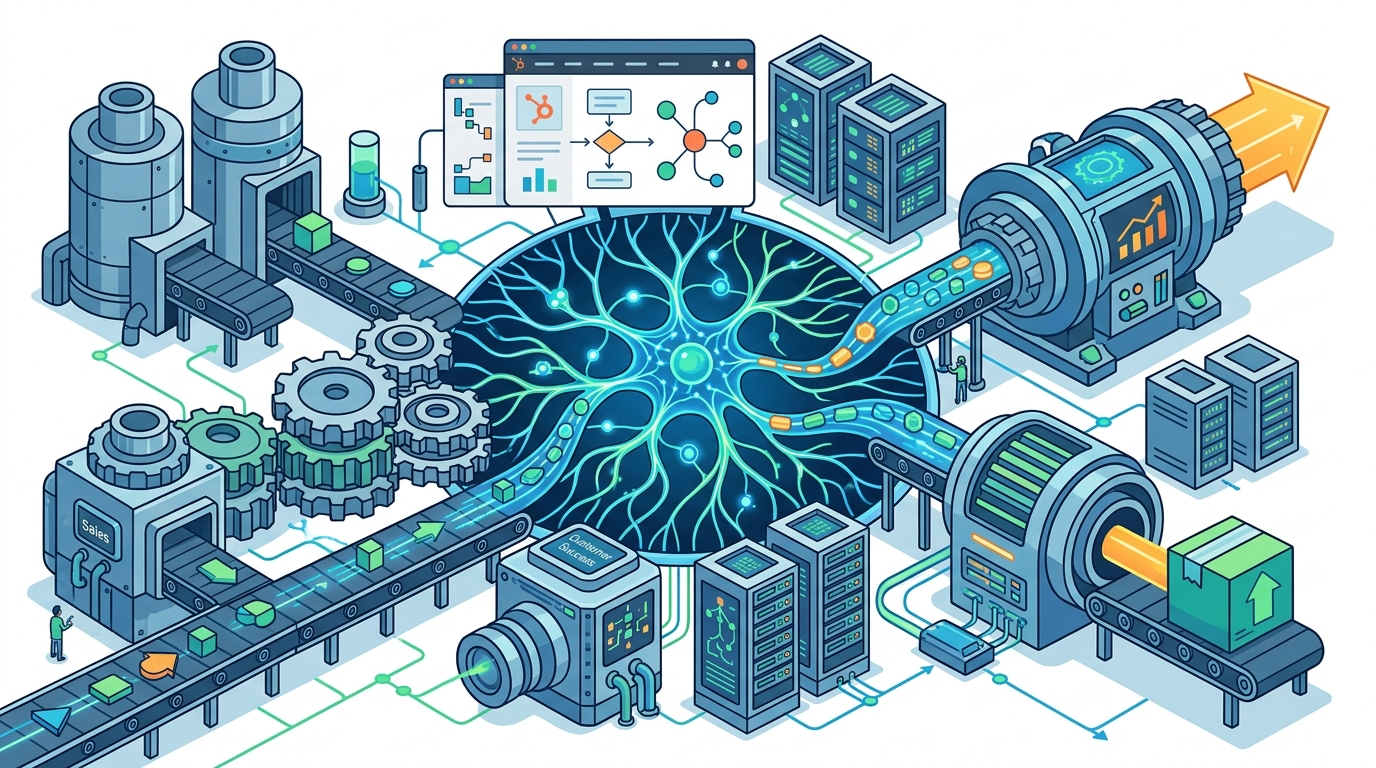
According to recent industry data, companies that align their sales and marketing operations see a 36% higher customer lifetime value than those that operate in silos. This statistic highlights the critical need for unified revenue operations. For growing B2B businesses, HubSpot is not just a contact database. It is the central nervous system of your entire revenue engine. Optimizing it requires more than basic setup. It demands a strategic approach to data governance, automation, and team alignment. (Revenue Operations Agency About)
Why HubSpot Matters for B2B Scaling
HubSpot is a comprehensive platform that unifies marketing, sales, service, and CMS tools. For B2B companies, this unification is vital. It eliminates data silos and provides a single source of truth. When your teams share accurate data, decision-making becomes faster and more accurate.
Many growing businesses start with a basic CRM setup. However, as revenue targets increase, the complexity of your operations grows. Without optimization, your CRM becomes a graveyard of stale contacts. This leads to missed opportunities and frustrated sales teams. Optimization ensures that your technology stack supports your growth trajectory rather than hindering it.
Revenue Operations, or RevOps, is the discipline of aligning these functions. It focuses on process, data, and technology. By implementing RevOps principles, you create a predictable revenue system. This system allows you to forecast accurately and scale efficiently. Revenue Operations consultants often emphasize that the technology is only as good as the processes driving it.
Building a Scalable CRM Architecture
A robust CRM architecture is the foundation of any successful HubSpot implementation. This involves defining your data model, object relationships, and custom properties. A well-designed architecture prevents data duplication and ensures consistency across the organization.
Custom Objects and Properties
Standard objects like contacts and companies often do not capture the full complexity of B2B sales cycles. Custom objects allow you to model unique entities such as deals, projects, or subscriptions. These objects link back to contacts and companies, providing a 360-degree view of your customer.
Custom properties should be used sparingly and with clear definitions. Each property must have a specific purpose. For example, a property named "Contract Value" should only be updated by authorized personnel. This discipline maintains data integrity. CRM Development services often focus on creating these custom structures to match specific business needs.
Integration Strategy
Your CRM must talk to your other tools. Email platforms, calendar apps, and ERP systems all need to sync with HubSpot. Native integrations are preferred for stability. However, custom API integrations may be necessary for complex workflows. A unified tech stack ensures that data flows seamlessly between departments.
Mastering Sales and Marketing Automation
Automation is the engine of scalability. It allows your team to focus on high-value activities while repetitive tasks are handled by the system. In HubSpot, workflows and sequences are the primary tools for automation.
Sales Workflows
Sales workflows automate internal actions. They can assign tasks, send notifications, or update record properties. For instance, when a deal stage changes to "Negotiation," a workflow can automatically assign a senior sales rep. This ensures that the right person is always engaged at the right time.
Lead routing is another critical automation. When a new lead enters the system, it should be routed to the appropriate salesperson based on territory, industry, or deal size. This reduces response time and improves conversion rates. Sales Hub Implementation experts stress the importance of testing these routes thoroughly before going live.
Marketing Automation
Marketing automation nurtures leads through the buyer's journey. Email sequences, content recommendations, and behavioral triggers are key components. By tracking how prospects interact with your content, you can score them accurately. High-scoring leads are then passed to sales with context.
Personalization at scale is possible through dynamic content. This allows you to tailor messages based on the recipient's industry or role. Personalized content drives higher engagement and faster decision-making. According to market research, personalized emails deliver six times higher transaction rates than non-personalized ones.
Leveraging AI Agents for Efficiency
Artificial Intelligence is transforming how B2B businesses operate. AI agents in HubSpot can automate prospect research, data enrichment, and even initial outreach. These tools reduce manual effort and improve data quality.
Data Enrichment
AI agents can automatically update contact records with missing information. They pull data from public sources and social media profiles. This ensures that your CRM is always up to date. Accurate data is essential for effective targeting and reporting.
Prospect Research
AI can analyze market trends and competitor activities. It identifies potential opportunities based on predefined criteria. This allows sales teams to focus on high-probability prospects. AI Agents like Astro and Nebula are designed to supercharge your sales pipeline by providing these insights.
Predictive Analytics
Machine learning models can predict which leads are most likely to convert. These predictions are based on historical data and behavioral patterns. By prioritizing these leads, your team can close deals faster. This data-driven approach reduces guesswork and increases revenue.
Data Governance and Lead Scoring
Data governance ensures that your CRM remains clean and reliable. Without governance, data quality degrades over time. This leads to inaccurate reporting and poor decision-making.
Lead Scoring Models
Lead scoring assigns points to contacts based on their profile and behavior. Demographic points are awarded for job title or company size. Behavioral points are awarded for email opens or website visits. When a lead reaches a certain threshold, it is marked as a Marketing Qualified Lead (MQL).
Regularly review and adjust your scoring model. Market conditions and buyer behavior change over time. A static model becomes obsolete quickly. Blog insights often highlight the need for continuous optimization of these models.
Data Hygiene
Implement regular data cleanup routines. Remove duplicates, update invalid emails, and archive inactive contacts. This keeps your database lean and effective. Data hygiene is not a one-time task. It is an ongoing process that requires dedicated resources.
Aligning Sales and Marketing Teams
Technology alone cannot drive growth. Your teams must be aligned on goals and processes. This alignment is the core of RevOps. It ensures that marketing generates leads that sales can close.
Shared KPIs
Both teams should share key performance indicators. Revenue is the ultimate metric. However, leading indicators like pipeline velocity and conversion rates are also important. When teams share KPIs, they collaborate rather than compete.
Feedback Loops
Create structured feedback loops between sales and marketing. Sales reps should provide insights on lead quality. Marketing should share insights on content performance. This continuous dialogue improves both lead generation and conversion strategies.
Training and Adoption
Even the best tools fail without adoption. Provide ongoing training for your team. Ensure they understand how to use HubSpot features effectively. Training programs help maximize the return on your technology investment.
Key Takeaways
- HubSpot unifies your tech stack, eliminating data silos and improving cross-departmental visibility.
- Custom objects and properties allow you to model complex B2B sales cycles accurately.
- Automation workflows save time by handling repetitive tasks like lead routing and notifications.
- AI agents enhance data quality and provide predictive insights for better prospecting.
- Data governance and lead scoring ensure that sales teams focus on high-value opportunities.
- Shared KPIs and feedback loops align sales and marketing efforts for consistent growth.
- Continuous training and optimization are essential for long-term HubSpot success.
Frequently Asked Questions
How do I start optimizing my HubSpot CRM?
Start by auditing your current data and processes. Identify gaps in your architecture and automation. Then, prioritize fixes that impact revenue directly. Consider engaging a Fractional RevOps consultant for expert guidance.
What is the difference between Marketing Hub and Sales Hub?
Marketing Hub focuses on lead generation and nurturing. Sales Hub focuses on deal management and closing. Both are essential for a complete B2B strategy.
How often should I review my lead scoring model?
Review your lead scoring model quarterly. Adjust points based on recent conversion data and market changes.
Can HubSpot integrate with non-HubSpot tools?
Yes, HubSpot integrates with thousands of third-party tools. Use the native integration marketplace or custom APIs for complex connections.
What are AI Agents in HubSpot?
AI Agents are tools that automate tasks like data enrichment and prospect research. They use machine learning to improve efficiency and accuracy.
How does HubSpot support B2B sales cycles?
HubSpot supports B2B sales through custom objects, complex workflows, and advanced reporting. These features handle long and multi-touch sales cycles.
Is HubSpot suitable for enterprise B2B companies?
Yes, HubSpot Enterprise offers advanced features for large organizations. It scales to handle high data volumes and complex requirements.
What is the ROI of optimizing HubSpot?
Optimizing HubSpot can significantly increase pipeline velocity and conversion rates. The ROI depends on your current baseline and implementation quality.
Start Your Engine
Optimizing your HubSpot instance is a journey, not a destination. It requires continuous effort and strategic alignment. If you are ready to scale your B2B business, let us help you build a predictable revenue system. Visit our Contact Us page to schedule a consultation. Together, we can unlock your business's full potential.