

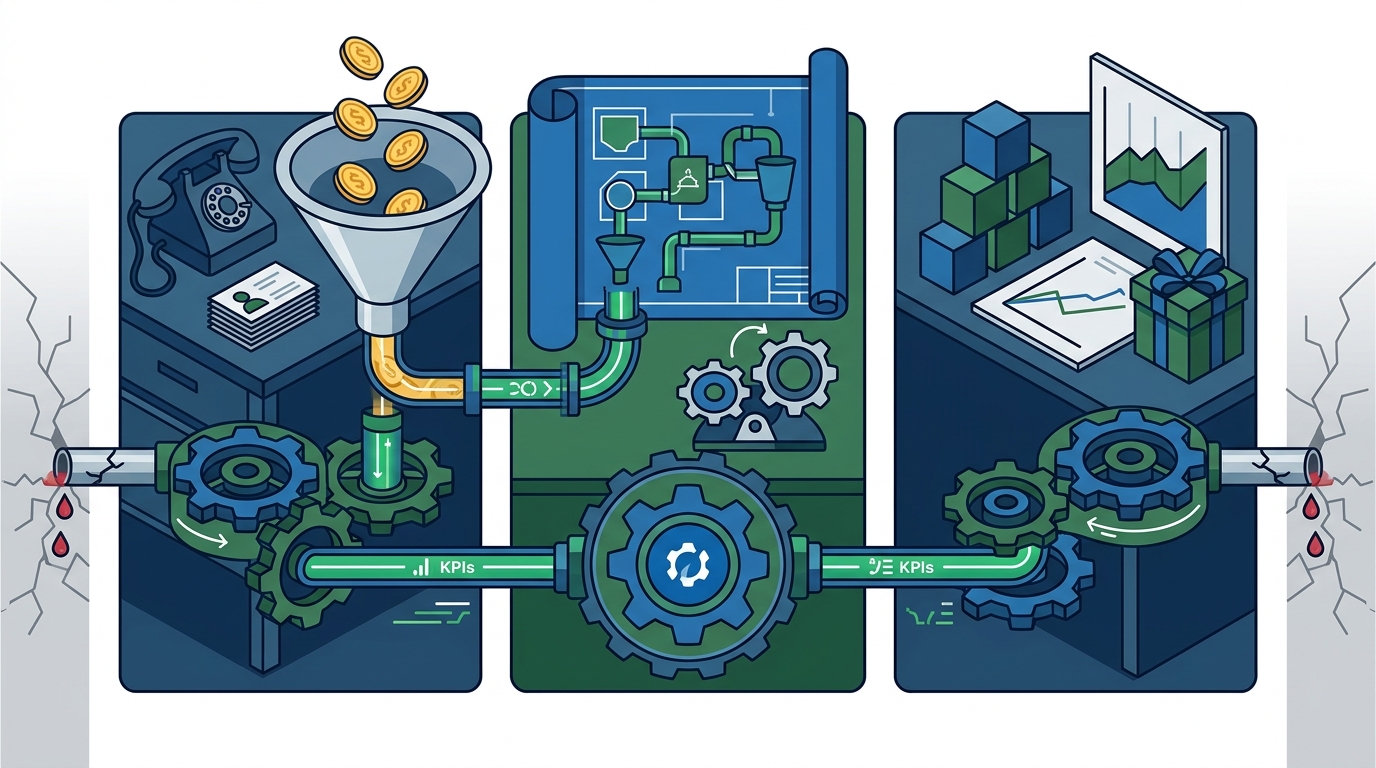
Revenue leakage between departments is the silent killer of B2B growth. According to recent industry analyses, companies with aligned sales and marketing teams report a 20% annual growth rate compared to those with siloed operations. This disparity highlights the critical need for unified Key Performance Indicators (KPIs) that bridge the gap between lead generation, revenue closure, and long-term retention. Without a shared language of metrics, teams operate in isolation, leading to wasted budget and frustrated stakeholders. (Revenue Operations Agency About)
Defining Shared KPIs Across Departments
Alignment begins with a fundamental shift in how success is measured. Traditionally, marketing is rewarded for volume, sales for closure, and customer success for retention. This creates conflicting incentives. To fix this, organizations must adopt a unified view of the customer journey. The core of this alignment is the concept of Revenue Operations, which is the strategic approach to unifying sales, marketing, and customer success under one operational umbrella. (Set2Close Revenue Ops Consultants)
When departments share KPIs, they stop competing for resources and start collaborating for outcomes. For example, if marketing is held accountable for the quality of leads that eventually convert, they will prioritize intent over volume. If sales is measured on the speed of follow-up and accuracy of data entry, they ensure the pipeline remains healthy. This shared accountability reduces friction and accelerates the sales cycle. (Blog amp Resources)
Implementing these shared metrics requires a robust technological foundation. A CRM is a centralized database that stores all customer interactions, serving as the single source of truth for all departments. Without a CRM, KPIs are often based on fragmented spreadsheets, leading to inaccurate reporting and misaligned strategies. Set2Close specializes in CRM development and build-outs to ensure your data architecture supports this level of transparency.
HubSpot Implementation for Unified Data
HubSpot serves as the operational backbone for many B2B companies seeking alignment. Its integrated ecosystem allows marketing, sales, and service hubs to communicate seamlessly. Marketing Hub Implementation ensures that lead capture and nurturing workflows are visible to sales teams in real time. This visibility allows sales representatives to understand the context of every interaction, leading to more personalized and effective outreach.
Sales Hub Implementation focuses on pipeline management and forecasting. By aligning sales activities with marketing-generated leads, teams can track the entire journey from first touch to closed deal. This integration eliminates the "black box" effect where leads disappear after marketing hands them off. Instead, every touchpoint is recorded, analyzed, and optimized.
Customer success also benefits from this integration. Service Hub Implementation ensures that support tickets and customer feedback are linked directly to sales records. This allows success teams to identify upsell opportunities and address churn risks proactively. When all three hubs are connected, the organization operates as a cohesive revenue engine rather than three separate departments.
For companies struggling with complex data structures, CRM Development & Build Outs can tailor the platform to specific business needs. This includes custom object creation, workflow automation, and API integrations that connect HubSpot with other essential tools. A well-built CRM is not just a repository of data; it is a dynamic tool that drives strategic decision-making.
The Revenue Operations Framework
Revenue Operations, or RevOps, is the discipline of aligning people, processes, and technology to drive predictable growth. Fractional Revenue Operations provides expert guidance to structure these systems without the overhead of a full-time executive. This approach ensures that KPIs are not just defined but actively monitored and optimized.
A key component of RevOps is the Sales Pipeline Modeling. This process involves mapping out every stage of the buyer journey and assigning specific metrics to each phase. By analyzing conversion rates at each stage, teams can identify bottlenecks and allocate resources more effectively. For instance, if a significant drop-off occurs at the proposal stage, the team can investigate whether the issue lies in pricing, communication, or product fit.
Lead Scoring Mechanism is another critical tool in the RevOps toolkit. This system assigns numerical values to leads based on their engagement and fit. High-scoring leads are routed to sales immediately, while lower-scoring leads continue through marketing nurture campaigns. This ensures that sales teams focus their energy on prospects with the highest likelihood of conversion, improving overall efficiency.
Account Based Marketing (ABM) further enhances alignment by targeting specific high-value accounts with personalized campaigns. This strategy requires close collaboration between marketing and sales to identify target accounts and develop tailored content. By focusing on quality over quantity, ABM drives higher engagement rates and shorter sales cycles for enterprise clients.
Leveraging AI Agents for Data Integrity
As B2B companies scale, manual data management becomes unsustainable. AI Agents in HubSpot are advanced artificial intelligence tools designed to automate and streamline various tasks, such as hiring processes, prospect research, and CRM data management. They leverage machine learning and natural language processing to assist in day-to-day operations, reducing manual effort and improving efficiency.
One of the primary challenges in aligning KPIs is data accuracy. If sales data is incomplete or outdated, KPIs become meaningless. AI Agents help by automatically updating CRM data through Data Entry Automation. This reduces manual data entry by pulling relevant information from emails, forms, and other sources into HubSpot. Additionally, Data Enrichment enhances existing CRM records with additional data, such as social profiles, job titles, and company details.
Astro and Nebula are examples of AI Agents that supercharge sales pipelines. Astro provides rapid data extraction and comprehensive profiles, while Nebula offers real-time data updates and automated data enrichment. These tools ensure that the data driving your KPIs is fresh, accurate, and actionable. By integrating these AI capabilities, Set2Close helps clients maintain data integrity at scale.
Furthermore, AI Agents can conduct comprehensive prospect research by aggregating data from various sources. This includes analyzing social media, company websites, and public databases to build detailed prospect profiles. Lead Scoring is enhanced by these insights, allowing teams to prioritize outreach efforts based on behavioral data. This level of intelligence enables more precise targeting and higher conversion rates.
Comparing Alignment Tools and Strategies
Selecting the right tools and strategies is crucial for successful KPI alignment. Below is a comparison of common approaches used in B2B organizations.
| Strategy | Primary Benefit | Best For | Implementation Complexity |
|---|---|---|---|
| HubSpot Unified CRM | Single source of truth for all departments | Companies seeking end-to-end integration | Medium |
| AI Data Enrichment | Automated data accuracy and lead scoring | High-volume sales teams | Low |
| Fractional RevOps | Expert process design without full-time hire | Scaling startups and mid-market firms | High |
| Account Based Marketing | Personalized engagement for high-value accounts | Enterprise B2B sales | High |
Each strategy offers distinct advantages depending on your company's size and maturity. HubSpot implementations provide the foundational data structure, while AI agents ensure that data remains clean and actionable. Fractional RevOps brings strategic oversight to ensure that these tools are used effectively to drive growth.
Key Takeaways
- Aligned teams report 20% annual growth compared to siloed operations.
- Revenue Operations unifies sales, marketing, and customer success under one operational umbrella.
- HubSpot's integrated hubs allow real-time visibility across the entire customer journey.
- CRM Development & Build Outs ensures your data architecture supports complex KPI tracking.
- AI Agents like Astro and Nebula automate data enrichment and lead scoring.
- Lead Scoring Mechanisms prioritize high-intent prospects for sales teams.
- Fractional Revenue Operations provides expert guidance for scaling organizations.
Frequently Asked Questions
What are the primary KPIs for aligning sales and marketing?
The primary KPIs include Marketing Qualified Leads (MQLs), Sales Qualified Leads (SQLs), Conversion Rates, and Customer Acquisition Cost (CAC). These metrics ensure both teams are focused on the quality and efficiency of the pipeline.
How does HubSpot help align these departments?
HubSpot provides a unified platform where marketing, sales, and service data coexist. This eliminates data silos and allows teams to track the customer journey from first touch to retention, ensuring all departments have access to the same information.
What is the role of RevOps in KPI alignment?
Revenue Operations designs the processes and technology stack that enable alignment. It ensures that KPIs are defined correctly, data is accurate, and workflows support cross-departmental collaboration.
Can AI agents improve data accuracy for KPIs?
Yes, AI agents automate data entry and enrichment, reducing human error. This ensures that KPIs are based on real-time, accurate data, leading to better decision-making.
How long does it take to implement aligned KPIs?
Implementation timelines vary based on complexity. Typically, projects range from 3 to 6 months, depending on the current state of your CRM and the extent of process changes required.
What is the difference between MQLs and SQLs?
MQLs are leads that marketing deems ready for sales based on engagement. SQLs are leads that sales has verified as a good fit and ready for direct outreach. Aligning on the definition of each is crucial for smooth handoffs.
Why is customer success included in KPI alignment?
Customer success ensures that acquired customers are retained and expanded. Including their KPIs, such as Net Revenue Retention (NRR), aligns the entire organization on long-term value, not just initial sales.
Start Your Engine
Achieving alignment is not just about setting metrics; it is about building a culture of shared accountability and data-driven decision-making. Set2Close offers specialized services in CRM Development, HubSpot Implementation, and Fractional Revenue Operations to help you build this foundation. Visit our Services page to explore how we can help you scale. Contact Us today to schedule your consultation and start driving predictable revenue growth.