

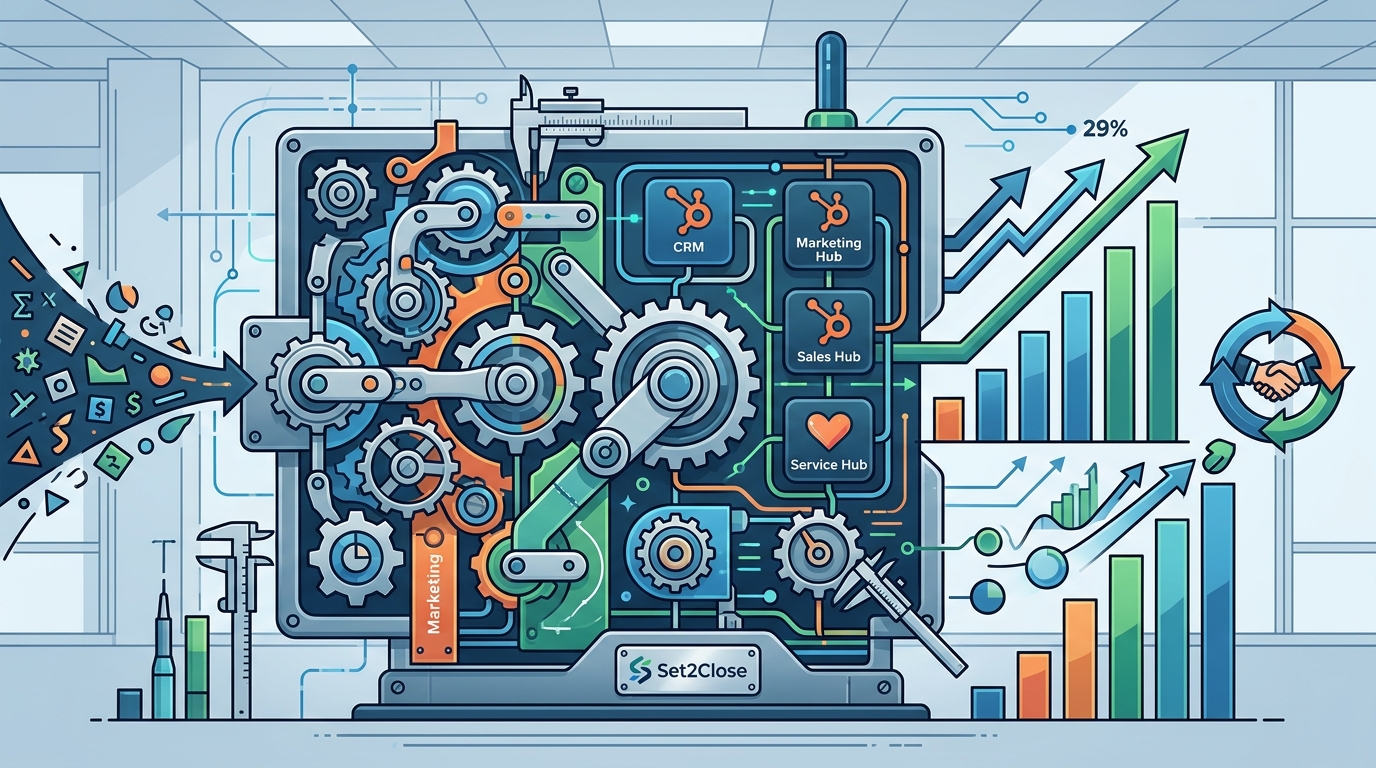
According to recent industry data, companies that effectively integrate their CRM with marketing automation see a 29% increase in sales revenue. This statistic highlights the critical gap between simply owning a platform and actively optimizing it for measurable growth. For growing B2B businesses, HubSpot is not just a database; it is the central nervous system of your revenue engine. Without deliberate optimization, even the most robust tech stack becomes a source of data debt rather than data-driven insight. This guide outlines the precise architectural and operational steps required to transform your HubSpot instance into a scalable growth asset. (Revenue Operations Agency About)
Foundational Architecture and Data Hygiene
Optimization begins long before you launch a campaign. It starts with the structural integrity of your CRM. Data hygiene is the prerequisite for all revenue growth. If your data is fragmented, inaccurate, or unstructured, every downstream process, from email sequencing to sales forecasting, will fail. The first step in optimization is establishing a unified view of the customer. This requires mapping your data fields to align with your specific B2B sales cycle, not just adopting default HubSpot properties. (Blog amp Resources)
Many organizations fall into the trap of over-customizing early on. This creates technical debt that slows down adoption. Instead, focus on standardizing your data entry points. Ensure that every form, integration, and manual entry feeds into a consistent schema. This consistency allows for accurate reporting and reliable segmentation. When your data is clean, your sales team can trust the information they see, leading to faster decision-making and higher conversion rates. (AI Agents)
Furthermore, you must define your source of truth. Is it HubSpot, Salesforce, or an ERP system? For most growing B2B companies, HubSpot should serve as the primary customer relationship management platform. This requires seamless two-way syncs with any other critical systems. HubSpot is a comprehensive customer platform that connects marketing, sales, and service teams. By centralizing your data, you eliminate silos and ensure that every department operates with the same real-time information.
Sales Hub Optimization and Pipeline Velocity
For B2B sales teams, speed and accuracy are paramount. Optimizing Sales Hub involves more than just logging calls. It requires the implementation of strategic workflows that reduce administrative burden and increase selling time. One of the most effective ways to optimize is through the use of custom sales pipelines. Default pipelines rarely match the nuance of complex B2B sales cycles. You must build pipelines that reflect your actual stages, from initial contact to closed-won.
Another critical optimization is the use of sequences and task automation. Repetitive manual tasks, such as follow-up emails or data enrichment, should be automated. This allows your sales development representatives to focus on high-value interactions. According to market analysis, sales teams that use automated sequences see a significant increase in response rates. By automating the mundane, you amplify the impact of your human touchpoints.
Additionally, leverage the power of deal management. Use deal stages to identify bottlenecks in your pipeline. If deals are stalling at a specific stage, it may indicate a need for better sales enablement materials or additional training. Regular pipeline reviews, powered by accurate HubSpot data, provide the visibility needed to forecast revenue with confidence. This level of insight is what separates growing B2B businesses from stagnant ones.
Marketing Automation and Lead Nurturing
Marketing Hub optimization is about creating personalized experiences at scale. For B2B buyers, the journey is long and non-linear. Your marketing automation must reflect this complexity. Start by building detailed buyer personas. These personas should inform your content strategy, email segmentation, and ad targeting. When your marketing efforts are aligned with specific persona needs, your engagement rates improve dramatically.
One of the most powerful features in HubSpot is the ability to create dynamic content. This allows you to serve different content variations to different segments of your audience based on their behavior or firmographic data. For example, a visitor from the healthcare industry might see different case studies than a visitor from the fintech sector. This level of personalization builds trust and accelerates the buying process.
Furthermore, integrate your marketing and sales efforts through lead scoring. Lead scoring assigns values to leads based on their engagement and fit. This ensures that your sales team is only pursuing the most qualified opportunities. By aligning your marketing and sales definitions of a qualified lead, you reduce friction and increase the efficiency of your revenue operations. Account Based Marketing is a strategic approach that focuses on targeting specific high-value accounts. HubSpot provides the tools to execute ABM campaigns effectively, allowing you to personalize outreach for key decision-makers.
Service Hub Integration for Retention
Optimization is not just about acquisition; it is also about retention. Service Hub plays a crucial role in the B2B customer lifecycle. By implementing a robust ticketing system and knowledge base, you can improve customer satisfaction and reduce churn. Happy customers are more likely to become advocates and drive referrals, which is a key growth driver for B2B companies.
Integrate your service data with your sales and marketing records. This creates a 360-degree view of the customer. When a sales rep reaches out to an existing customer, they should have immediate access to the customer's support history. This context allows for more meaningful conversations and identifies upsell opportunities. Customer retention is often more cost-effective than acquisition. Therefore, optimizing Service Hub is a direct investment in your bottom line.
Use Service Hub to gather feedback and insights. Customer surveys and feedback loops can inform product development and marketing messaging. By closing the loop between service and marketing, you create a continuous improvement cycle that enhances the overall customer experience. This holistic approach ensures that your HubSpot instance is driving value across the entire organization.
Leveraging AI Agents for Efficiency
The integration of artificial intelligence is the next frontier in HubSpot optimization. AI agents can automate data extraction, enrich profiles, and provide predictive insights. For example, AI can help identify market trends and competitor activities, allowing your team to adjust strategies in real-time. This level of intelligence was previously only available to enterprises with massive data science teams.
Set2Close offers specialized AI agents like Astro and Nebula to supercharge your sales pipeline. Astro focuses on rapid data extraction and comprehensive profile building. Nebula provides real-time data updates and automated data enrichment. These tools ensure that your CRM is always up-to-date and accurate, reducing the manual effort required to maintain data quality. By leveraging these AI capabilities, you can scale your operations without proportionally increasing your headcount.
Furthermore, AI can assist in predicting deal outcomes. By analyzing historical data, AI models can identify patterns that indicate a high probability of closing. This allows sales leaders to prioritize resources on the most promising deals. The result is a more efficient sales process and higher win rates. Embracing AI is not just about keeping up with trends; it is about gaining a competitive advantage in a crowded market.
The Role of Fractional Revenue Operations
For many growing B2B businesses, hiring a full-time Head of Revenue Operations is not feasible or necessary. This is where fractional revenue operations services come into play. Fractional RevOps provides access to expert guidance and strategic oversight without the overhead of a full-time executive. This model allows you to optimize your HubSpot instance incrementally, ensuring that every change drives measurable value.
Fractional RevOps consultants can help you navigate the complexities of HubSpot implementation and optimization. They bring best practices from multiple industries and can help you avoid common pitfalls. Whether you are migrating from Salesforce or scaling your existing HubSpot instance, expert guidance is invaluable. Fractional Revenue Operations provides scalable expertise to align your technology with your business goals. This alignment is critical for sustained growth.
Additionally, fractional RevOps can help you establish key performance indicators and reporting structures. By defining clear metrics, you can track the impact of your optimization efforts and make data-driven decisions. This strategic oversight ensures that your HubSpot investment continues to deliver a strong return on investment. Partnering with experts like Set2Close allows you to focus on your core business while they handle the technical and operational complexities.
Key Takeaways
- Data Hygiene is Critical: Clean, structured data is the foundation of all HubSpot optimization efforts.
- Customize Your Pipelines: Default sales pipelines rarely fit complex B2B cycles; build custom pipelines to reflect your actual process.
- Automate Repetitive Tasks: Use sequences and automation to free up sales teams for high-value activities.
- Integrate Service Hub: Leverage Service Hub for retention and to create a 360-degree customer view.
- Utilize AI Agents: Tools like Astro and Nebula can automate data enrichment and provide predictive insights.
- Consider Fractional RevOps: Expert guidance can help you optimize your HubSpot instance without the cost of a full-time hire.
- Align Marketing and Sales: Use lead scoring and ABM to ensure both teams are focused on the same qualified opportunities.
Frequently Asked Questions
How long does a typical HubSpot optimization take?
Optimization is an ongoing process, but initial implementations or major overhauls typically range from 3 to 6 months. This timeline allows for proper data migration, workflow configuration, and team training.
What is the difference between HubSpot and Salesforce?
HubSpot is known for its user-friendly interface and integrated marketing, sales, and service hubs. Salesforce is often preferred by larger enterprises for its deep customization capabilities. Many companies successfully migrate from Salesforce to HubSpot for improved usability.
Can I use AI agents with my existing HubSpot instance?
Yes, AI agents like Astro and Nebula can integrate with your existing HubSpot setup to enhance data quality and provide predictive insights without requiring a full platform migration.
What is Fractional Revenue Operations?
Fractional Revenue Operations is a service model where experienced RevOps professionals provide strategic guidance and technical support on a part-time or project basis, offering flexibility and cost-efficiency.
How does HubSpot support Account Based Marketing?
HubSpot provides tools for identifying target accounts, creating personalized content, and tracking engagement across multiple channels, making it easier to execute effective ABM campaigns.
Why is data hygiene important in HubSpot?
Data hygiene ensures that your reports are accurate, your automation works correctly, and your sales team has reliable information to close deals. Poor data quality can lead to missed opportunities and inefficient processes.
What are the benefits of migrating from Salesforce to HubSpot?
Migrating to HubSpot can offer improved ease of use, better integration between marketing and sales, and lower total cost of ownership for growing B2B businesses.
Start Your Engine
Optimizing your HubSpot instance is not a one-time task; it is a continuous journey of improvement. Whether you need help with CRM development, marketing operations, or AI integration, Set2Close is here to help. We provide the expertise and support you need to scale your growth. Contact us today to discuss your specific needs and start building your predictable revenue system.