

How to Optimize Your HubSpot Setup for Sales, Marketing, and Customer Success
According to recent industry data, companies that effectively integrate their sales and marketing operations see a 209% increase in marketing revenue compared to those with poor integration. This statistic highlights the critical need for a unified HubSpot ecosystem. Many organizations treat HubSpot as a collection of isolated tools rather than a cohesive revenue engine. This fragmentation creates data silos that hinder growth and confuse customer interactions. To fix this, you must align your technical setup with your operational workflows. This guide details the precise steps to unify your HubSpot instance for maximum efficiency. (B2B Sales Strategy Services)
Understanding Revenue Operations in HubSpot
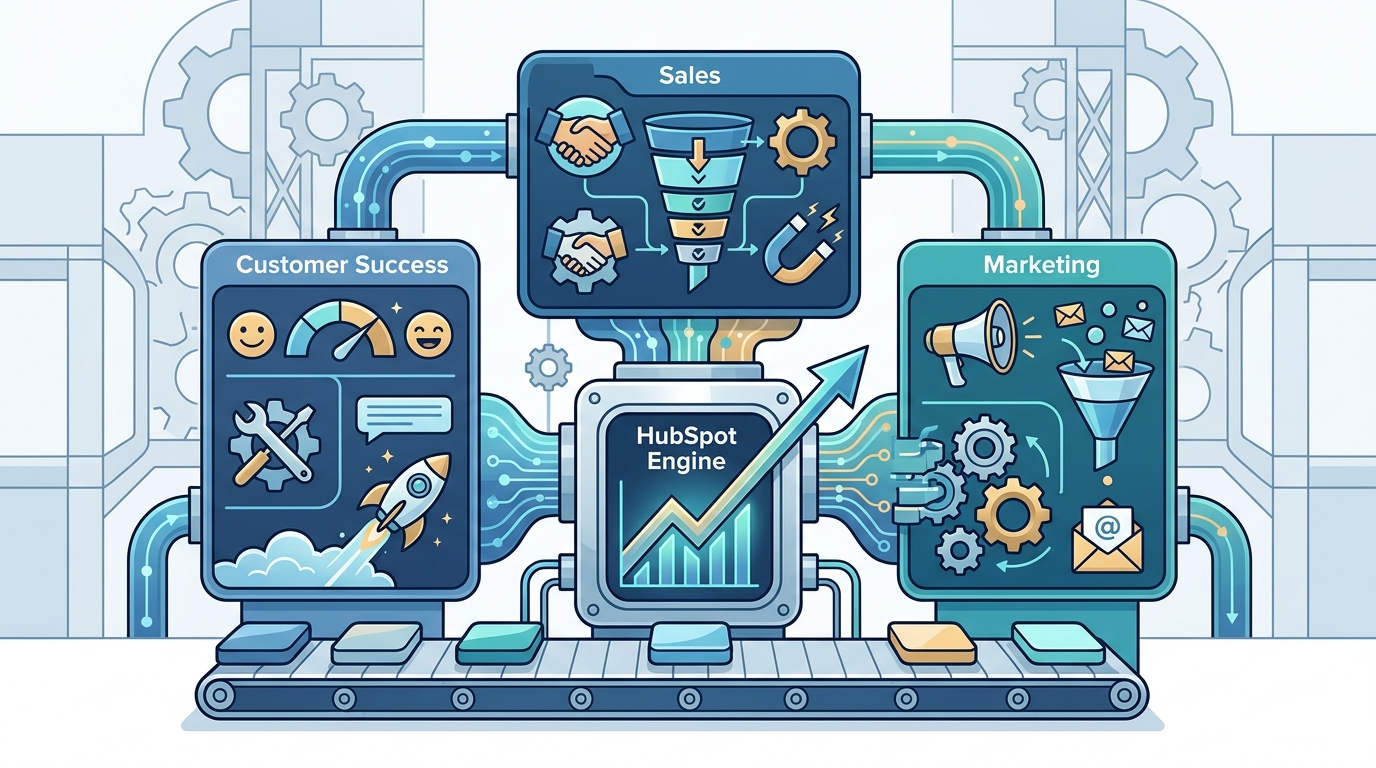
Revenue Operations, or RevOps, is the strategic discipline of aligning sales, marketing, and customer success teams around a shared set of goals and data. In the context of HubSpot, RevOps means configuring the platform so that data flows seamlessly between departments. Without this alignment, marketing cannot track which leads convert, sales cannot prioritize high-value prospects, and customer success cannot anticipate churn risks.
HubSpot Certified Partner status is not just a badge; it represents a rigorous understanding of these operational complexities. When you engage with a HubSpot Certified Partner, you gain access to proven frameworks that prevent common implementation errors. These errors often include misaligned contact properties, broken workflow automations, and inaccessible reporting dashboards. By treating your HubSpot setup as a dynamic revenue system, you ensure that every tool serves a specific business outcome.
Many businesses struggle with the initial phase of this alignment. This is where Fractional Revenue Operations becomes invaluable. Fractional RevOps provides expert oversight without the overhead of a full-time hire. It ensures that your CRM is not just a database, but a strategic asset that drives predictable growth.
Optimizing the Marketing Hub
The Marketing Hub is the engine of lead generation. However, a poorly configured marketing stack leads to wasted ad spend and low-quality leads. Optimization begins with accurate contact segmentation. You must define clear buyer personas and map their journey stages to specific HubSpot properties. This ensures that marketing automation triggers only the right messages at the right time.
One of the most critical aspects of marketing optimization is the implementation of robust attribution models. You need to know which campaigns drive revenue, not just clicks. Marketing Hub Implementation services focus on setting up these attribution models correctly. This involves linking marketing activities to closed-won deals in the CRM. Without this link, you are flying blind regarding your return on investment.
Furthermore, consider the role of Account Based Marketing (ABM) in your strategy. ABM requires a different data structure than traditional inbound marketing. You must configure your HubSpot instance to track account-level engagement rather than just individual contact interactions. This shift allows your sales team to focus on high-value targets with personalized content. Properly configured ABM workflows in HubSpot can significantly increase win rates for enterprise deals.
Aligning the Sales Hub
Sales teams thrive on clarity and speed. If your sales reps spend more time updating the CRM than selling, your setup is failing. The Sales Hub must be configured to minimize manual data entry. This is achieved through automated task creation, email tracking, and meeting scheduling integrations. When a lead enters the system, the CRM should automatically assign it to the correct rep based on predefined rules.
Another critical component is the sales pipeline structure. Your pipeline stages must reflect your actual sales process. Generic stages like "Qualified" or "Negotiation" are often too vague. Instead, use specific stages that indicate clear next steps. This granularity allows for more accurate forecasting. Sales Hub Implementation experts help you build pipelines that match your unique sales methodology.
Additionally, leverage the power of AI Agents within the Sales Hub. Tools like Astro and Nebula can automate data enrichment and prospecting tasks. Astro, for instance, can rapidly extract critical information from web sources and build detailed prospect profiles. This reduces the time sales reps spend on administrative tasks. Nebula complements this by ensuring real-time data updates and quality assurance. These AI-driven insights allow your team to focus on high-impact conversations.
Integrating the Service Hub
Customer success is often the final piece of the revenue puzzle. The Service Hub must be integrated with the Sales and Marketing Hubs to provide a 360-degree view of the customer. When a support ticket is created, the service agent should have immediate access to the customer's purchase history and engagement data. This context enables faster and more personalized resolutions.
Effective service integration also involves proactive support. By analyzing customer usage data from the CRM, you can identify at-risk accounts before they churn. Service Hub Implementation focuses on setting up these proactive workflows. This includes automated health scores and renewal reminders. When service data informs sales strategies, you create a continuous feedback loop that improves product offerings and customer satisfaction.
Consider the impact of seamless onboarding. A disjointed handoff from sales to service leads to early churn. Ensure that your CRM Development & Build Outs include automated onboarding sequences. These sequences should trigger immediately after a deal is closed. They should guide the new customer through initial setup, training, and value realization. This proactive approach sets the tone for a long-term partnership.
Ensuring Data Hygiene and Governance
Data is the lifeblood of HubSpot. If your data is dirty, your insights are useless. Data hygiene involves regular audits, deduplication, and standardization of properties. Inconsistent data, such as varying formats for phone numbers or company sizes, breaks automation and reporting. Establishing a data governance policy is essential for long-term success.
One effective strategy is to limit the number of custom properties. Every new property adds complexity and potential for error. Only create properties that are strictly necessary for your operations. Use standard HubSpot properties wherever possible. This reduces maintenance overhead and ensures compatibility with third-party integrations. CRM Build Outs should prioritize simplicity and scalability over feature bloat.
Regular data audits should be scheduled quarterly. Check for duplicate contacts, outdated leads, and inactive accounts. Use HubSpot's built-in tools to merge duplicates and archive old data. This keeps your database lean and actionable. Clean data improves the performance of your AI agents and ensures that your reporting is accurate. Remember, garbage in, garbage out. Your AI tools are only as good as the data they process.
Leveraging AI Agents for Efficiency
The integration of AI into HubSpot is transforming how businesses operate. AI Agents like Astro and Nebula are not just futuristic concepts; they are practical tools available today. Astro excels at rapid data extraction and building comprehensive prospect profiles. This capability allows sales teams to personalize outreach at scale. Nebula focuses on data quality, ensuring that the information in your CRM is accurate and up-to-date.
These agents integrate seamlessly with your existing tech stack. They sync data directly into your sales platform, reducing manual entry errors. By automating these repetitive tasks, your team can focus on building relationships. The AI Agents page on our site details the specific features and benefits of these tools. Implementing these agents is a key step in modernizing your revenue operations.
Furthermore, AI can enhance your content creation and customer support processes. AI-driven insights can suggest the best times to contact prospects or the most effective email subject lines. In customer support, AI can triage tickets and suggest responses based on historical data. This level of automation increases efficiency and improves customer experience. Embracing AI is no longer optional; it is a competitive necessity.
Key Takeaways
- Unified Revenue Ops: Aligning sales, marketing, and service data in HubSpot is critical for predicting revenue growth and improving customer retention.
- Marketing Attribution: Implementing robust attribution models ensures you can track marketing ROI accurately and optimize ad spend.
- Sales Automation: Minimizing manual data entry through automated workflows and AI agents increases sales rep productivity.
- Data Governance: Regular data audits and strict property governance prevent data silos and ensure reporting accuracy.
- AI Integration: Tools like Astro and Nebula provide rapid data enrichment and quality assurance, enhancing prospecting efficiency.
- Service Integration: Connecting Service Hub to the CRM enables proactive customer support and reduces churn risk.
- Expert Partnership: Working with a HubSpot Certified Partner ensures best practices are followed during implementation.
Frequently Asked Questions
How do I start optimizing my HubSpot setup?
Begin by auditing your current data and workflows. Identify gaps in your sales and marketing alignment. Then, prioritize fixing data hygiene issues before adding new features. Consider engaging a Fractional RevOps expert to guide this process.
What is the difference between Marketing Hub and Sales Hub?
Marketing Hub focuses on lead generation, content management, and automation. Sales Hub focuses on deal tracking, email sequences, and pipeline management. Both must be integrated to provide a complete view of the customer journey.
How can AI agents improve my sales process?
AI agents like Astro automate data extraction and profile building. This allows your sales team to spend less time on research and more time on selling. Nebula ensures data quality, keeping your CRM accurate.
Why is data hygiene important in HubSpot?
Dirty data leads to failed automations, inaccurate reporting, and poor customer experiences. Regular audits and governance policies ensure your data remains actionable and reliable.
What is Fractional Revenue Operations?
Fractional RevOps is a service model where experts manage your revenue operations on a part-time or project basis. It provides high-level strategic oversight without the cost of a full-time executive.
How long does a HubSpot implementation take?
Implementation timelines vary based on complexity. Simple setups may take a few weeks, while complex CRM Build Outs can take several months. A clear scope of work helps define the timeline.
Can HubSpot integrate with my existing tech stack?
Yes, HubSpot has a vast app marketplace and robust API. It can integrate with most major CRMs, ERPs, and marketing tools. Our team specializes in CRM Development & Build Outs to ensure seamless connectivity.
What is Account Based Marketing (ABM)?
ABM is a strategy that focuses on targeting specific high-value accounts rather than broad audiences. It requires specialized HubSpot configurations to track account-level engagement and personalize outreach.
Start Your Engine
Optimizing your HubSpot setup is not a one-time task; it is an ongoing process of refinement and alignment. By implementing the strategies outlined in this guide, you can unlock the full potential of your revenue operations. Whether you need help with Marketing Hub Implementation, Sales Hub Alignment, or Service Hub Integration, our team is ready to assist. We specialize in building scalable, data-driven systems that drive growth. Contact us today to schedule a consultation and Start Your Engine towards predictable revenue.