

How to Align Sales, Marketing, and Customer Success Around Shared KPIs in B2B
Revenue leakage between departments is a silent killer of B2B growth. According to recent industry analyses, companies with aligned sales and marketing teams report significantly higher revenue growth rates than those with siloed operations. When departments operate in isolation, data becomes fragmented, and customer experiences become disjointed. This guide provides a definitive framework for unifying your revenue engine through shared Key Performance Indicators (KPIs), leveraging HubSpot's ecosystem to create a seamless workflow from lead generation to customer retention. (Revenue Operations Agency About)
Why Alignment Matters for B2B Growth
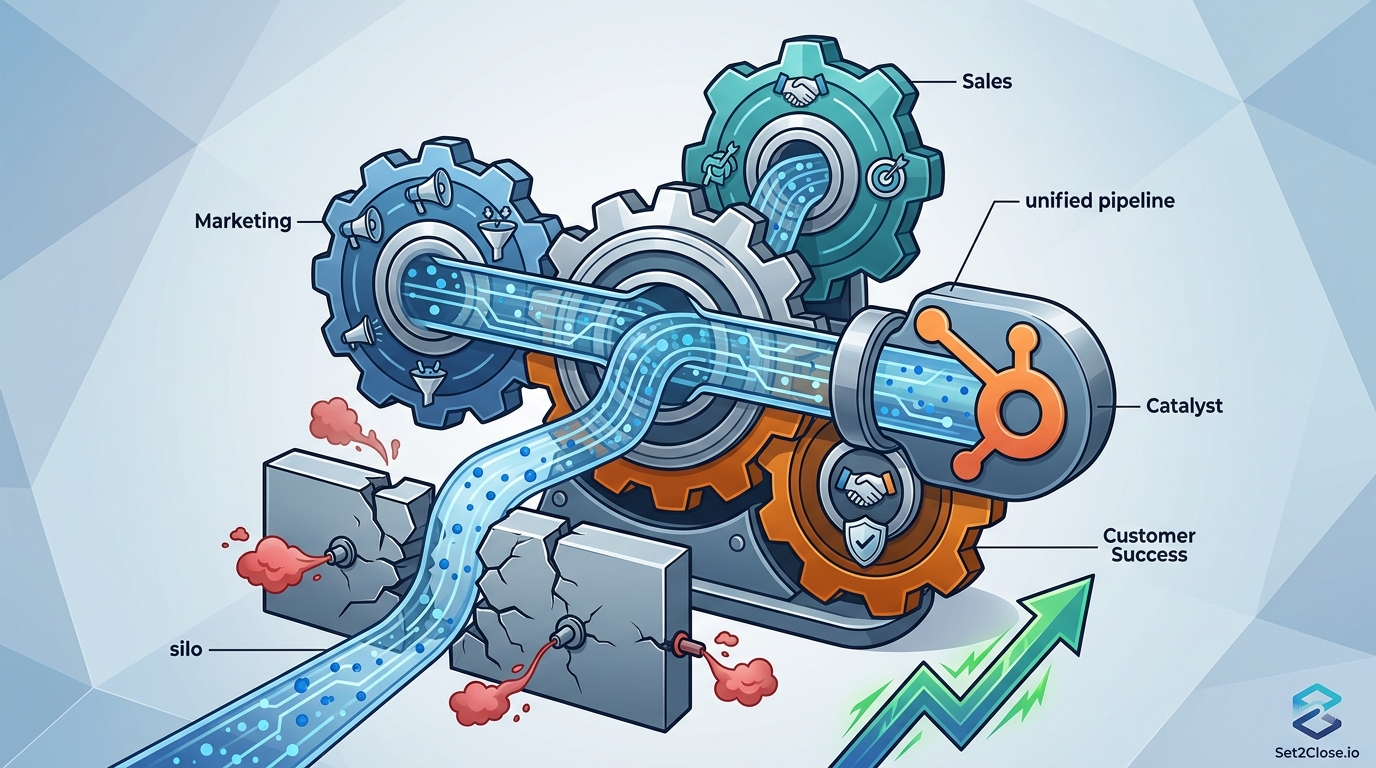
In the modern B2B landscape, the traditional handoff model is obsolete. Marketing generates leads, sales closes them, and customer success retains them. If these stages do not share a common language of metrics, friction occurs. Revenue Operations (RevOps) is the discipline dedicated to breaking down these silos by aligning strategy, processes, and technology.
When KPIs are misaligned, marketing may focus on top-of-funnel volume, such as click-through rates, while sales prioritizes closed-won deals. This disconnect leads to poor lead quality and frustrated sales teams. By establishing shared goals, you ensure that every department contributes to the overarching objective: predictable revenue growth. Companies that successfully integrate these functions often see a dramatic increase in customer lifetime value and a reduction in sales cycle length.
Defining Shared KPIs Across Departments
To align your teams, you must first define metrics that reflect the entire customer journey. Generic metrics like "number of calls made" do not drive strategic alignment. Instead, focus on outcome-based indicators that require collaboration.
1. Marketing Qualified Leads (MQLs) to Sales Accepted Leads (SALs)
This metric measures the quality of marketing efforts from the sales perspective. If marketing generates 100 MQLs but sales rejects 90 of them, the definition of an MQL is flawed. Aligning on SALs forces marketing to understand sales criteria and sales to provide feedback on lead quality.
2. Customer Acquisition Cost (CAC) Payback Period
This KPI tracks how long it takes to recover the cost of acquiring a new customer. It requires input from finance, marketing, and sales. A shorter payback period indicates efficient spending and faster revenue realization, benefiting all departments.
3. Net Revenue Retention (NRR)
Often overlooked by sales and marketing, NRR is critical for customer success. It measures the revenue retained from existing customers, including upsells and cross-sells. When sales and marketing share accountability for NRR, they focus on long-term customer health rather than just new logo acquisition.
HubSpot Implementation for Unified Data
Technology is the backbone of KPI alignment. Without a single source of truth, data discrepancies will undermine your efforts. HubSpot offers a comprehensive platform that integrates marketing, sales, and service hubs into one cohesive system.
CRM Development & Build Outs are essential for customizing this platform to your specific workflow. A well-configured HubSpot CRM ensures that every interaction is tracked, from the first marketing touch to the final renewal. This visibility allows leaders to attribute revenue accurately and identify bottlenecks in the pipeline.
For organizations transitioning from other platforms, HubSpot Implementations provide a structured path to migration and optimization. Proper setup includes defining custom properties, automating workflows, and establishing reporting dashboards that reflect your shared KPIs. Without this technical foundation, even the best strategic plans will fail due to data silos.
The Role of Fractional Revenue Operations
Not every B2B company needs a full-time RevOps leader immediately. Fractional Revenue Operations provides high-level strategic oversight without the overhead of a full-time executive. This model is particularly effective for scaling companies that need expert guidance on KPI definition and technology stack optimization.
Fractional RevOps professionals bring experience from multiple industries, allowing them to implement best practices quickly. They help define the Fractional Revenue Operations framework, ensuring that your KPIs are not just tracked but actively drive behavior. This approach accelerates the alignment process by providing immediate access to specialized expertise.
Leveraging AI Agents for Data Integrity
Data accuracy is paramount for KPI alignment. Manual data entry is prone to errors and inconsistencies. AI Agents automate the enrichment and validation of contact records, ensuring that your CRM is always up-to-date.
Tools like Astro and Nebula enhance your sales pipeline by providing real-time data updates and automated data enrichment. These agents can identify missing data points and correct errors automatically, reducing the administrative burden on your sales team. By integrating AI into your workflow, you ensure that the data used to calculate shared KPIs is reliable and actionable.
Comparing Alignment Strategies
Choosing the right approach to KPI alignment depends on your company's size, maturity, and resources. Below is a comparison of common strategies:
| Strategy | Best For | Key Benefit | Implementation Complexity |
|---|---|---|---|
| Shared Revenue Goals | Early-stage B2B companies | Simple, direct alignment on top-line growth | Low |
| HubSpot Integrated Workflows | Mid-market companies | Automated data flow and reporting | Medium |
| Fractional RevOps | Scaling startups | Expert guidance without full-time cost | Medium |
| AI-Driven Data Enrichment | Data-heavy organizations | High accuracy and reduced manual work | High |
Key Takeaways
- Unified Data is Critical: A single source of truth in HubSpot eliminates data silos and ensures accurate KPI tracking.
- Shared Metrics Drive Behavior: Aligning on MQLs, CAC, and NRR ensures all departments work toward the same revenue goals.
- Fractional RevOps Offers Agility: This model provides expert strategic oversight for scaling companies without the overhead of a full-time hire.
- AI Enhances Data Quality: AI agents like Astro and Nebula automate data enrichment, reducing errors and saving time.
- Continuous Optimization is Key: KPIs should be reviewed regularly to reflect changes in market conditions and business strategy.
- Customer Success is a Shared Responsibility: Including NRR in sales and marketing goals fosters long-term customer relationships.
- Technology Enables Alignment: Proper CRM Development & Build Outs are essential for supporting complex KPI frameworks.
Frequently Asked Questions
What are the most important shared KPIs for sales and marketing?
The most critical shared KPIs include Marketing Qualified Leads (MQLs), Sales Accepted Leads (SALs), Customer Acquisition Cost (CAC), and Revenue Growth Rate. These metrics ensure both teams are focused on quality and efficiency rather than just volume.
How does HubSpot help align sales and marketing?
HubSpot provides a unified CRM that tracks every customer interaction across marketing, sales, and service. This visibility allows teams to see the full customer journey, attribute revenue accurately, and collaborate on workflows. Marketing Hub Implementation ensures that your marketing data is seamlessly integrated with sales activities.
What is Fractional Revenue Operations?
Fractional Revenue Operations is a service model where experienced RevOps professionals provide strategic oversight on a part-time or project basis. This approach is cost-effective for companies that need expert guidance but do not require a full-time executive.
How can AI agents improve KPI alignment?
AI agents automate data entry, enrichment, and validation, ensuring that your CRM data is accurate and up-to-date. This reduces manual errors and provides reliable data for KPI calculations. AI Agents like Astro and Nebula can also provide predictive insights to optimize lead scoring.
What is the role of customer success in KPI alignment?
Customer success ensures that acquired customers remain engaged and expand their usage. By including Net Revenue Retention (NRR) as a shared KPI, sales and marketing are incentivized to focus on long-term customer value rather than just new acquisitions.
How long does it take to align sales and marketing KPIs?
The timeline varies depending on the complexity of your tech stack and organizational culture. Typically, initial alignment can be achieved in 3-6 months with proper Fast Track Onboarding and consistent leadership support.
Why is data integrity important for KPI alignment?
Inaccurate data leads to incorrect KPI calculations, which can misguide strategic decisions. Ensuring data integrity through automation and regular audits is essential for maintaining trust in your metrics.
Start Your Revenue Engine
Aligning your sales, marketing, and customer success teams is not just a strategic move; it is a operational necessity for B2B growth. By leveraging HubSpot's integrated platform, implementing shared KPIs, and utilizing AI-driven insights, you can create a predictable revenue engine that scales with your business.
Ready to transform your revenue operations? Contact Set2Close today to discuss your services and begin your journey toward unified growth. Our team of experts is ready to help you build a robust RevOps framework tailored to your unique needs.