

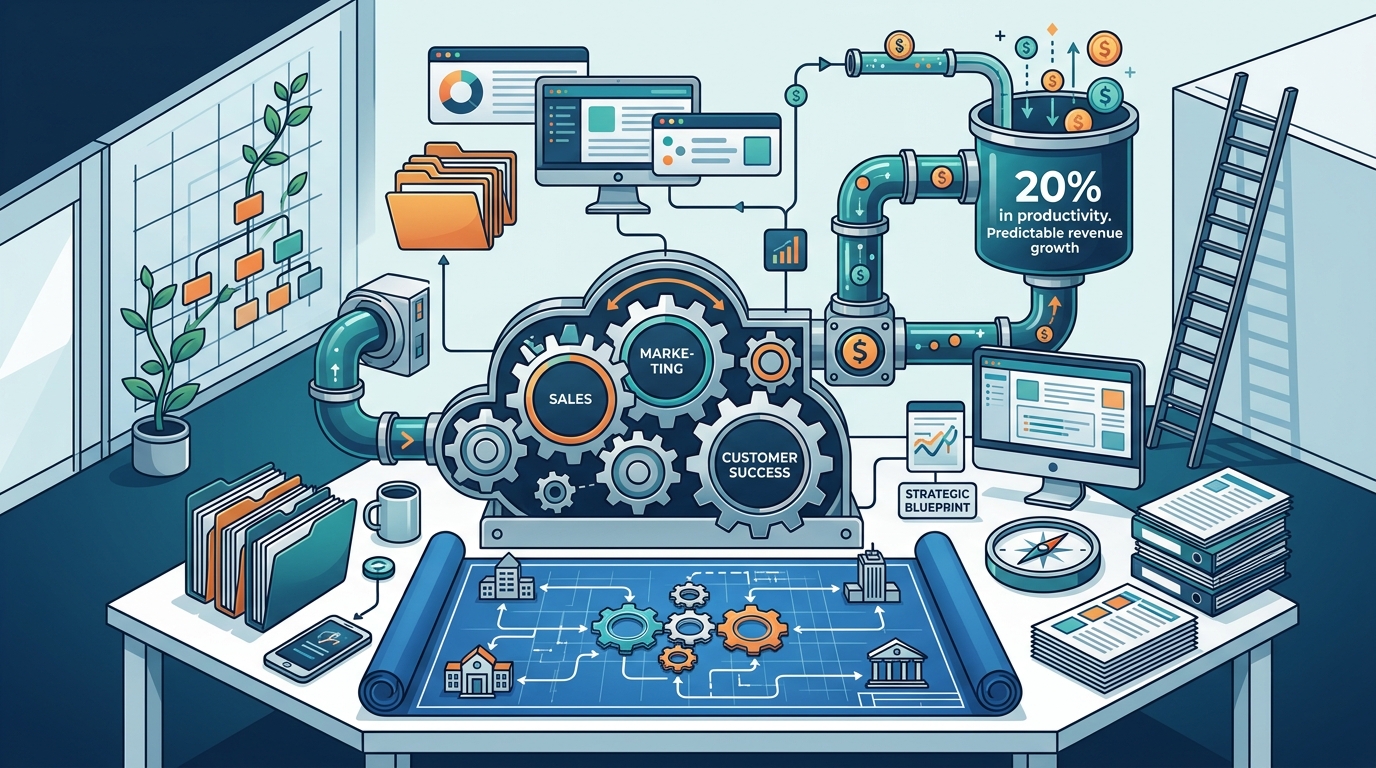
Revenue operations is the central nervous system of a scaling B2B enterprise. For companies with 50 to 200 employees, the transition from founder-led sales to a structured revenue engine is critical. According to recent industry benchmarks, organizations that mature their revenue operations see a 20% increase in sales productivity within the first year of implementation. This guide details the exact operational frameworks, technology integrations, and strategic interventions required to scale predictably. (Revenue Operations Agency About)
Defining Revenue Operations in the Mid-Market
Revenue operations is the strategic alignment of sales, marketing, and customer success under a single operational umbrella. In the 50–200 employee range, silos often begin to form, causing data fragmentation and inefficient workflows. A dedicated RevOps function eliminates these barriers by standardizing processes and ensuring data integrity across the entire customer lifecycle. (Blog amp Resources)
At this stage of growth, the company is no longer relying solely on individual heroics. The focus shifts to repeatable, scalable systems. This requires a shift from ad-hoc tools to integrated platforms. The goal is to create a predictable revenue model where every touchpoint is tracked, measured, and optimized. (AI Agents)
Core Services for Scaling Teams
A revenue operations agency must provide more than just technical support. It must act as a strategic partner that understands the nuances of B2B sales cycles. The following services are essential for companies in this size bracket.
1. CRM Development & Build Outs
The Customer Relationship Management (CRM) system is the single source of truth. For a 50–200 person company, a basic CRM setup is insufficient. You need a robust architecture that supports complex deal structures, multi-threaded accounts, and automated reporting. This involves configuring object models, defining field dependencies, and establishing security roles that protect sensitive data while enabling collaboration.
Effective CRM development ensures that sales teams spend less time on data entry and more time selling. It also provides leadership with real-time visibility into pipeline health, forecast accuracy, and team performance metrics.
2. Marketing Operations as a Service
Marketing operations bridges the gap between creative campaigns and revenue outcomes. This service includes lead management, campaign tracking, and attribution modeling. By aligning marketing efforts with sales goals, RevOps ensures that every dollar spent contributes to the bottom line.
Key components include setting up automated lead scoring models, integrating marketing automation platforms with the CRM, and creating dashboards that track key performance indicators (KPIs) such as cost per acquisition (CPA) and customer lifetime value (CLV).
3. Sales Process Optimization
Sales process optimization involves mapping the buyer journey and identifying friction points. For mid-market B2B companies, this often means implementing a buyer-centric sales framework. This approach focuses on understanding the buyer's needs and tailoring the sales conversation accordingly.
By standardizing the sales process, companies can reduce sales cycles and increase win rates. This includes creating playbooks for common objections, defining qualification criteria, and establishing clear handoff protocols between sales and customer success.
HubSpot Implementation & CRM Architecture
HubSpot is the preferred platform for many mid-market B2B companies due to its scalability and ease of use. However, a successful implementation requires more than just installing the software. It demands a strategic approach to data migration, user adoption, and workflow automation.
Seamless Data Migration
Moving from legacy systems like Salesforce or Excel to HubSpot is a critical milestone. This process involves cleaning historical data, mapping fields, and ensuring that no customer interactions are lost during the transition. A well-executed migration ensures that the new CRM is immediately useful to the sales team.
Workflow Automation
Automation is the key to scaling without proportional headcount growth. HubSpot workflows can automate repetitive tasks such as email follow-ups, task assignments, and data updates. This allows sales representatives to focus on high-value activities like building relationships and closing deals.
For example, automated lead routing ensures that inquiries are assigned to the right salesperson based on territory, product expertise, or deal size. This reduces response times and improves the overall customer experience.
Custom Reporting & Dashboards
Data-driven decision-making requires accurate and accessible reporting. Custom dashboards provide real-time insights into pipeline velocity, conversion rates, and revenue forecasts. By tailoring these reports to specific stakeholder needs, leadership can make informed strategic decisions quickly.
Leveraging AI Agents for Pipeline Velocity
Artificial Intelligence (AI) is transforming revenue operations by providing predictive insights and automating complex tasks. AI agents can analyze vast amounts of data to identify patterns and opportunities that human analysts might miss.
Rapid Data Extraction
AI agents can collect critical information about prospects and accounts in minutes. This includes company size, industry trends, and recent news. By automating this research, sales teams can personalize their outreach more effectively and increase engagement rates.
Competitive Intelligence
Understanding the competitive landscape is crucial for winning deals. AI tools can monitor competitor activities and market trends, providing sales teams with the insights they need to position their solutions effectively. This intelligence helps salespeople anticipate objections and highlight unique value propositions.
Automated Data Enrichment
Data quality is paramount for accurate forecasting. AI agents can automatically enrich contact records with missing information, such as job titles, phone numbers, and social profiles. This ensures that the CRM is always up-to-date and that sales teams have the information they need to connect with prospects.
Fractional RevOps vs. Full-Time Hires
For 50–200 employee companies, the decision to hire a full-time RevOps leader or engage a fractional agency is significant. Both options have distinct advantages depending on the company's specific needs and budget.
| Factor | Fractional RevOps Agency | Full-Time RevOps Hire |
|---|---|---|
| Cost | Predictable monthly retainer or project-based pricing | High salary, benefits, and overhead costs |
| Expertise | Broad experience across multiple industries and tech stacks | Deep knowledge of internal company culture and processes |
| Scalability | Easily scales up or down based on project needs | Fixed capacity, requires hiring additional staff to scale |
| Speed to Value | Immediate access to established frameworks and tools | Longer ramp-up time to understand business nuances |
| Strategic Insight | Objective, external perspective on best practices | Internal advocacy and alignment with company goals |
Fractional RevOps services are particularly beneficial for companies undergoing rapid growth or significant technological transitions. They provide access to specialized expertise without the long-term commitment of a full-time hire. This model allows companies to implement best practices quickly and adapt to changing market conditions.
Key Takeaways
- Predictable Revenue: Mature RevOps practices can increase sales productivity by up to 20% within the first year.
- CRM Architecture: A robust CRM is the foundation of scalable B2B sales, requiring careful planning and data migration.
- AI Integration: AI agents accelerate pipeline velocity by automating data extraction and enrichment.
- Fractional Flexibility: Fractional RevOps offers cost-effective access to high-level expertise for mid-market companies.
- Buyer-Centric Sales: Shifting focus to the buyer's journey improves engagement and conversion rates.
- Marketing Alignment: Integrated marketing operations ensure that campaigns drive measurable revenue outcomes.
- Strategic Onboarding: Fast-track onboarding processes reduce time-to-value for new CRM implementations.
Frequently Asked Questions
What is the typical timeline for a HubSpot implementation?
Standard projects typically range from 3 to 6 months, depending on the complexity of the data migration and the level of customization required. Some teams may need longer timelines to adapt to new processes and produce deliverables.
How does a revenue operations agency price its services?
Pricing is often structured by the project or as a monthly retainer for ongoing support. Costs vary based on individual needs, but agencies strive to make expenses feasible for organizations of all sizes.
What is buyer-centric sales?
Buyer-centric sales is an approach that focuses on understanding and meeting the needs of the buyer. It involves shifting the focus from simply pitching products to creating a personalized experience for each buyer.
Why is data migration critical during a CRM transition?
Data migration ensures that historical customer interactions and insights are preserved. A seamless transition prevents data loss and allows the new system to be immediately useful to the sales team.
Can AI agents replace human sales representatives?
No, AI agents augment human capabilities by handling repetitive tasks and providing insights. They enable sales representatives to focus on high-value activities like relationship building and negotiation.
What are the benefits of fractional RevOps?
Fractional RevOps provides access to specialized expertise and proven frameworks without the high cost of a full-time hire. It offers flexibility and scalability for growing companies.
How do you measure the success of RevOps initiatives?
Success is measured through KPIs such as sales cycle length, win rates, customer acquisition cost, and revenue growth. Regular reporting and analysis help identify areas for improvement.
What is the role of marketing operations in RevOps?
Marketing operations aligns marketing efforts with sales goals by managing lead flow, campaign tracking, and attribution. This ensures that marketing contributes directly to revenue generation.
Start Your Engine
Scaling a 50–200 employee B2B company requires more than just ambition. It demands a rigorous operational framework, the right technology stack, and strategic guidance. Set2Close specializes in helping B2B companies achieve predictable revenue growth through HubSpot optimization and fractional RevOps services.
Whether you need a complete CRM build-out, AI agent integration, or a strategic sales framework, our team is ready to help. Contact us today to schedule a consultation and discover how we can accelerate your growth.