

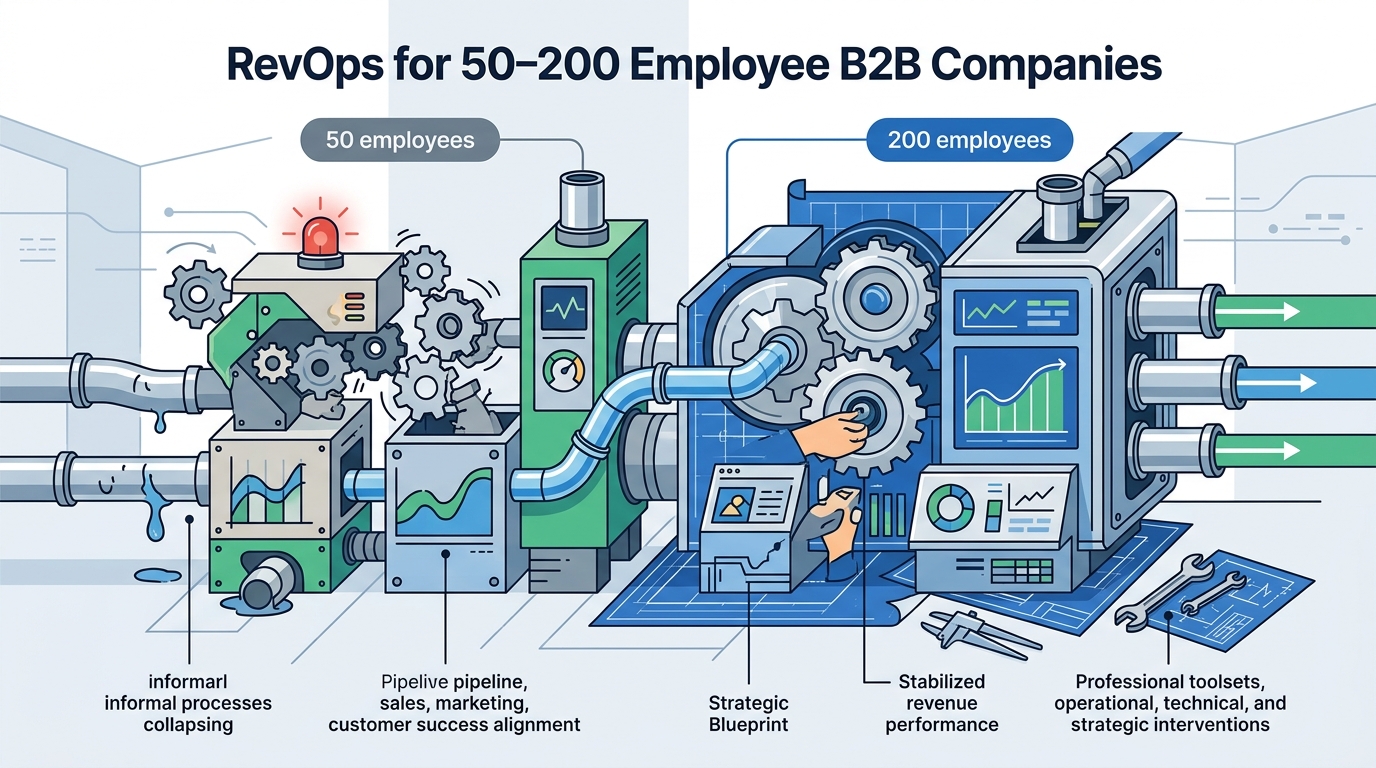
Scaling a B2B company from 50 to 200 employees represents a critical inflection point where informal processes collapse under the weight of complexity. According to recent industry benchmarks, HubSpot research indicates that organizations failing to align sales and marketing operations during this growth phase experience a 30% higher churn rate in customer acquisition efficiency. This guide outlines the exact operational, technical, and strategic interventions required to stabilize revenue engines during hyper-growth. (Revenue Operations Agency About)
The Scaling Paradox: Why Growth Breaks Operations
At 50 employees, a company often relies on the founder's direct oversight. By 200 employees, that model is obsolete. The primary failure point is not sales talent but data integrity. When headcount expands, silos form between marketing, sales, and customer success. Data becomes fragmented across spreadsheets, legacy CRMs, and email inboxes.
Revenue Operations (RevOps) is the strategic discipline that unifies these functions. It ensures that technology, data, and processes work in harmony. Without this unification, the cost of customer acquisition (CAC) spikes because sales teams waste time on bad leads, and marketing cannot accurately attribute revenue. The goal is to create a single source of truth that allows leadership to make data-driven decisions in real time.
HubSpot Infrastructure: The Central Nervous System
For a B2B company of this size, the CRM is not just a database; it is the operating system of the business. Migration from legacy systems like Salesforce to a unified platform like HubSpot is a common and necessary step to reduce technical debt.
CRM Architecture & Governance
A robust CRM architecture requires strict governance. This includes defining custom object structures, standardizing field types, and implementing validation rules to prevent data pollution. CRM Development & Build Outs ensure that the system is tailored to the specific workflow of the sales team rather than forcing the team to adapt to rigid software constraints.
Sales & Marketing Alignment
Alignment is achieved through automated lead routing and scoring. When a marketing qualified lead (MQL) is generated, it must automatically trigger a sales task in the CRM. This eliminates the "black hole" where leads disappear after initial contact. Sales Hub Implementation focuses on building these automated workflows to ensure no opportunity falls through the cracks.
Marketing Operations as a Service
Marketing operations often suffer from a lack of technical expertise. Marketing Operations as a Service provides the necessary support to manage campaigns, track attribution, and optimize the customer journey. This ensures that marketing spend is directly tied to revenue outcomes.
Process Documentation & Standardization
Technology alone cannot fix broken processes. If a sales team follows inconsistent steps, the data they enter will be inconsistent. Standardization is the bridge between strategy and execution.
Sales Pipeline Modeling
A clear sales pipeline model defines every stage of the buyer's journey. It includes specific criteria for moving a deal from one stage to the next. This allows for accurate sales forecasting. Fractional Revenue Operations experts help build these models by analyzing historical data to identify bottlenecks and conversion rates at each stage.
Lead Scoring Mechanism
Lead scoring assigns a numerical value to prospects based on their engagement and fit. This helps sales teams prioritize high-value opportunities. A dynamic lead scoring mechanism updates in real time as prospects interact with content, attend webinars, or visit pricing pages.
Quoting Process Design
For complex B2B sales, the quoting process can be a major friction point. Automating quote generation reduces errors and speeds up the sales cycle. RevTech solutions integrate quoting tools directly into the CRM, allowing sales reps to generate accurate proposals without leaving their workflow.
Deploying AI Agents for Efficiency
As headcount grows, manual tasks become unsustainable. AI agents are no longer a luxury; they are a necessity for maintaining efficiency in a 200-person organization.
Automated Data Enrichment
AI agents can automatically enrich CRM records with data from external sources. This includes updating job titles, company revenue, and social profiles. AI Agents like Astro and Nebula specialize in rapid data extraction and comprehensive profile building, ensuring that sales teams always have the most current information.
Competitive Intelligence
AI tools can monitor market trends and competitor activities. This intelligence allows sales teams to tailor their pitches and address potential objections before they arise. By identifying market shifts early, companies can adjust their strategies proactively rather than reactively.
Prospect Research Automation
Manual prospect research is time-consuming and prone to error. AI agents can aggregate data from various sources to build detailed prospect profiles. This includes analyzing social media activity, company news, and public databases to identify key decision-makers and their pain points.
The Role of Fractional RevOps
Hiring a full-time RevOps leader for a 50–200 employee company can be cost-prohibitive and risky if the role's scope is not yet defined. Fractional RevOps provides high-level expertise on a flexible basis.
Strategic Oversight
Fractional RevOps leaders provide the strategic oversight needed to align sales, marketing, and customer success. They ensure that technology investments deliver a measurable return on investment. Fractional RevOps as a Service allows companies to access top-tier talent without the long-term commitment of a full-time hire.
Fast Track Onboarding
Speed to value is critical. Fast Track Onboarding methodologies ensure that new systems and processes are implemented quickly. This reduces the disruption to daily operations and allows the team to start benefiting from the new infrastructure sooner.
Training & Adoption
Technology adoption is often the biggest hurdle. Comprehensive training programs ensure that all employees understand how to use the new tools effectively. User training throughout projects and on-demand education resources help drive adoption and minimize resistance to change.
Key Takeaways
- Unify Data Early: Fragmented data is the primary cause of revenue leakage in scaling B2B companies.
- HubSpot as Core: Implementing a unified CRM like HubSpot is essential for breaking down silos between sales and marketing.
- AI for Scale: AI agents automate data enrichment and prospect research, freeing up sales teams for high-value activities.
- Fractional Expertise: Fractional RevOps provides strategic oversight and fast-track onboarding without the cost of a full-time executive.
- Process First: Technology cannot fix broken processes; documentation and standardization must precede implementation.
- Lead Scoring: Dynamic lead scoring ensures sales teams focus on the highest probability opportunities.
- Continuous Training: Ongoing education is critical for maintaining high adoption rates of new technologies.
Frequently Asked Questions
What is the primary challenge for a 50–200 employee B2B company?
The primary challenge is maintaining data integrity and process alignment as headcount expands. Informal systems break down, leading to silos and inefficient workflows.
Why is HubSpot recommended for this size company?
HubSpot offers a unified platform that integrates marketing, sales, and service operations. This reduces technical debt and provides a single source of truth for revenue data.
How do AI agents improve sales efficiency?
AI agents automate manual tasks such as data enrichment, prospect research, and competitive intelligence. This allows sales teams to focus on building relationships and closing deals.
What is Fractional RevOps?
Fractional RevOps is a service model where experienced revenue operations leaders provide strategic oversight and implementation support on a part-time or project basis.
How long does a typical RevOps implementation take?
Typical projects range from 3 to 6 months, depending on the complexity of the tech stack and the scope of process documentation required.
What is the role of lead scoring?
Lead scoring prioritizes prospects based on their likelihood to convert. This ensures that sales teams focus their efforts on high-value opportunities.
How does Set2Close help with CRM migration?
Set2Close provides seamless migration services from legacy systems like Salesforce to HubSpot, ensuring data integrity and minimal disruption to operations.
Start Your Engine
Scaling from 50 to 200 employees requires more than just hiring more salespeople. It requires a robust operational foundation. Set2Close provides the expertise, technology, and strategic guidance needed to build a predictable revenue engine. Contact us today to discuss your specific needs and start building your scalable growth framework.