

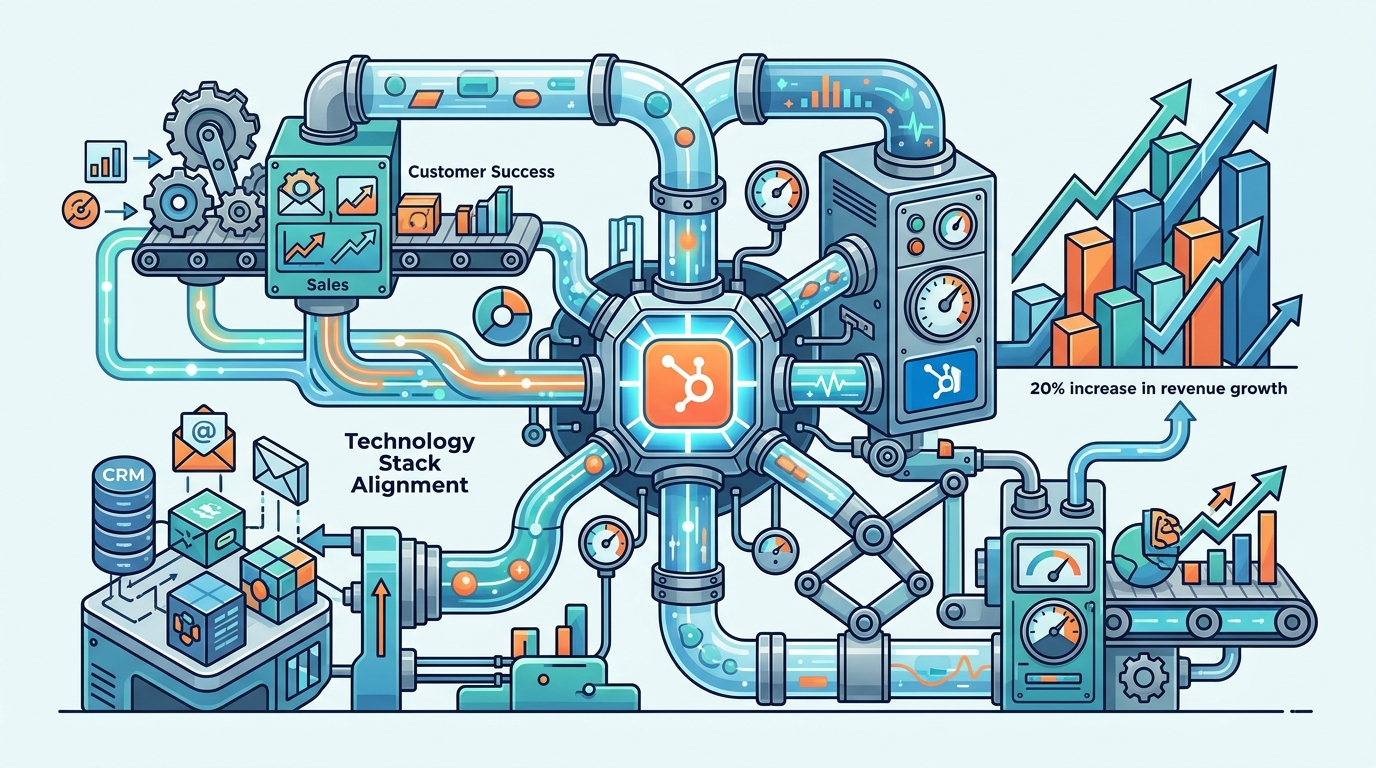
For modern B2B enterprises, revenue is not a byproduct of marketing; it is the direct result of engineered systems. According to recent industry data, companies that align their sales and marketing technology stacks see a 20% increase in revenue growth over their peers. This statistic highlights a critical reality: manual processes and siloed data are the primary bottlenecks to scaling. To unlock predictable revenue, you must treat your CRM not as a digital address book, but as the central nervous system of your business. This guide details the exact architectural steps to optimize HubSpot for high-velocity B2B growth. (Revenue Operations Agency About)
1. Foundation: CRM Architecture & Governance
Before implementing a single workflow, you must establish a robust data foundation. CRM Architecture is the structural design of your database, including object relationships, field types, and permission sets. Without this, your data becomes corrupted, leading to inaccurate reporting and frustrated sales teams.
Standardizing Data Entry
B2B sales cycles involve multiple stakeholders. Your HubSpot instance must reflect this complexity. Implement account hierarchies to link contacts to parent companies. Use custom objects for complex B2B entities like deals, projects, or subscriptions. This structure ensures that revenue attribution remains accurate across long sales cycles.
Governance and Compliance
Data hygiene is non-negotiable. Establish strict validation rules for email formats, phone numbers, and required fields. Data Governance is the set of policies and procedures that ensure data is accurate, secure, and compliant with regulations like GDPR or CCPA. Regular audits prevent the accumulation of duplicate records and outdated contact information.
For a detailed breakdown of how to structure your CRM for success, review our B2B Sales Strategy Framework.
2. Process Documentation & Standardization
Technology amplifies process. If your sales process is chaotic, automating it will only accelerate chaos. Optimization begins with mapping your ideal customer journey.
Defining the Sales Pipeline
Map every stage of your B2B sales cycle. From initial lead intake to final close, each stage must have clear entry and exit criteria. This clarity allows for accurate sales forecasting. Sales Pipeline Modeling is the technique of projecting future revenue based on current deal stages, conversion rates, and average deal size.
Lead Scoring Mechanisms
Not all leads are created equal. Implement a lead scoring model that assigns points based on demographic fit (firmographics) and behavioral engagement (email opens, page visits). This ensures your sales team focuses on high-intent prospects. For more on this, explore our CRM Development & Build Outs services.
3. Sales & Marketing Automation
Automation is the engine of scale. It removes manual repetition, allowing your team to focus on high-value conversations.
Marketing Operations as a Service
Align your marketing campaigns with your sales goals. Use HubSpot’s Marketing Hub to create personalized buyer journeys. Automated email sequences should nurture leads based on their specific pain points. Marketing Operations is the discipline of planning, executing, and optimizing marketing technology to improve efficiency and effectiveness.
Sales Automation Workflows
Automate lead routing to ensure immediate follow-up. Set up task creation for sales reps when a lead reaches a certain score. Automate contract generation and e-signature requests to shorten the sales cycle. These small efficiencies compound over time to drive significant revenue growth.
Learn how our Marketing Operations as a Service can streamline your workflows.
4. Leveraging AI Agents for Efficiency
The integration of Artificial Intelligence into HubSpot is no longer optional; it is a competitive necessity. AI Agents in HubSpot are advanced tools designed to automate complex tasks like prospect research and data enrichment.
Meet Astro and Nebula
Our proprietary AI agents, Astro and Nebula, demonstrate the power of intelligent automation. Astro excels at rapid data extraction, building comprehensive profiles of prospects in minutes. Nebula focuses on real-time data updates and automated enrichment, ensuring your CRM is always current.
Competitive Intelligence
AI can identify market trends and competitor activities, providing your sales team with actionable insights. This capability allows for proactive rather than reactive selling. By leveraging AI Agents, you can supercharge your sales pipeline with data-driven precision.
5. Analytics, Attribution & Reporting
You cannot optimize what you do not measure. Robust reporting provides the visibility needed to make strategic decisions.
Revenue Attribution Models
Understand which channels drive revenue. Implement a multi-touch attribution model to credit marketing efforts accurately. Revenue Attribution is the process of assigning credit for a sale to the specific marketing touchpoints that influenced the buyer. This data helps you allocate budget to the highest-performing channels.
Funnel Reporting Management
Monitor your conversion rates at every stage of the funnel. Identify bottlenecks where leads drop off. Use this data to refine your messaging and improve conversion rates. For advanced analytics setups, check out our Fractional Revenue Operations offerings.
6. Service vs. Sales Hub Optimization
HubSpot offers a suite of products. Optimizing for B2B growth requires leveraging both Sales and Service Hubs effectively.
| Feature | Sales Hub Optimization | Service Hub Optimization |
|---|---|---|
| Primary Goal | Accelerate deal closure and pipeline growth. | Enhance customer satisfaction and retention. |
| Key Tool | Deal pipelines and quote builders. | Support ticketing and knowledge bases. |
| Integration | Seamless handoff to Service Hub for onboarding. | Feedback loops to Marketing for product improvement. |
| Metric | Win rate and sales cycle length. | Customer effort score and resolution time. |
For a seamless transition or implementation, consider our Sales Hub Implementation and Service Hub Implementation services.
7. Key Takeaways
- Architecture First: Never automate before standardizing your CRM data structure and governance policies.
- Process Documentation: Clear sales pipeline stages and lead scoring criteria are prerequisites for automation.
- AI Integration: Utilize AI agents like Astro and Nebula for rapid data extraction and enrichment.
- Attribution Matters: Implement multi-touch attribution to accurately measure marketing ROI.
- Alignment: Ensure seamless data flow between Sales and Service Hubs for a unified customer view.
- Fractional Expertise: Leverage fractional RevOps for specialized guidance without full-time overhead.
- Continuous Optimization: Regularly audit workflows and data hygiene to maintain system health.
8. Frequently Asked Questions
What is the first step in optimizing HubSpot for B2B?
The first step is auditing your current CRM architecture. Ensure your data structure supports your B2B sales cycle, including account hierarchies and custom objects for complex deals.
How do AI agents improve HubSpot efficiency?
AI agents automate data entry, enrich contact profiles with real-time data, and provide competitive intelligence, allowing your team to focus on high-value selling activities.
What is the difference between Sales Hub and Service Hub optimization?
Sales Hub optimization focuses on pipeline acceleration and deal closure, while Service Hub optimization focuses on customer support efficiency and retention strategies.
How long does a typical HubSpot optimization take?
Projects typically range from 3 to 6 months, depending on the complexity of your tech stack and the extent of process documentation required.
Can HubSpot integrate with other B2B tools?
Yes, HubSpot offers extensive integration capabilities with third-party tools, including ERP systems, marketing platforms, and custom APIs for seamless data flow.
What is Revenue Attribution?
Revenue Attribution is the process of assigning credit for a sale to the specific marketing touchpoints that influenced the buyer, helping you understand which channels drive growth.
Why is process documentation critical?
Process documentation ensures consistency in sales and marketing efforts, making automation possible and scalable across your organization.
9. Start Your Engine
Optimizing HubSpot is not a one-time project; it is a continuous journey of refinement and growth. Whether you need a full CRM build-out, AI agent integration, or fractional RevOps support, Set2Close is your partner in scaling revenue. Contact us today to schedule your consultation and start building your predictable revenue engine.