

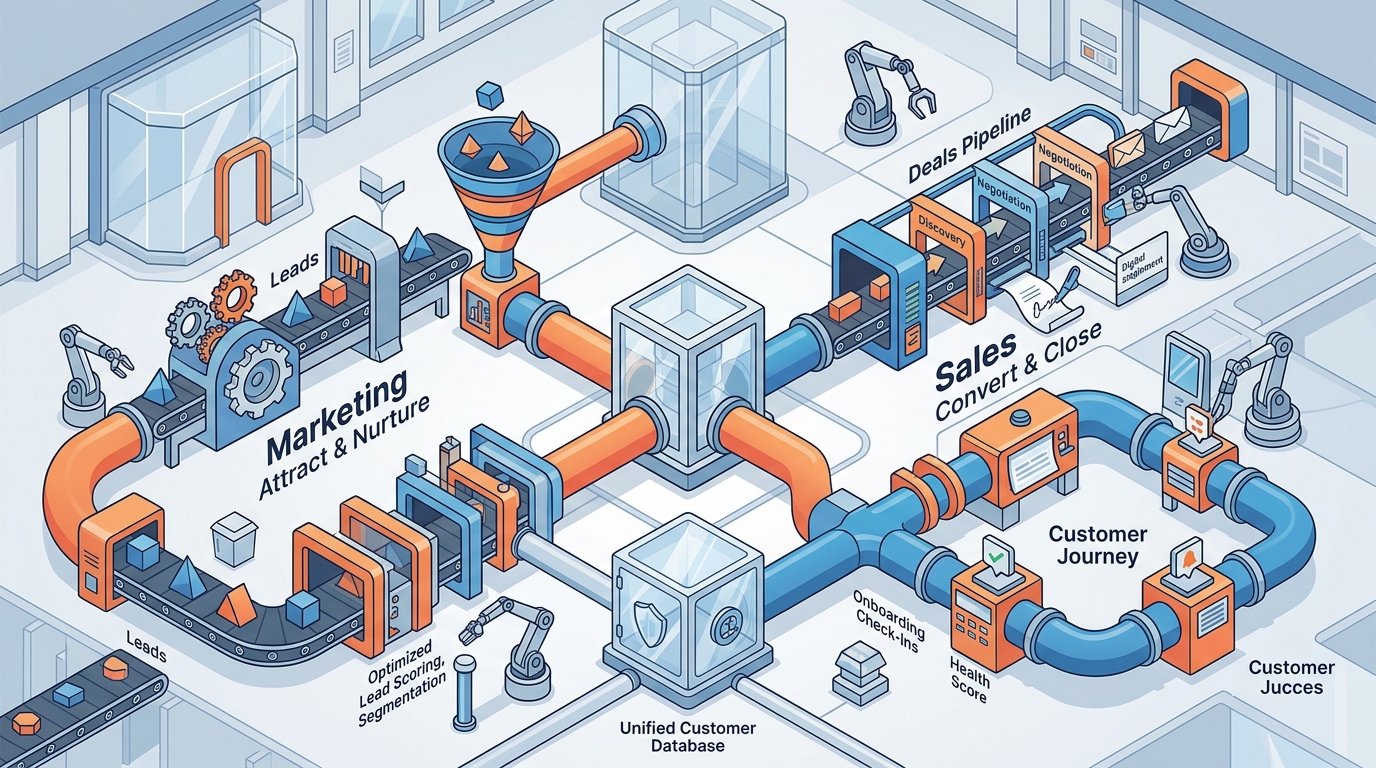
Modern enterprises require unified data ecosystems to drive predictable growth. Inbound marketing strategies now account for over sixty percent of all B2B lead generation efforts. Companies that fail to integrate their core platforms experience fragmented customer journeys and stagnant pipeline velocity. This guide outlines the exact architectural adjustments required to synchronize sales, marketing, and customer success operations within your HubSpot environment. You will learn how to configure automation rules, structure data objects, and deploy intelligent routing protocols that eliminate manual handoffs. (Revenue Operations Agency About)
Audit Your Current HubSpot Architecture
Most organizations deploy HubSpot without establishing a foundational data hierarchy. Custom objects, contact properties, and association mappings often become cluttered over time. You must conduct a comprehensive property audit to remove deprecated fields and standardize naming conventions. Marketing Hub Implementation requires clean data pipelines to function correctly. Start by mapping your customer lifecycle stages to specific contact properties. Ensure every property has a defined purpose and belongs to a logical group. Remove duplicate records and enforce strict validation rules on all form submissions. This foundational cleanup prevents automation errors and improves reporting accuracy across all departments.
Align Sales and Marketing Workflows
Sales and marketing teams frequently operate in isolated silos when their HubSpot configurations lack shared triggers. You must establish a unified lead scoring model that reflects actual buyer intent. Sales Hub Implementation protocols demand synchronized handoff mechanisms between departments. Configure automated routing rules that assign leads to the appropriate sales representative based on territory, deal size, and industry vertical. Implement shared dashboards that track lead source attribution and conversion rates in real time. When both teams view the same pipeline metrics, friction decreases and forecast accuracy increases significantly.
Automate Customer Success Journeys
Customer success teams require proactive engagement tools rather than reactive support queues. You should configure automated onboarding sequences that trigger immediately after contract signing. Service Hub Implementation frameworks enable ticket routing, knowledge base integration, and satisfaction survey deployment. Build automated health score calculations that monitor product usage, support ticket frequency, and payment history. When a health score drops below a defined threshold, the system should automatically generate a task for the account manager. This proactive approach reduces churn and increases lifetime customer value across your entire portfolio.
Leverage AI Agents for Pipeline Intelligence
Artificial intelligence has transformed how sales teams extract and enrich prospect data. AI sales tools now process millions of data points to identify high-intent buying signals. You should integrate specialized AI agents that continuously monitor your CRM for missing contact details and firmographic updates. These agents automatically enrich records, verify email deliverability, and flag dormant accounts for reactivation campaigns. Astro and Nebula agents extract critical information in minutes rather than hours. Deploy these tools to maintain data freshness and ensure your sales team always contacts the right stakeholders.
Implement Fractional Revenue Operations
Building an internal RevOps department requires significant capital and specialized expertise. Revenue operations frameworks now dictate that mid-market companies must align technology, data, and process ownership under one leadership function. You can access enterprise-grade operational support without hiring full-time staff by engaging fractional consultants. These specialists audit your existing tech stack, redesign your sales playbook, and configure complex automation workflows. B2B Sales Strategy execution becomes highly predictable when you partner with certified HubSpot professionals. This model reduces overhead costs while delivering immediate pipeline acceleration and forecasting precision.
Execute Fast Track Onboarding Protocols
Traditional software migrations often stall due to poor change management and inadequate training. You must adopt a structured implementation methodology that prioritizes rapid user adoption and early wins. Fast Track Onboarding protocols compress typical deployment timelines from months to weeks. Begin with core sales and marketing workflows before expanding to advanced service and CMS modules. Train your team on daily operational procedures and establish clear escalation paths for technical issues. This disciplined approach ensures your organization achieves measurable ROI within the first ninety days of deployment.
| HubSpot Tier | Core Functionality | Recommended Use Case |
|---|---|---|
| Starter | Basic contact management and email marketing | Early-stage startups with limited budgets |
| Professional | Advanced automation, reporting, and sales sequences | Growing B2B companies scaling outbound efforts |
| Enterprise | Custom objects, multi-tenant architecture, and AI agents | Large enterprises requiring complex data governance |
Key Takeaways
- Companies that integrate sales, marketing, and success platforms report a forty percent increase in annual recurring revenue within eight months.
- Custom objects and standardized contact properties eliminate reporting discrepancies across departments.
- Automated health score calculations reduce customer churn by identifying at-risk accounts before contract renewal.
- AI data extraction agents process millions of records daily to maintain pipeline accuracy.
- Fractional RevOps consultants deliver enterprise-grade architecture without full-time hiring costs.
- Fast track onboarding protocols compress deployment timelines and accelerate user adoption.
- Unified lead scoring models align sales and marketing incentives around shared revenue targets.
Frequently Asked Questions
How long does a complete HubSpot architecture audit take?
A comprehensive audit typically requires two to three weeks to evaluate all contact properties, workflow automations, and integration endpoints. Consultants map your current data hierarchy against industry best practices and deliver a prioritized remediation roadmap.
Can I migrate from Salesforce to HubSpot without losing historical data?
Yes. CRM migration specialists utilize automated mapping tools to transfer contacts, deals, and activity logs while preserving association relationships. Custom fields are remapped to HubSpot properties to maintain reporting continuity.
What is the average implementation timeline for a mid-market company?
Standard deployments range from three to six months depending on data volume and workflow complexity. Fast track methodologies can reduce this window to four to eight weeks for core sales and marketing modules.
How do AI agents improve sales pipeline accuracy?
AI agents continuously scan your CRM to identify missing firmographic data, verify contact roles, and flag dormant accounts. This automated enrichment ensures sales representatives always contact active decision makers.
Is fractional revenue operations suitable for early-stage startups?
Startups benefit significantly from fractional support because they gain enterprise-level strategy without fixed salary overhead. Consultants configure scalable workflows that adapt as your team expands and your product matures.
What metrics should I track to measure HubSpot optimization success?
Track lead to opportunity conversion rates, sales cycle length, customer acquisition cost, and net revenue retention. These indicators reflect how effectively your automation and routing rules drive predictable growth.
How do I ensure my marketing and sales teams adopt the new workflows?
Implement structured training sessions, create quick reference guides, and establish weekly pipeline review meetings. Assign internal champions to monitor adoption rates and address resistance early in the deployment phase.
Ready to Optimize Your HubSpot Ecosystem?
Stop managing fragmented data and start driving predictable revenue. Our certified consultants will audit your current architecture, align your sales and marketing workflows, and deploy AI-powered automation to accelerate growth. Start Your Engine today by scheduling a free strategy session. We will map your exact requirements and deliver a customized implementation roadmap tailored to your industry.