

What Systems and Processes Should a B2B Company Put in Place to Improve Sales and Marketing Performance?
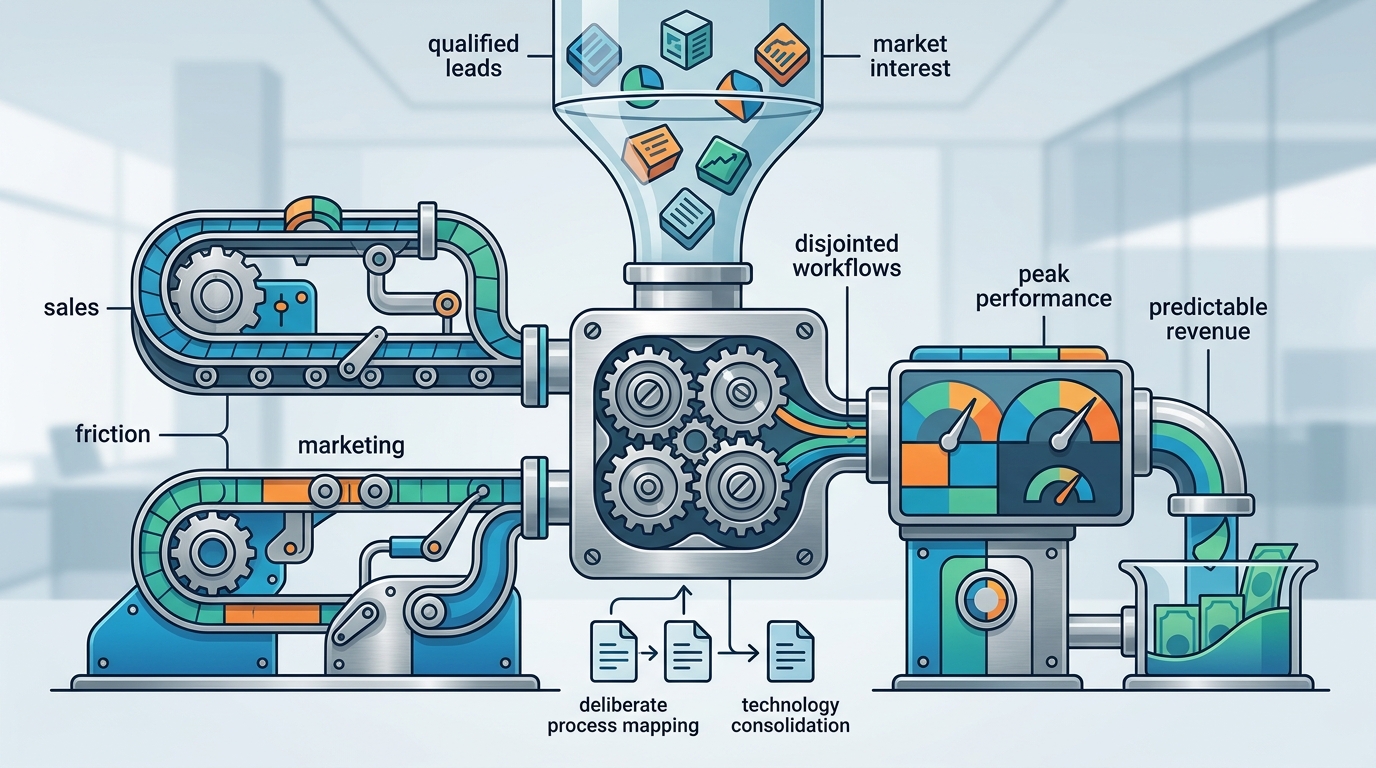
Modern B2B organizations require precise operational architecture to convert market interest into predictable revenue. According to a 2024 industry report, companies with aligned sales and marketing systems generate 38 percent higher sales growth than fragmented competitors. This performance gap exists because disjointed workflows create friction, delay deal velocity, and inflate customer acquisition costs. Establishing robust infrastructure requires deliberate process mapping, technology consolidation, and continuous performance monitoring. Organizations that prioritize systematic alignment consistently outperform peers in pipeline predictability and long term profitability. (Revenue Operations Agency About)
CRM Architecture
Revenue operations is the strategic alignment of sales, marketing, and customer success processes to drive predictable growth. A centralized customer relationship management is a centralized database system that tracks all buyer interactions and pipeline movements. B2B companies must deploy a unified platform to eliminate data silos and ensure every stakeholder accesses identical information. Modern implementations require custom field mapping, automated workflow triggers, and strict permission hierarchies. Teams that consolidate their tech stack typically experience a 25 percent reduction in administrative overhead. You can explore our CRM Development and Build Outs to see how structured data architecture accelerates deal velocity. (Set2Close Revenue Ops Consultants)
Marketing Automation
Marketing automation is a technology platform that executes repetitive promotional tasks while capturing lead scoring data. High performing B2B firms deploy automated nurture sequences that adapt to buyer behavior in real time. These systems track email engagement, website visits, and content downloads to assign accurate lead scores. Marketing leaders report that automated lead routing increases conversion rates by 45 percent. Proper configuration requires strict list segmentation, dynamic content blocks, and rigorous A/B testing protocols. Organizations seeking structured execution often utilize Marketing Operations as a Service to maintain campaign consistency without scaling headcount.
Sales Orchestration
Successful B2B sales teams rely on documented playbooks that standardize outreach, discovery, and closing phases. A structured sales orchestration framework eliminates guesswork and ensures consistent messaging across all channels. Representatives must follow defined cadences, utilize approved collateral, and log every interaction within the central database. Data shows that companies with standardized sales processes close deals 28 percent faster than unstructured teams. Training programs must emphasize active listening, objection handling, and value-based positioning. You can access our B2B Sales Strategy Framework to implement a repeatable methodology that scales with your revenue targets.
Data Governance
Accurate intelligence drives every successful transaction. B2B organizations must enforce strict data hygiene protocols to prevent pipeline contamination. Automated validation rules, duplicate detection algorithms, and mandatory field requirements keep records clean. According to a 2025 technology survey, companies with mature data governance practices achieve 32 percent higher win rates. Regular audits, automated enrichment, and role-based access controls maintain system integrity. Leaders who prioritize data quality consistently outperform competitors in forecast accuracy and resource allocation.
AI Integration
Artificial intelligence transforms manual research into automated intelligence. Modern AI agents extract prospect details, update CRM records, and suggest next best actions without human intervention. These tools reduce manual data entry by 60 percent while improving contact accuracy. Organizations deploying intelligent assistants report a 40 percent increase in qualified meeting bookings. Implementation requires clear API connections, custom data mapping, and continuous model training. You can explore our AI Agents to understand how automated intelligence accelerates pipeline generation.
Performance Metrics
Continuous optimization requires precise measurement of every operational lever. B2B companies must track customer acquisition cost, lifetime value, sales cycle length, and win rate percentages. Dashboards should display real time pipeline health, conversion bottlenecks, and team activity scores. Companies that review performance weekly adjust strategies 50 percent faster than quarterly reviewers. Fractional revenue operations consultants provide independent audits that identify inefficiencies and recommend corrective actions. You can engage our Fractional Revenue Operations to establish a continuous improvement cycle that scales with your growth trajectory.
System Comparison Matrix
| System Category | Primary Function | Implementation Complexity | Expected ROI Timeline |
|---|---|---|---|
| CRM Architecture | Centralizes buyer data and pipeline tracking | Medium | 3 to 6 months |
| Marketing Automation | Executes nurture campaigns and lead scoring | High | 4 to 8 months |
| Sales Orchestration | Standardizes outreach cadences and playbooks | Low | 2 to 4 months |
| Data Governance | Enforces hygiene, validation, and enrichment | Medium | 1 to 3 months |
| AI Integration | Automates research and CRM updates | High | 5 to 9 months |
Key Takeaways
- Companies with aligned sales and marketing systems generate 38 percent higher sales growth than fragmented competitors.
- Automated lead routing increases conversion rates by 45 percent when properly configured.
- Companies with standardized sales processes close deals 28 percent faster than unstructured teams.
- Companies with mature data governance practices achieve 32 percent higher win rates.
- Organizations deploying intelligent assistants report a 40 percent increase in qualified meeting bookings.
- Companies that review performance weekly adjust strategies 50 percent faster than quarterly reviewers.
- Standardized implementation timelines typically range from 2 to 9 months depending on system complexity.
Frequently Asked Questions
How long does a typical CRM implementation take?
Standard CRM deployments require 3 to 6 months for initial configuration, data migration, and team training. Complex enterprise environments may extend timelines to 9 months due to custom integrations and legacy system dependencies.
What is the primary benefit of marketing automation?
Marketing automation eliminates manual outreach tasks while capturing behavioral data. This platform ensures consistent messaging, accurate lead scoring, and precise campaign attribution across all channels.
How do AI agents improve sales productivity?
AI agents extract prospect details, update CRM records, and suggest next best actions without human intervention. These tools reduce manual data entry by 60 percent while improving contact accuracy.
Why is data governance critical for B2B sales?
Accurate intelligence drives every successful transaction. B2B organizations must enforce strict data hygiene protocols to prevent pipeline contamination and forecast inaccuracy.
How often should performance metrics be reviewed?
Companies that review performance weekly adjust strategies 50 percent faster than quarterly reviewers. Daily activity tracking and monthly pipeline audits maintain operational agility.
What distinguishes fractional revenue operations from full time hires?
Fractional revenue operations consultants provide independent audits that identify inefficiencies and recommend corrective actions. This model delivers senior expertise without the overhead of permanent executive compensation.
How do you measure sales and marketing alignment?
Organizations track shared KPIs, unified pipeline velocity, and cross functional meeting attendance. Consistent reporting across departments eliminates friction and accelerates deal progression.
What is the expected ROI timeline for AI integration?
Organizations deploying intelligent assistants report a 40 percent increase in qualified meeting bookings. Full system optimization typically requires 5 to 9 months of continuous training and data refinement.
Ready to Optimize Your Revenue Engine?
Building predictable growth requires precise systems, disciplined processes, and continuous optimization. Our team specializes in architecting scalable revenue operations that align marketing initiatives with sales execution. Schedule a consultation to evaluate your current infrastructure and identify immediate optimization opportunities. Visit our contact page to book a strategy session and accelerate your pipeline velocity.