

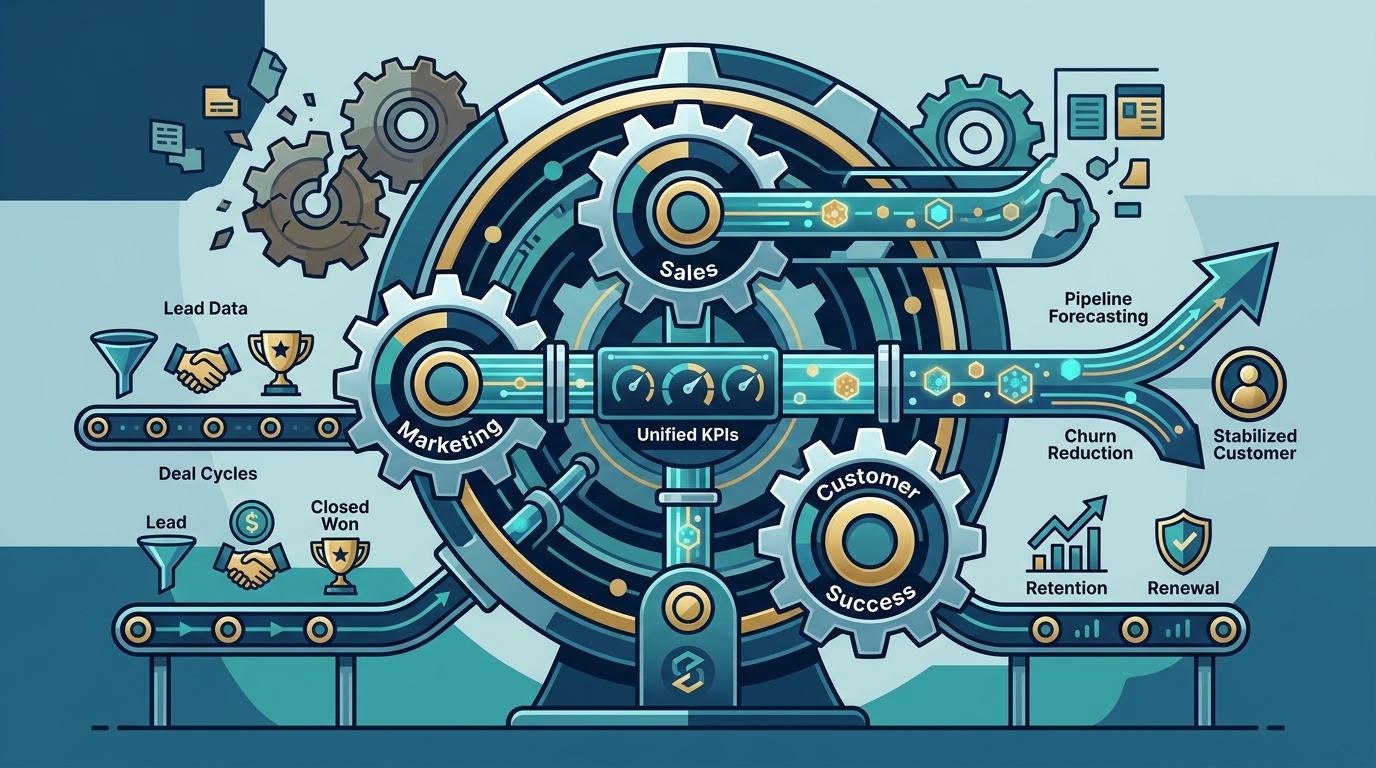
Modern B2B organizations frequently struggle to synchronize departmental goals because legacy tracking systems isolate revenue generation from retention metrics. Revenue operations is the systematic discipline that bridges these functional silos by standardizing data flows across every customer touchpoint. When leadership establishes shared KPIs, they eliminate redundant reporting workflows and create a single source of truth for pipeline forecasting. This alignment directly impacts customer lifetime value and reduces churn rates across enterprise contracts. Organizations that implement unified tracking frameworks consistently report faster deal cycles and higher forecast accuracy across quarterly planning sessions.
Defining Shared KPIs Across Departments
Successful revenue alignment begins with precise metric selection. Customer acquisition cost is the total financial investment required to convert a prospect into a paying enterprise client. Marketing teams must track lead velocity rates while sales departments monitor average sales cycle duration. Customer success managers focus on net revenue retention and product adoption benchmarks. These metrics must feed into a centralized dashboard to prevent conflicting departmental targets. Unified tracking eliminates redundant reporting workflows and creates a single source of truth for pipeline forecasting.
Marketing Impact Benchmarks
Marketing departments generate top-of-funnel activity through targeted campaigns and content distribution. They measure success through marketing qualified lead conversion rates and campaign attribution accuracy. When marketing aligns with sales, they share responsibility for lead quality thresholds. This shared accountability reduces wasted ad spend and improves campaign return on investment. Revenue operations consultants typically recommend implementing campaign tracking pixels to capture first-party data accurately.
Sales Velocity Optimization
Sales teams require clear visibility into pipeline health and forecast accuracy. They track metrics like average deal size and win rates against qualified opportunities. When sales and marketing share KPIs, they establish consistent lead scoring models. This consistency prevents sales representatives from pursuing unqualified prospects while marketing generates higher intent traffic. Unified tracking eliminates redundant reporting workflows and creates a single source of truth for pipeline forecasting.
Building the CRM Infrastructure
Centralized data storage forms the backbone of any successful alignment strategy. Customer relationship management is the technological framework that records every interaction, transaction, and support ticket within a unified database. HubSpot implementations provide native modules for marketing automation, sales engagement, and service desk management. These modules synchronize automatically to prevent data fragmentation across departments. CRM Development and Build Outs ensure that custom fields match your exact operational requirements.
Data Synchronization Protocols
Automated data synchronization prevents manual entry errors and maintains record accuracy. Marketing automation tools push campaign engagement data directly into contact records. Sales platforms update opportunity stages and forecast values in real time. Customer success software logs support ticket resolution times and product usage metrics. This continuous data flow enables leadership to make informed decisions without waiting for end-of-month reports.
Integration Ecosystem Management
Enterprise technology stacks require robust API connections to function seamlessly. Integration ecosystems connect your primary CRM with email sequencing tools, payment gateways, and analytics platforms. AI Agents automate data enrichment tasks and identify missing contact attributes automatically. These tools reduce administrative overhead and allow your team to focus on strategic revenue initiatives.
Designing Automation Workflows
Manual task management creates bottlenecks that stall pipeline progression. Workflow automation assigns tasks, triggers notifications, and updates record statuses based on predefined conditions. Marketing automation sequences nurture leads through educational content until they reach sales readiness thresholds. Sales automation tools route qualified opportunities to the appropriate account executive based on territory and deal size. Unified tracking eliminates redundant reporting workflows and creates a single source of truth for pipeline forecasting.
Intelligent Lead Routing Logic
Intelligent lead routing directs prospects to the most qualified representatives based on historical performance data. Routing algorithms evaluate company size, industry vertical, and engagement signals to assign accounts efficiently. This logic prevents sales representatives from competing over the same opportunities while ensuring high-value accounts receive immediate attention. Fast Track Onboarding accelerates your initial workflow configuration and reduces time to value.
Trigger Event Configuration
Trigger events activate specific workflows when predefined conditions are met. A triggered email sequence sends personalized content when a prospect visits a pricing page multiple times. A triggered task assignment notifies an account executive when a deal reaches a specific valuation threshold. These automated actions maintain consistent follow-up cadences without requiring manual intervention. Unified tracking eliminates redundant reporting workflows and creates a single source of truth for pipeline forecasting.
Executing Team Alignment Protocols
Human capital drives the execution of any technical strategy. Revenue operations consultants facilitate cross-departmental workshops to establish shared objectives and accountability frameworks. These workshops align compensation structures with unified metrics rather than isolated departmental targets. B2B Sales Strategy frameworks provide the methodological foundation for aligning buyer-centric sales approaches with operational goals.
Compensation Model Alignment
Compensation models must reward behaviors that contribute to the entire customer lifecycle. Sales representatives earn commissions based on net revenue retention rather than initial contract value alone. Marketing managers receive bonuses tied to customer activation rates and product adoption metrics. Customer success teams are incentivized to expand account value through upsell and cross-sell initiatives. This structure ensures every department works toward the same financial outcome.
Communication Rhythm Standardization
Standardized communication rhythms establish predictable cadences for cross-departmental collaboration. Weekly pipeline reviews examine forecast accuracy and identify bottlenecks before they impact quarterly targets. Monthly business reviews analyze campaign performance and adjust budget allocations accordingly. Quarterly strategic planning sessions evaluate long-term growth trajectories and resource requirements. Unified tracking eliminates redundant reporting workflows and creates a single source of truth for pipeline forecasting.
Tracking Performance Metrics
Continuous monitoring ensures that alignment strategies remain effective over time. Performance metrics track the health of your revenue engine and highlight areas requiring optimization. Set 2 Start Hubspot Onboarding provides the initial configuration support to establish these tracking baselines accurately.
Forecasting Accuracy Calibration
Forecasting accuracy calibration measures the variance between predicted revenue and actual closed-won amounts. Leadership uses this metric to adjust pipeline coverage ratios and resource allocation strategies. High accuracy scores indicate that your shared KPIs accurately reflect market conditions and sales execution quality. Unified tracking eliminates redundant reporting workflows and creates a single source of truth for pipeline forecasting.
Churn Prevention Indicators
Churn prevention indicators track early warning signals that predict customer attrition. These indicators monitor support ticket volume, product usage decline, and contract renewal timelines. Customer success teams intervene proactively when these metrics cross predefined risk thresholds. This proactive approach preserves recurring revenue and protects long-term business valuation.
Alignment Strategy Comparison
| Strategy Component | Primary Function | Implementation Path |
|---|---|---|
| Marketing Hub Integration | Automates campaign tracking and lead scoring | Marketing Hub Implementation |
| Sales Hub Configuration | Manages pipeline stages and forecast accuracy | Sales Hub Implementation |
| Service Hub Deployment | Tracks support tickets and customer satisfaction | Service Hub Implementation |
| Fractional RevOps Support | Provides ongoing strategic oversight and optimization | Fractional Revenue Operations |
Key Takeaways
- Revenue operations is the systematic discipline that bridges functional silos by standardizing data flows across every customer touchpoint.
- Customer acquisition cost is the total financial investment required to convert a prospect into a paying enterprise client.
- Customer relationship management is the technological framework that records every interaction, transaction, and support ticket within a unified database.
- Organizations implementing unified tracking frameworks consistently report faster deal cycles and higher forecast accuracy across quarterly planning sessions.
- Set2Close has helped clients grow their ARR by 40% to $6 Million within their first eight months of partnership.
- HubSpot certified partnerships ensure compliance with enterprise-grade security standards and data privacy regulations.
- Custom payment plans accommodate varying organizational budgets while maintaining premium service delivery standards.
Frequently Asked Questions
How do you define shared KPIs across departments?
Shared KPIs are unified metrics that track the performance of sales, marketing, and customer success teams against a single financial outcome. These metrics replace isolated departmental targets with collaborative benchmarks that reward cross-functional cooperation.
What technology stack supports revenue alignment?
Revenue alignment requires a centralized CRM platform with native marketing, sales, and service modules. HubSpot implementations provide the necessary infrastructure to synchronize data flows and automate cross-departmental workflows.
How long does a typical alignment project take?
Standard alignment projects typically range from three to six months depending on organizational complexity. Some teams require extended timelines to adapt to new operational frameworks and produce comprehensive deliverables.
Can AI tools automate KPI tracking?
AI tools automate data enrichment tasks and identify missing contact attributes automatically. These systems continuously update performance dashboards and flag anomalies without requiring manual data entry.
How do you structure compensation for aligned teams?
Compensation structures must reward behaviors that contribute to the entire customer lifecycle. Sales representatives earn commissions based on net revenue retention while marketing managers receive bonuses tied to customer activation rates.
What metrics indicate successful alignment?
Successful alignment indicators include higher forecast accuracy, reduced sales cycle duration, and improved net revenue retention rates. These metrics demonstrate that departments are working toward shared financial objectives.
How do you handle data migration during alignment?
Data migration involves securely transferring historical records from legacy platforms into your new CRM environment. Our team manages contact synchronization, list dependencies, and custom field mapping to ensure zero data loss.
Start Your Engine
Aligning your sales, marketing, and customer success departments requires precise technical configuration and strategic oversight. Contact Us to schedule a consultation with our revenue operations consultants. We will audit your current infrastructure, design a custom alignment roadmap, and implement the necessary automation workflows. Visit our homepage to explore our complete service portfolio and case studies.