

How to Align Sales, Marketing, and Customer Success Around Shared KPIs in Your B2B Company
Misaligned departments are one of the most expensive problems in B2B. When sales chases quota, marketing optimizes clicks, and customer success focuses on satisfaction scores alone, revenue suffers. According to Gartner's 2025 State of Revenue Operations Report, only 34% of mid-market B2B companies have established formal alignment between marketing and sales, and 65% of executives cite different goals and metrics as the biggest obstacle to collaboration. The fix is not another meeting; it is a structured approach to shared KPIs powered by Revenue Operations (RevOps). This guide walks you through the exact steps to get every revenue-facing team rowing in the same direction.
Why KPI Alignment Matters More Than Ever
The cost of misalignment is staggering. Research from LinkedIn suggests that misaligned teams contribute to over $1 trillion in wasted marketing and sales spend each year. On the positive side, aligned teams increase annual revenue by 32% and enjoy 36% higher customer retention rates.
Before RevOps, sales teams traditionally operated in a vacuum, concentrating on quotas and targets. Marketing focused on short-term metrics like cost per click and lead volume that did not directly correlate with revenue. Customer success tracked satisfaction scores in isolation. The result? Fragmented data, duplicated effort, and missed growth targets.
What Are Shared KPIs?
A shared KPI is a key performance indicator that two or more revenue-facing departments are jointly accountable for achieving. Unlike siloed metrics, shared KPIs force collaboration because no single team can move the number alone.
Revenue Operations (RevOps) is a strategic function designed to align and integrate sales, marketing, and customer success teams to drive revenue growth efficiently. It provides the operating framework that makes shared KPIs actionable rather than aspirational.
Step 1: Audit Your Current Metrics Landscape
Before selecting shared KPIs, catalog every metric each team currently tracks. You will likely find overlap, conflict, and blind spots.
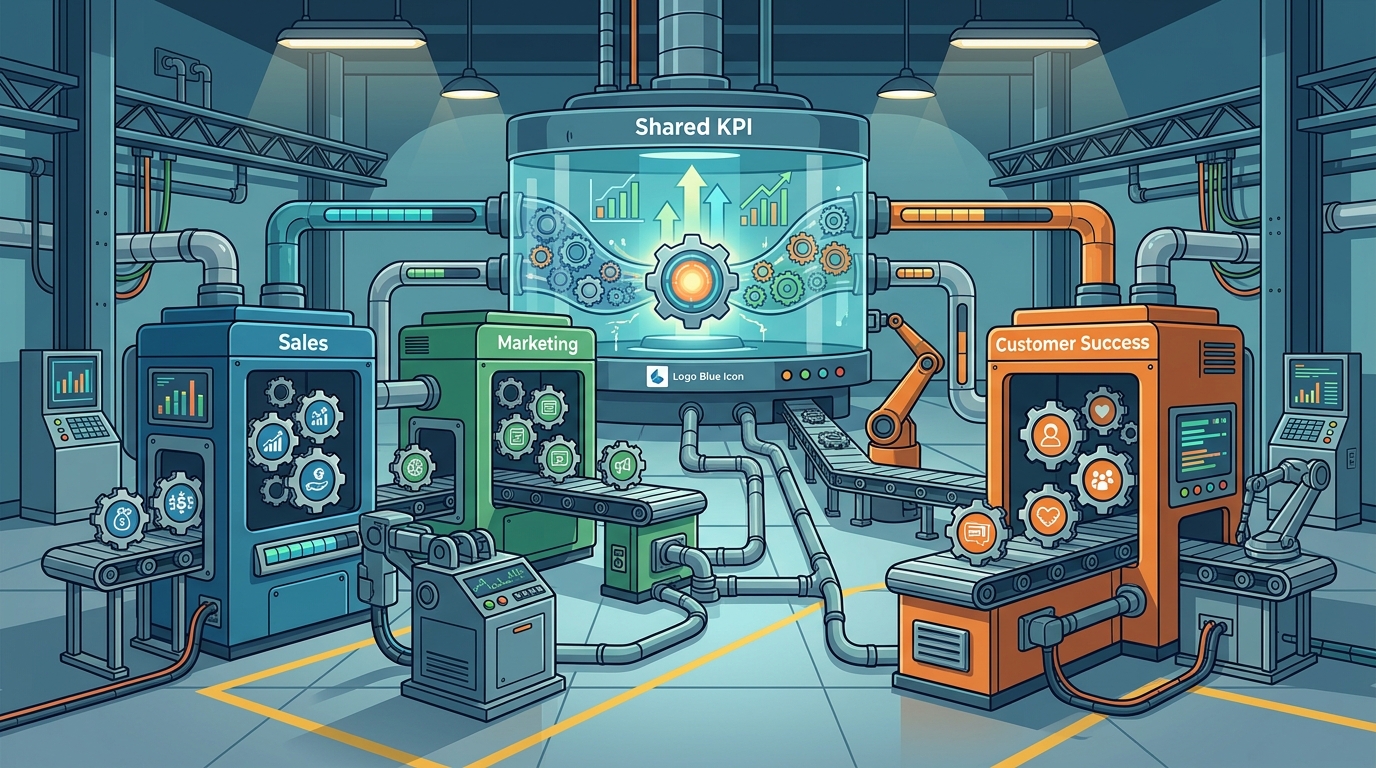
Identify Conflicting Incentives
A common problem: marketing teams often have goals disconnected from sales goals, prioritizing cost per click and lead volume over revenue impact. When marketing is rewarded for lead quantity alone, it delivers poorer-quality prospects to the sales team.
Map Metrics to the Customer Lifecycle
Plot each metric against the stages of your buyer journey: awareness, consideration, decision, onboarding, retention, and expansion. Any stage without a metric is a blind spot. Any stage with conflicting metrics from different teams is a friction point.
Use a RevOps Readiness Assessment
A structured self-assessment helps you evaluate your organization's current maturity. Set2Close offers a free RevOps Readiness Assessment that scores alignment across 15 dimensions to pinpoint where your gaps live.
Step 2: Choose the Right Shared KPIs
Not every metric deserves shared ownership. Focus on KPIs that span the full funnel and require cross-team effort to move. The table below compares common siloed metrics with their shared alternatives.
| Siloed Metric | Team | Shared KPI Alternative | Teams Accountable |
|---|---|---|---|
| MQL Volume | Marketing | MQL-to-SQL Conversion Rate | Marketing + Sales |
| Quota Attainment | Sales | Pipeline Velocity ($ per day) | Sales + Marketing |
| CSAT Score | Customer Success | Net Revenue Retention (NRR) | CS + Sales + Marketing |
| Cost Per Lead | Marketing | Customer Acquisition Cost (CAC) | Marketing + Sales |
| Churn Rate | Customer Success | Customer Lifetime Value (CLV) | All Three Teams |
Customer Lifetime Value (CLV) is the total revenue a business expects from a single customer account over the duration of the relationship. Pipeline velocity is the speed at which qualified opportunities move through your sales funnel measured in dollars per day. Both require input from every revenue team to improve.
Step 3: Build a Cross-Functional SLA
A Service Level Agreement (SLA) is a documented commitment between teams that defines responsibilities, handoff criteria, and response times. Without one, shared KPIs become shared blame.
Define Lead Stages Together
Companies with clearly defined lead definitions achieve a 30% higher lead-to-opportunity conversion rate. Sit sales, marketing, and customer success in one room and agree on what constitutes an MQL, SQL, and opportunity. Document it in your CRM.
Set Response-Time Commitments
Your SLA should specify how quickly sales follows up on an MQL (e.g., within 4 business hours) and how quickly marketing provides feedback on lead quality. Setting joint success metrics that align with overall business objectives fosters collaboration and accountability across departments.
Step 4: Unify Your Tech Stack and Dashboards
Shared KPIs require shared data. If marketing lives in one platform, sales in another, and customer success in a third, alignment is nearly impossible. According to RevOps Squared, 76% of the most successful B2B companies use standardized data models across all customer-facing systems.
A unified CRM like HubSpot serves as the single source of truth. An optimized RevOps tech stack integrates CRM, marketing automation, sales engagement, and customer success tools into one data layer. Set2Close specializes in HubSpot Sales Hub implementation and Marketing Hub implementation to ensure every team works from the same dashboards.
Organizations report 73% improved alignment when using joint dashboards, making shared visibility one of the highest-leverage investments you can make.
Step 5: Establish a Review Cadence
Shared KPIs only work if teams review them together, regularly. Here is a simple cadence framework:
- Weekly: 15-minute stand-up between sales and marketing leads to review MQL acceptance rates and pipeline movement.
- Biweekly: Cross-functional meeting including customer success to review NRR, churn signals, and expansion opportunities.
- Monthly: Executive review of CAC, CLV, and pipeline velocity with all department heads.
- Quarterly: Full alignment session to recalibrate KPI targets, update ICPs, and refresh the SLA.
RevOps is not a set-it-and-forget-it initiative. As markets change and technology evolves, your strategy needs to be flexible and adaptable. Continuous iteration is what separates high-growth B2B companies from the rest.
Key Takeaways
- Only 34% of mid-market B2B companies have formal sales and marketing alignment, yet aligned teams see 32% higher annual revenue.
- Shared KPIs like MQL-to-SQL conversion rate, pipeline velocity, NRR, CAC, and CLV require cross-team ownership to improve.
- A documented SLA between sales, marketing, and customer success eliminates ambiguity and shared blame.
- Unified dashboards in a single CRM (like HubSpot) are the infrastructure layer that makes shared KPIs visible and actionable.
- Regular cross-functional review cadences (weekly through quarterly) keep alignment from degrading over time.
- RevOps provides the strategic framework that turns shared KPIs from an idea into an operating system for revenue growth.
- Starting with a RevOps readiness assessment helps you pinpoint exactly where misalignment lives before you try to fix it.
Frequently Asked Questions
What is the best first shared KPI for a B2B company to adopt?
MQL-to-SQL conversion rate is an excellent starting point because it sits at the handoff between marketing and sales. It forces both teams to agree on lead definitions and quality standards, creating immediate collaboration.
How does RevOps differ from just having regular meetings between departments?
RevOps is a strategic function that unifies processes, data, and technology across sales, marketing, and customer success. Regular meetings are one tactic within RevOps, but without shared systems, data standards, and accountable KPIs, meetings alone will not drive alignment.
What tools do I need to track shared KPIs?
At minimum, you need a unified CRM with reporting dashboards accessible to all teams. HubSpot is a popular choice because it offers Sales Hub, Marketing Hub, and Service Hub on one platform. Set2Close offers fast-track HubSpot onboarding to get your team operational in 30 days.
How many shared KPIs should we track?
Start with three to five shared KPIs. Tracking too many dilutes focus. Choose metrics that span the full customer lifecycle: one for lead quality, one for pipeline health, one for revenue efficiency, and one for retention.
How long does it take to see results from KPI alignment?
Most organizations see measurable improvement within one to two quarters. Set2Close has helped clients cut average sales cycles from over 100 days down to approximately 30 days through process optimization and CRM alignment.
What role does executive leadership play in KPI alignment?
Executive buy-in is crucial for resource allocation and strategic direction. Leaders must model cross-functional accountability and participate in quarterly alignment reviews to signal that shared KPIs are a company priority, not a departmental suggestion.
Can small B2B teams benefit from shared KPIs?
Absolutely. Companies with 50 to 200 employees often benefit most because they can move faster than enterprises. A lean RevOps framework with shared dashboards and a simple SLA can deliver outsized results without heavy overhead.
Ready to Align Your Revenue Teams?
If your sales, marketing, and customer success teams are still chasing different numbers, it is time to fix the foundation. Set2Close is a HubSpot Elite Partner that helps B2B companies build RevOps frameworks, implement unified CRM systems, and align teams around the KPIs that actually drive revenue. Schedule a free consultation with Set2Close to start building your shared KPI framework today.