

If your sales, marketing, and customer success teams are pulling in different directions, hiring a revenue operations agency can be the turning point. For B2B companies with 50 to 200 employees, the challenge is rarely a lack of effort. It is misaligned processes, fragmented data, and a tech stack no one fully owns. A qualified RevOps agency steps in to unify those functions, build a single source of truth, and create repeatable systems that scale revenue. This guide breaks down exactly what services you should expect and how to evaluate whether an agency is delivering real value.
What Is Revenue Operations?
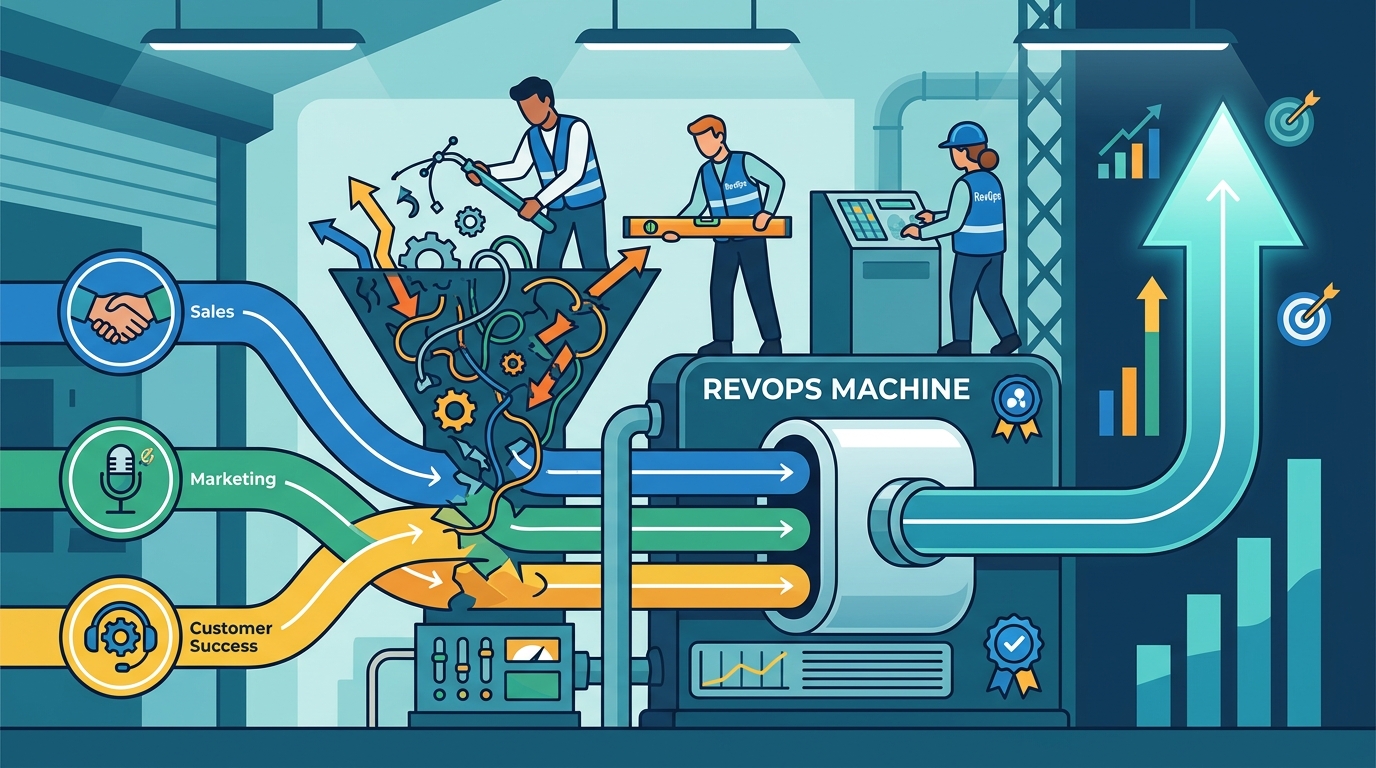
Revenue Operations (RevOps) is a strategic function designed to align and integrate sales, marketing, and customer success teams to drive revenue growth efficiently. Rather than letting each department operate in isolation, RevOps creates shared KPIs, unified data, and coordinated processes across the entire customer lifecycle.
According to Forrester research, companies that align people, processes, and technology across their revenue teams achieve 36% more revenue and up to 28% more profitability. That is why Gartner predicts 75% of the highest-growth companies will adopt a RevOps model.
Why 50 to 200 Employee Companies Need RevOps Most
At this stage, most B2B companies have outgrown spreadsheet-based processes but have not yet built the internal operations team to manage complex go-to-market motions. Departmental silos form quickly as headcount grows, and the tech stack starts accumulating tools that do not communicate with each other.
The Complexity Tipping Point
A company at 50 employees may still rely on tribal knowledge for deal handoffs. By 100 or 150 employees, that approach creates pipeline leakage, forecast inaccuracy, and customer churn. A RevOps readiness assessment can help determine whether your organization has reached this tipping point.
The Fractional Advantage
Fractional RevOps is an engagement model where an agency provides expert, on-demand support without the cost of full-time hires. For mid-market companies, this means accessing senior-level strategy and execution at a fraction of the cost of building an internal team. Set2Close delivers fractional RevOps services that cover CRM configuration, process automation, and sales team coaching.
Core Services a RevOps Agency Should Deliver
Not every agency calling itself a RevOps partner actually delivers end-to-end value. Here is a comparison of what a comprehensive agency should provide versus a basic CRM consultancy:
| Capability | Basic CRM Consultancy | Full RevOps Agency |
|---|---|---|
| CRM setup and configuration | Yes | Yes |
| Process automation | Limited | Cross-functional workflows |
| Custom reporting and dashboards | Template-based | Revenue-aligned, real-time |
| Sales, marketing, and CS alignment | No | Shared KPIs, SLAs, handoff design |
| Tech stack audit and optimization | Single platform | Full stack integration |
| Revenue strategy and forecasting | No | Data-driven pipeline modeling |
| Ongoing coaching and enablement | Rarely | Continuous training and playbooks |
A qualified agency should cover CRM configuration, process automation, custom reporting, sales team training, and sophisticated marketing strategies. At Set2Close, these services are bundled under a data-driven methodology designed to enhance growth and operational efficiency.
CRM Implementation and Optimization
Your CRM is the operational backbone of revenue operations. A poorly configured CRM disrupts workflows, hinders customer connections, and costs valuable deals. The right agency does not just set up software. It engineers the platform around your revenue goals.
Onboarding vs. Implementation
Onboarding is the process of getting started with a platform's standard features and basic training. Implementation goes deeper: custom pipelines, lead routing rules, data migration, and integration with your existing stack. Set2Close's HubSpot Sales Hub implementation includes a Discovery and Design phase where key stakeholders define objectives before any configuration begins.
Data Migration and Integrity
Before migrating data to a new CRM, a thorough audit of your existing data model is essential. Dirty CRM data silently destroys forecasting accuracy. Your agency should assess data integrity, evaluate field utilization, and clean records before any migration takes place.
Driving Adoption
Even the best CRM fails without team buy-in. A RevOps agency should deliver documentation for your team to reference and for onboarding new employees, ensuring 100% adoption and real-time reporting.
Sales, Marketing, and Customer Success Alignment
Alignment is the defining goal of RevOps. It means sales, marketing, and customer success teams operate against the same revenue targets, use the same data, and follow coordinated handoff processes.
A RevOps agency should design service-level agreements (SLAs) between marketing and sales, build lead scoring models, and create shared dashboards that give every team visibility into the full funnel. This is what transforms a collection of departments into a unified revenue engine.
Team alignment is especially critical for manufacturers, SaaS companies, and professional services firms where customer lifetime value depends on seamless post-sale handoffs to customer success.
Data Infrastructure and Reporting
Data integration is the practice of creating a single source of truth for all customer data. This integration allows for more accurate forecasting, reporting, and decision-making across departments.
Your agency should build reporting infrastructure that answers three questions: Where is pipeline leaking? Which channels drive the highest-quality leads? And what is the true cost of customer acquisition? An optimized RevOps tech stack integrates CRM, marketing automation, sales engagement, data analytics, and revenue intelligence tools into a coherent system.
Measuring Agency Impact
Expect first reporting clarity within 30 to 45 days and early pipeline performance improvements within 60 to 120 days, according to industry benchmarks. Companies commonly see a 10 to 20% increase in qualified pipeline once lead routing and scoring are fixed.
Track these core KPIs to judge your RevOps agency's impact:
- Pipeline creation velocity
- Sales cycle length
- Lead-to-close conversion rate
- Forecast accuracy
- Customer acquisition cost (CAC)
- Net revenue retention
- CRM adoption rate
Key Takeaways
- A revenue operations agency should align sales, marketing, and customer success around shared KPIs and unified data.
- Companies with 50 to 200 employees are at the ideal stage to adopt RevOps before silos become entrenched.
- Fractional RevOps provides senior-level expertise without the cost of a full-time internal team.
- CRM implementation must go beyond basic setup to include data migration, custom pipelines, and adoption coaching.
- Expect measurable pipeline improvements within 60 to 120 days of engagement.
- Data infrastructure and a single source of truth are the foundation of every effective RevOps strategy.
- Evaluate agencies on their ability to deliver cross-functional alignment, not just technical CRM configuration.
Frequently Asked Questions
What is a revenue operations agency?
A revenue operations agency is a strategic and operational partner that helps companies unify their sales, marketing, and customer success functions to drive predictable revenue growth. It combines technology, process design, and team coaching.
When should a B2B company hire a RevOps agency?
Most B2B companies benefit from RevOps support once they reach 50 or more employees. At that size, departmental silos, inconsistent data, and manual processes start limiting growth.
What is the difference between RevOps and sales operations?
Sales operations focuses exclusively on supporting the sales team. RevOps takes a broader view, aligning sales, marketing, and customer success under one operational framework with shared goals and data.
How long does it take to see results from a RevOps agency?
Expect initial reporting clarity within 30 to 45 days. Early pipeline improvements typically appear within 60 to 120 days, depending on the complexity of your existing systems.
What should a RevOps agency do with my CRM?
A qualified agency should audit your current data, migrate and clean records, configure custom pipelines, build automation workflows, create dashboards, and train your team to drive full adoption.
How much does a RevOps agency cost?
Costs vary by scope. Fractional RevOps engagements for mid-market companies typically range from project-based fixed fees to monthly retainers. The right model depends on whether you need a one-time buildout or continuous optimization.
Can a RevOps agency help with HubSpot specifically?
Yes. Many RevOps agencies specialize in HubSpot as the core CRM platform. Set2Close, for example, is a recognized HubSpot partner offering onboarding, implementation, and ongoing optimization across Sales, Marketing, and Service Hubs.
What industries benefit most from RevOps?
RevOps delivers strong results for SaaS, manufacturing, technology, professional services, and private equity portfolio companies. Any B2B organization with complex sales cycles and multiple revenue-facing teams can benefit.
Ready to Build Your Revenue Operations Foundation?
If your B2B company is between 50 and 200 employees and your teams are not operating from a single source of truth, it is time to explore what a RevOps agency can do for you. Schedule a free consultation with Set2Close to assess your current operations and get a step-by-step plan for aligning your revenue teams.