

What a Revenue Operations Agency Should Do for a 50–200 Employee B2B Company
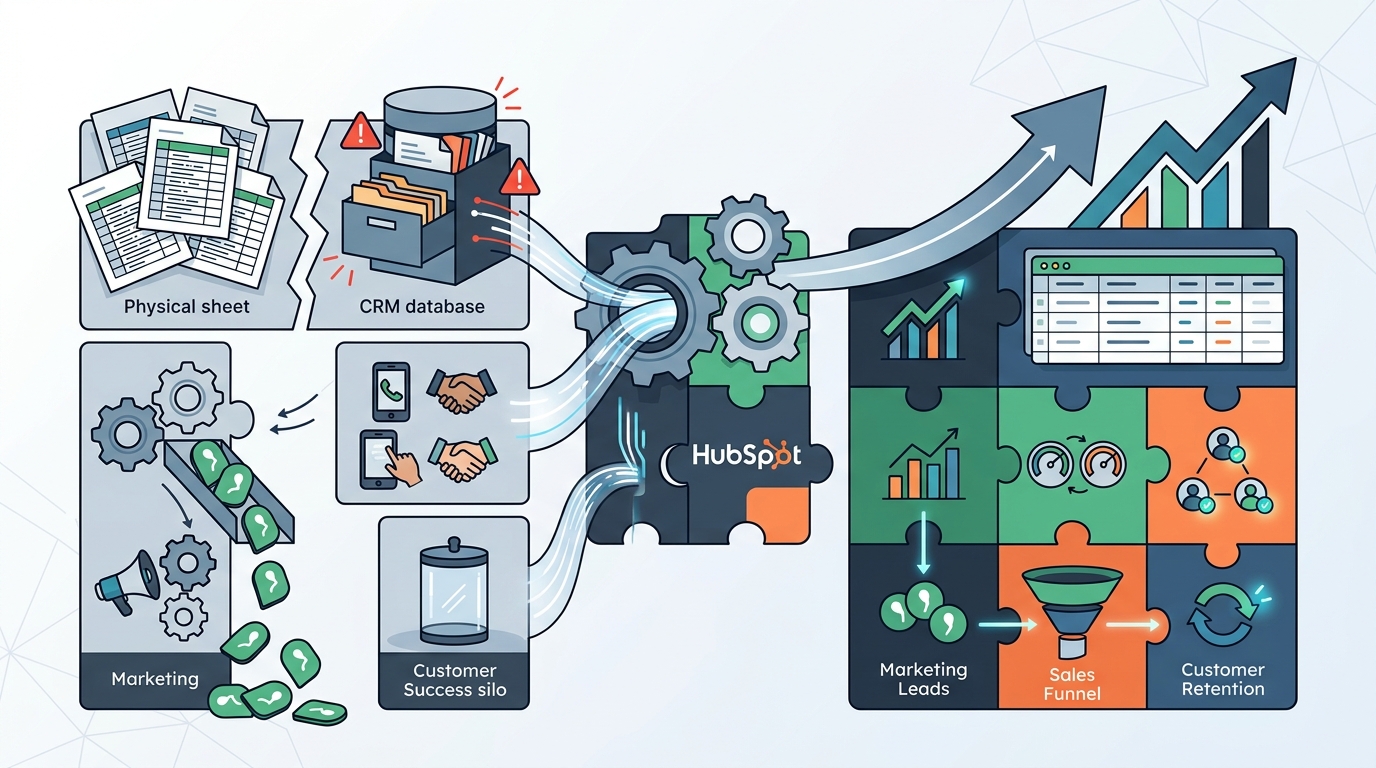
If your B2B company has grown past 50 employees, you have likely outgrown the ad-hoc systems that powered your early revenue. Spreadsheets conflict with your CRM. Marketing generates leads that sales cannot convert. Customer success operates in its own silo. A revenue operations agency exists to solve exactly this problem. RevOps is a strategic function designed to align and integrate sales, marketing, and customer success teams to drive revenue growth efficiently. For companies in the 50–200 employee range, the right agency partner can mean the difference between stalled growth and predictable, scalable revenue. Here is what that partnership should look like.
Why RevOps Matters at the 50–200 Employee Stage
Revenue Operations, often abbreviated as RevOps, is an integrated business function that aligns sales, marketing, and customer service departments to drive growth. At this company size, the stakes are clear. According to Forrester Research, companies with well-implemented RevOps strategies record an average of 19% faster revenue growth compared to companies working in traditional silos.
At 50 employees, a dedicated RevOps lead typically reports to the CFO or COO, cleaning the CRM and building the forecast model. By 200 employees, RevOps becomes a centralized function with a team of 3–5. A revenue operations agency fills the gap between these stages, providing fractional RevOps expertise without requiring full-time hires for every specialty role.
Research from Boston Consulting Group shows that B2B companies implementing RevOps report 10–20% increases in sales productivity and 100–200% increases in digital marketing ROI. For a mid-market company, those gains translate directly into millions of dollars in additional revenue.
Start With an Operations Audit, Not a Tool Purchase
The best RevOps agencies do not start with tools. They start with operations. A thorough agency engagement begins by evaluating current operations, identifying pain points, and defining objectives across sales, marketing, and customer success.
Diagnosing Operational Debt
Operational debt is the compounding cost of inconsistent processes, unclear roles, and undocumented expectations. Common signs include stalled deals, conflicting reports, and teams redefining processes on their own. A quality agency will diagnose revenue problems at the operations level before touching any technology.
Defining Ownership and SOPs
Before automation is added, roles, handoffs, definitions, and cadence must be set. This means documenting standard operating procedures that reduce tribal knowledge and improve execution consistency across departments.
CRM Implementation and Optimization
A CRM system is the backbone of any RevOps tech stack. It centralizes customer data, tracks interactions, and provides insights that drive strategic decision-making. The right agency should handle everything from migration to customization.
Onboarding vs. Implementation
Onboarding is about getting started with standard, out-of-the-box features. Implementation is where the real value lives. It involves tailoring HubSpot to your business with custom properties, objects, sales automations, and workflows. The difference matters: proper HubSpot Sales Hub implementation means hitting the ground running instead of spending months configuring an unfamiliar system.
Data Migration and Integrity
Before migrating data to a new platform, the agency should audit your existing data model, assess data integrity, and evaluate how fields are utilized. A custom CRM development approach ensures your system is optimized from day one, not patched together over years.
Sales, Marketing, and Customer Success Alignment
Alignment is the core promise of RevOps. According to Deloitte Digital's 2024 B2B sales research, organizations with established RevOps functions were 1.4 times more likely to exceed revenue goals by 10% or more compared to those without RevOps.
A revenue operations agency should create common goals and reward structures to foster collaboration. This includes establishing shared KPIs, unified lead definitions, and agreed-upon handoff processes between teams. When marketing, sales, and customer success share a single set of go-to-market definitions, the entire revenue cycle becomes measurable and improvable.
| Area | Before RevOps | After RevOps |
|---|---|---|
| Lead Definitions | Each team uses its own criteria | Unified MQL/SQL definitions across departments |
| Forecasting | Spreadsheet-based guesses | CRM-driven forecasts with historical conversion data |
| Tech Stack | Disconnected tools per department | Integrated platform with single source of truth |
| Reporting | Manual, monthly, conflicting | Automated dashboards updated in real time |
| Customer Handoffs | Ad hoc, undocumented | Documented SOPs with clear ownership |
| Revenue Growth | Unpredictable | 10–20% faster with aligned operations |
Tech Stack Unification and Data Integration
A RevOps tech stack is the collection of integrated tools that support all stages of the customer lifecycle, from lead generation to retention. An optimized stack ensures that technology empowers rather than hinders the flow of data and processes.
For 50–200 employee companies, the tech stack typically has five layers: CRM as the system of record, marketing automation for lead flow and attribution, billing and finance for revenue recognition, analytics and forecasting for the operating view, and sales enablement for rep productivity. An agency like Set2Close can help you build an optimized RevOps tech stack that fits your specific growth stage.
The budget ceiling for your tech stack should fall between 5–8% of ARR. Overspending on enterprise tools before you need them is one of the most common RevOps mistakes.
Reporting, Forecasting, and Accountability
Seven metrics prove RevOps is working: pipeline coverage, forecast accuracy, win rate, cycle length, CAC payback, net revenue retention (NRR), and gross revenue retention (GRR). All seven should come from one source of truth.
A revenue operations agency should build custom reports and dashboards that connect marketing activities to revenue and show progress through contact and deal stages. The agency should also establish a weekly revenue review cadence and quarterly planning sessions structured around the same data. This rhythm prevents the system from drifting back to instinct-based decision-making.
Companies that have worked with agencies focused on these fundamentals have seen measurable results. For example, one company tripled monthly acquisition revenue and increased lead-to-conversion ratio by 50% after implementing a structured RevOps playbook.
Key Takeaways
- A RevOps agency should start with an operations audit, not a software purchase, to diagnose the real barriers to revenue growth.
- CRM implementation must go beyond onboarding to include custom configuration, data migration, and team training.
- Sales, marketing, and customer success must share unified definitions, KPIs, and handoff processes.
- The tech stack should be unified under a single source of truth with a budget of 5–8% of ARR.
- Reporting should center on seven core metrics reviewed weekly from a single dashboard.
- Companies implementing RevOps see 10–20% faster sales productivity and up to 200% higher marketing ROI.
- Fractional RevOps services let 50–200 employee companies access expert support without full-time hiring costs.
Frequently Asked Questions
What is a revenue operations agency?
A revenue operations agency is a firm that helps B2B companies align sales, marketing, and customer success operations under a unified strategy. It combines process design, technology implementation, and team coaching to build a predictable revenue engine.
When should a B2B company hire a RevOps agency?
Most B2B companies benefit from RevOps support once they reach 50 employees or exceed $5 million in annual revenue. At this stage, siloed teams and disconnected data begin limiting growth.
What is the difference between RevOps and sales operations?
Sales operations primarily focuses on optimizing sales processes, while revenue operations pursues a holistic approach that integrates marketing, sales, and customer service toward shared revenue goals.
How long does a RevOps engagement take to show results?
Initial improvements in reporting and process clarity typically appear within 30–60 days. Measurable revenue impact, such as improved conversion rates and shorter sales cycles, usually materializes within 3–6 months.
What CRM platform works best for RevOps?
HubSpot is one of the most accessible RevOps platforms on the market, combining CRM, marketing hub, sales hub, and service hub in a single interface. It is especially well-suited for 50–200 employee companies that need unified reporting without complex integrations.
Can a RevOps agency replace a full-time hire?
Yes. Fractional RevOps services provide expert, on-demand support to optimize sales, marketing, and revenue processes. Many companies use this model to access specialized expertise without incurring full-time costs while they scale.
What ROI can I expect from RevOps?
A typical mid-sized B2B company can see ROI exceeding 200% within 18 months. Results include more qualified leads, shorter sales cycles, and improved forecast accuracy.
Ready to Build Your Revenue Engine?
If your 50–200 employee B2B company is struggling with siloed teams, messy CRM data, or unpredictable revenue, it is time to talk to a RevOps agency that starts with operations, not just tools. Set2Close specializes in helping B2B companies build predictable revenue systems through HubSpot optimization, process alignment, and fractional RevOps support. Schedule a free consultation to get a clear-eyed assessment of your revenue operations today.