

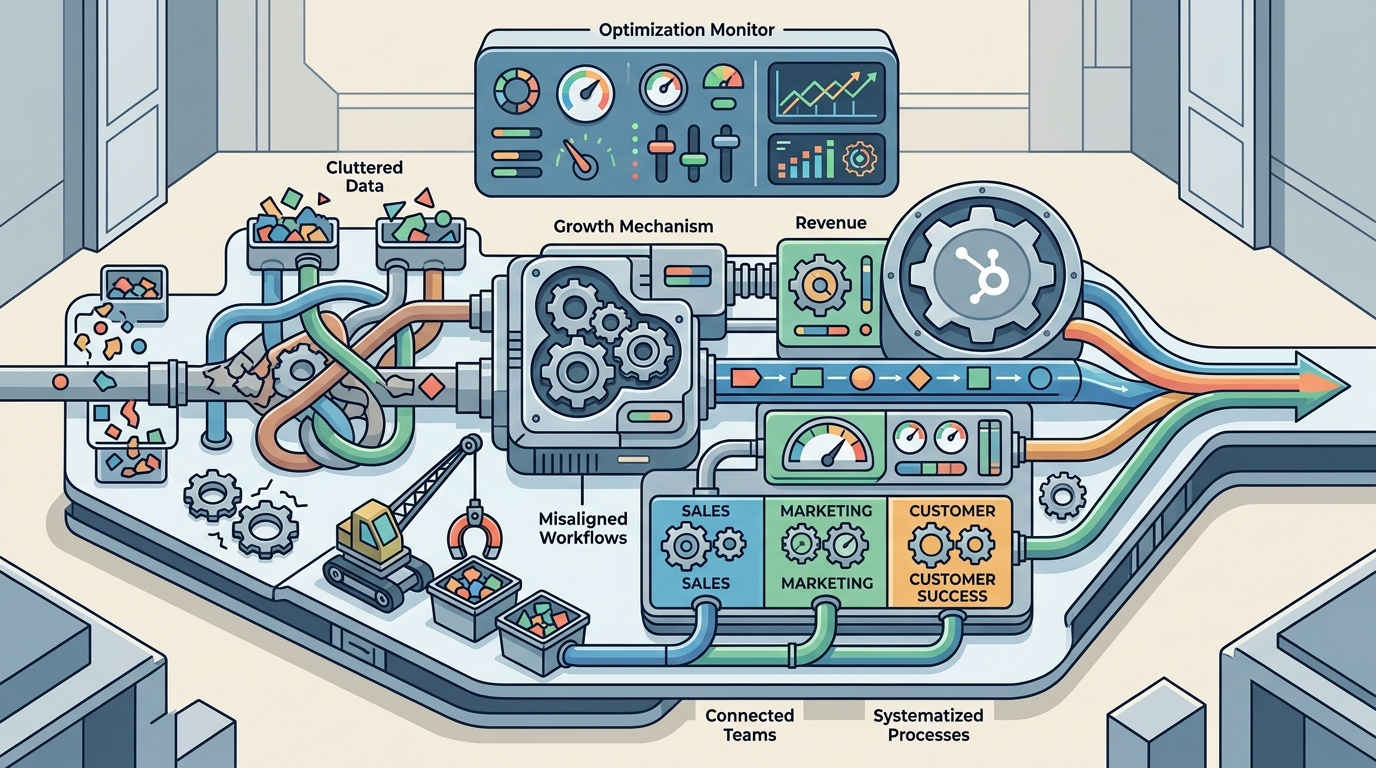
HubSpot is one of the most powerful CRM platforms available for B2B companies, but simply having it is not the same as using it well. As your business scales from startup mode into a structured growth phase, misaligned workflows, cluttered data, and disconnected teams can quietly erode revenue. HubSpot optimization is the process of auditing, restructuring, and enhancing your CRM configuration so every hub, workflow, and report directly supports your business goals. This guide walks you through the best strategies for optimizing HubSpot at each stage of B2B growth, backed by current data and real-world outcomes.
Why HubSpot Optimization Matters for B2B Growth
HubSpot optimization is the ongoing practice of refining CRM configuration, automation, and reporting to match evolving business needs. Many B2B companies purchase HubSpot but only scratch the surface of its capabilities. According to recent HubSpot statistics, 84% of customers report increased revenue with HubSpot, yet that outcome depends entirely on how well the platform is set up.
For companies with 50 to 200 employees, the gap between a basic HubSpot setup and a fully optimized one often means the difference between predictable pipeline growth and operational chaos. A certified HubSpot partner like Set2Close focuses on enhancing CRM functionality, improving automation, and ensuring alignment with business goals.
Align Sales, Marketing, and Customer Success
Team alignment is the single biggest lever for revenue growth inside HubSpot. Revenue Operations (RevOps) is a strategic framework that unifies sales, marketing, and customer success around shared KPIs and a single source of truth.
Set Unified Goals and KPIs
Start by establishing common revenue targets and joint key performance indicators. Regular cross-functional meetings keep everyone focused. When marketing and sales share the same dashboards, handoff friction drops significantly. Learn more about what RevOps looks like in practice.
Use Lifecycle Stages Effectively
HubSpot lifecycle stages let you track exactly where a contact sits in the buyer journey. Properly configured lifecycle automation ensures timely communication and smoother transitions from Marketing Qualified Lead (MQL) to Sales Qualified Lead (SQL). For a deeper dive, explore HubSpot lifecycle automation for B2B.
Leverage Automation and Workflows
Workflow automation is a HubSpot feature that streamlines repetitive tasks such as lead nurturing, follow-ups, and internal notifications. According to a 2026 report, over 64% of HubSpot automation users exceeded their revenue targets.
Email Sequences and Nurturing
Automated email campaigns segment your audience and follow up based on specific triggers. Personalized emails outperform generic ones by a wide margin, and segmented campaigns show significantly higher click rates. Build sequences that match each stage of the B2B sales cycle for maximum impact.
Internal Process Automation
Beyond marketing, automate deal stage updates, task creation for sales reps, and SLA-based escalation alerts. These operational workflows free your team to focus on selling rather than administrative tasks.
Optimize Lead Scoring and Routing
Lead scoring is a system that assigns numerical values to leads based on behavior and engagement level. It helps sales teams prioritize high-intent prospects and ignore noise. Without it, reps waste time on contacts who are not ready to buy.
Build a Scalable Routing System
As teams grow, basic round-robin routing breaks down. Leads sit unassigned, reps argue over ownership, and reporting becomes unreliable. Implementing team-based routing with SLA enforcement and data stamping solves these problems. For a step-by-step walkthrough, see HubSpot team-based lead routing.
| Routing Model | Best For | Complexity |
|---|---|---|
| Simple Round-Robin | Small teams (2-4 reps), single product | Low |
| Segment-Based | Most B2B teams (by size or industry) | Medium |
| Geo-Based | Field sales or regional teams | Medium |
| Weighted/Capacity-Aware | Large, scaling sales organizations | High |
Prioritize Data Hygiene and Reporting
Dirty data silently destroys pipeline accuracy. Duplicate contacts, missing fields, and outdated properties make every report unreliable. Build automated data cleansing workflows inside HubSpot to merge duplicates, standardize formats, and flag incomplete records.
Custom Reporting That Drives Decisions
Default dashboards are a starting point, not a destination. Create custom reports that track metrics like Customer Acquisition Cost (CAC), Lifetime Value (LTV), and sales velocity. When leadership trusts the data, they make faster, better decisions. Explore how to optimize revenue reporting in HubSpot.
Connect Your Tech Stack with Key Integrations
HubSpot becomes exponentially more valuable when connected to the rest of your tech stack. Common B2B integrations include billing platforms like Maxio, calling tools, product usage trackers, and enrichment services. A connected system eliminates data silos and gives every team a complete customer view.
Set2Close helps companies identify and implement essential HubSpot integrations that create a unified RevOps foundation.
Adopt a RevOps-First Approach
Revenue Operations is the strategic alignment of systems, processes, and people across every revenue-generating function. Instead of treating HubSpot as a marketing tool or a sales CRM, a RevOps approach treats it as the central nervous system of your entire go-to-market operation.
Companies that take this approach see measurable results. One Set2Close client grew ARR 40% to $6 million in the first eight months of working together, and another saw a 1,497% increase in sales velocity after a full RevOps overhaul. These outcomes come from treating HubSpot optimization as a continuous, cross-functional discipline rather than a one-time project.
Key Takeaways
- HubSpot optimization is an ongoing process, not a one-time setup task.
- Aligning sales, marketing, and customer success around shared KPIs is the most impactful change you can make.
- Workflow automation reduces manual tasks and directly improves conversion rates and response times.
- Scalable lead routing with SLA enforcement prevents lead leaks as your team grows.
- Clean data is the foundation of every trustworthy report and forecast.
- Integrating your full tech stack into HubSpot eliminates silos and creates a single source of truth.
- A RevOps-first approach transforms HubSpot from a basic CRM into a predictable revenue engine.
Frequently Asked Questions
What does HubSpot optimization mean for a B2B company?
HubSpot optimization means auditing and improving your CRM setup, including workflows, properties, automation, lead scoring, and reporting, so the platform fully supports your sales, marketing, and customer success goals.
How often should we optimize our HubSpot instance?
At minimum, perform a quarterly review of workflows, data quality, and reporting. Major optimization projects (like pipeline restructuring or lead routing overhauls) should happen whenever your team structure or go-to-market strategy changes significantly.
What is RevOps, and why does it matter for HubSpot?
RevOps, short for Revenue Operations, is a strategic framework that aligns sales, marketing, and customer success teams around shared data, processes, and KPIs. It matters for HubSpot because the platform is designed to serve all three functions, but only delivers full value when those functions are coordinated.
Can a small B2B team benefit from HubSpot optimization?
Absolutely. Even companies with fewer than 50 employees benefit from clean data, automated follow-ups, and proper lifecycle stage configuration. Starting with strong foundations makes scaling much smoother later.
What is lead scoring, and how does it work in HubSpot?
Lead scoring is a method of assigning point values to contacts based on actions like page visits, email clicks, and form submissions. HubSpot uses these scores to help sales reps prioritize the most engaged and qualified leads.
How do I know if my HubSpot setup needs professional help?
Common warning signs include unreliable reporting, leads falling through the cracks, low CRM adoption among reps, and teams using separate spreadsheets instead of HubSpot. If any of these sound familiar, a professional audit can identify the gaps.
What results can I expect from optimizing HubSpot?
Results vary, but HubSpot reports that 89% of customers see increased productivity, and nearly 95% achieve positive ROI. With a RevOps-driven optimization, B2B companies commonly see improved pipeline visibility, shorter sales cycles, and higher close rates.
Why should I work with a HubSpot Partner instead of doing it in-house?
A certified partner brings deep platform expertise and cross-industry experience that accelerates time-to-value. Set2Close, for example, takes a RevOps-first approach that covers CRM configuration, process automation, custom reporting, and team training all at once.
Get Expert Help Optimizing HubSpot
If your HubSpot instance is not delivering the pipeline visibility and revenue predictability your B2B business needs, it is time for a professional assessment. Set2Close is a certified HubSpot Elite Partner and RevOps agency that helps B2B companies align their teams, automate their processes, and scale with confidence. Schedule a free RevOps consultation today to find out what is holding your CRM back.