

What a Revenue Operations Agency Should Do for a 50–200 Employee B2B Company
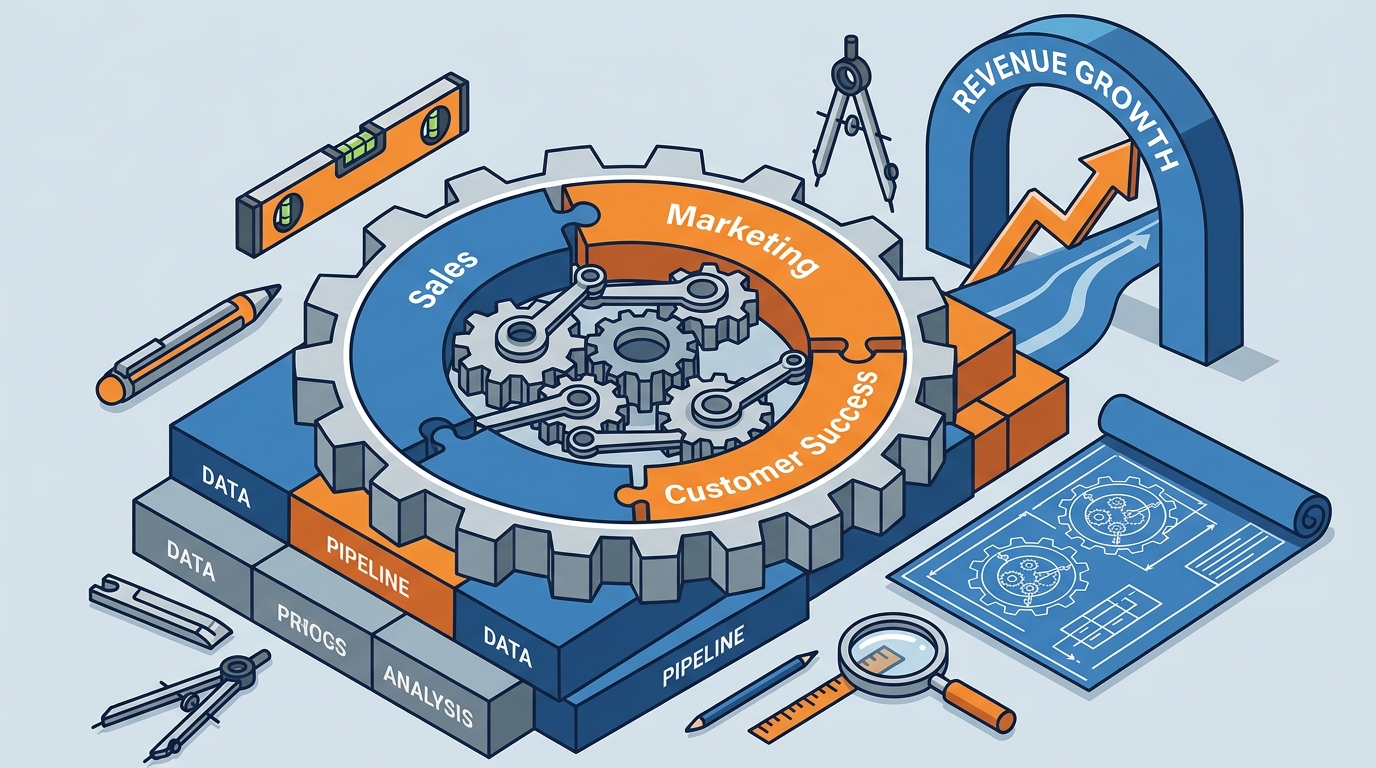
If your B2B company has between 50 and 200 employees, you have likely outgrown the spreadsheets and tribal knowledge that powered your early growth. Deals stall, forecasts miss, and your sales, marketing, and customer success teams operate from different playbooks. A revenue operations agency exists to solve exactly this problem. Revenue Operations (RevOps) is a strategic function designed to align and integrate sales, marketing, and customer success teams to drive revenue growth efficiently. This guide breaks down the specific services a qualified RevOps agency should deliver, why each matters at your stage, and how to evaluate whether a partner is the right fit.
Start with an Operational Audit, Not a Tool Demo
A credible RevOps agency will never lead with software. The first step is to assess your RevOps readiness by evaluating current operations, identifying pain points, and defining objectives. This diagnostic phase maps every handoff between marketing, sales, and customer success to find where leads leak and deals stall.
Operational debt is the accumulated cost of unclear processes, undocumented expectations, inconsistent ownership, and reactive decision-making. A proper audit surfaces this debt before any technology decisions are made. At companies in the 50–200 employee range, the audit often reveals that revenue problems live in operations, not in the CRM.
Align Sales, Marketing, and Customer Success Around Shared KPIs
Siloed departments are the single largest revenue killer at mid-market B2B companies. According to Deloitte Digital research, B2B organizations leveraging RevOps are 1.4 times more likely to surpass revenue targets by 10% or more compared to those with siloed teams.
Your agency should define shared metrics that every department owns. The primary focus should be on lead-to-opportunity conversion rate, sales cycle length, customer acquisition cost (CAC), and monthly recurring revenue (MRR) growth. These four metrics give you a clear picture of how well your revenue engine is performing.
What Alignment Looks Like in Practice
A RevOps agency should create common goals and reward structures to foster collaboration between sales, marketing, and customer success teams. This means standardized definitions for lifecycle stages, SLAs for lead follow-up, and a unified approach that ensures a cohesive customer journey.
Implement and Optimize Your CRM
A CRM system is the backbone of any RevOps tech stack. It centralizes customer data, tracks interactions, and provides insights that drive strategic decision-making. For B2B companies between 50 and 200 employees, HubSpot is the most accessible RevOps platform on the market because it combines CRM, marketing hub, sales hub, and customer service hub in a single interface.
However, implementation quality matters enormously. Research shows that 80% of marketing and sales professionals who had smooth implementations report that their technology is extremely effective at helping them achieve their goals. A RevOps agency should handle Sales Hub implementation, Marketing Hub implementation, and Service Hub implementation as interconnected workstreams rather than separate projects.
| CRM Approach | Time to Value | Adoption Risk | Best For |
|---|---|---|---|
| DIY onboarding | 6–12 months | High | Very small teams (<20) |
| Guided onboarding | 2–4 months | Medium | Teams with internal ops staff |
| Full agency implementation | 4–8 weeks | Low | 50–200 employee companies scaling fast |
Build an Integrated RevOps Tech Stack
An optimized RevOps tech stack is essential for driving revenue growth and operational efficiency. Your agency should audit existing tools, eliminate redundancies, and ensure that all platforms integrate seamlessly. The average B2B SaaS company uses 12 tools in its revenue operations stack, and about half of them overlap.
Core Stack Components
At minimum, a RevOps agency should integrate your CRM with marketing automation, sales engagement tools, data enrichment, and revenue intelligence platforms. Each tool must serve a clear purpose: reducing manual work or improving forecast accuracy.
AI and Automation
In 2026, the execution layer is where outperformance comes from. Look for an agency that can implement AI-driven analytics, automated email sequences, and custom AI sales agents that translate strategy into daily workflows rather than letting playbooks gather dust in a wiki.
Design Repeatable Processes and Playbooks
Process design is the often-overlooked differentiator between a good RevOps agency and a great one. Repeatable processes are the systems that allow you to scale without chaos. This means developing clear lead management protocols that define exactly when and how leads move between teams.
A qualified agency will deliver documented sales playbooks, lead scoring models, deal stage definitions, and handoff protocols. One Set2Close case study showed that developing a detailed sales playbook and integrating automated email sequencing tripled monthly acquisition revenue and increased the lead-to-conversion ratio by 50%.
Create a Single Source of Truth for Revenue Data
Data integration is the practice of creating a single source of truth for all customer data. This integration allows for more accurate forecasting, reporting, and decision-making across departments. Without it, every downstream process breaks down into data silos and conflicting reports.
Your agency should configure executive, management, and rep-level dashboards that provide insight, accountability, and performance visibility throughout your sales process. When a CRM becomes the source of truth rather than a place teams argue with, sales productivity can double alongside meaningful increases in lead conversion.
Provide Ongoing Coaching and Fractional Support
RevOps is not a one-time project. Fractional Revenue Operations is a service model that provides expert, on-demand support to optimize your sales, marketing, and revenue processes without the need for full-time hires. For companies with 50–200 employees, this approach provides access to specialized expertise without incurring full-time costs and enables faster implementation with proven frameworks.
According to Forrester research, companies with well-implemented RevOps strategies record an average of 19% faster revenue growth. A strong agency partner will provide continuous coaching, quarterly strategy reviews, and on-demand education to keep your teams sharp as you scale.
Key Takeaways
- Always start with an operational audit before implementing or changing any technology.
- Align sales, marketing, and customer success around four core KPIs: conversion rate, cycle length, CAC, and MRR growth.
- Your CRM implementation approach directly determines how effective the platform will be for your team.
- Eliminate tech stack redundancy; every tool should reduce manual work or improve forecast accuracy.
- Documented playbooks and defined handoff protocols are essential for scaling past 50 employees.
- A single source of truth for revenue data is non-negotiable for accurate forecasting.
- Fractional RevOps support gives mid-market companies enterprise-grade expertise without full-time overhead.
Frequently Asked Questions
What is a revenue operations agency?
A revenue operations agency is a consulting firm that aligns sales, marketing, and customer success teams through shared processes, integrated technology, and unified data to drive predictable revenue growth.
When should a B2B company hire a RevOps agency?
Most companies implement dedicated RevOps between 25 and 100 employees, or when they have more than five sales reps. If forecasting feels unreliable and teams operate from different data, it is time.
How is RevOps different from sales operations?
Sales operations focuses on optimizing sales processes alone, while RevOps takes a holistic approach that integrates marketing, sales, and customer service across the entire customer lifecycle.
What should a RevOps engagement cost?
Costs vary widely. A mid-sized B2B company with 50 employees might invest around $120,000 in implementing a RevOps approach across personnel, technology, and consulting, with ROI often exceeding 200% within 18 months.
Can a RevOps agency replace an in-house hire?
Yes. Many smaller companies successfully use fractional RevOps providers to get started. This offers flexibility to scale according to your needs and lower risk for companies new to RevOps.
What CRM platform works best for 50–200 employee B2B companies?
HubSpot is widely regarded as the most accessible RevOps platform because it combines CRM, marketing, sales, and service in one interface without complex integrations. Salesforce is better suited to enterprise teams with highly complex sales processes.
How long does a typical RevOps engagement take?
Most projects range from 3 to 6 months for initial implementation. Ongoing fractional support continues indefinitely as the company grows and processes evolve.
What results should I expect from a RevOps agency?
Benchmarks vary, but well-executed RevOps implementations commonly deliver 10–20% faster sales productivity and 15–20% revenue growth, according to McKinsey research.
Ready to Build a Predictable Revenue Engine?
If your B2B company has outgrown its current systems and you need expert guidance to align teams, optimize HubSpot, and build scalable processes, book a complimentary B2B sales strategy audit with Set2Close. As a HubSpot Elite Partner specializing in revenue operations for mid-market B2B companies, Set2Close delivers the strategy, implementation, and coaching your team needs to scale with confidence.