

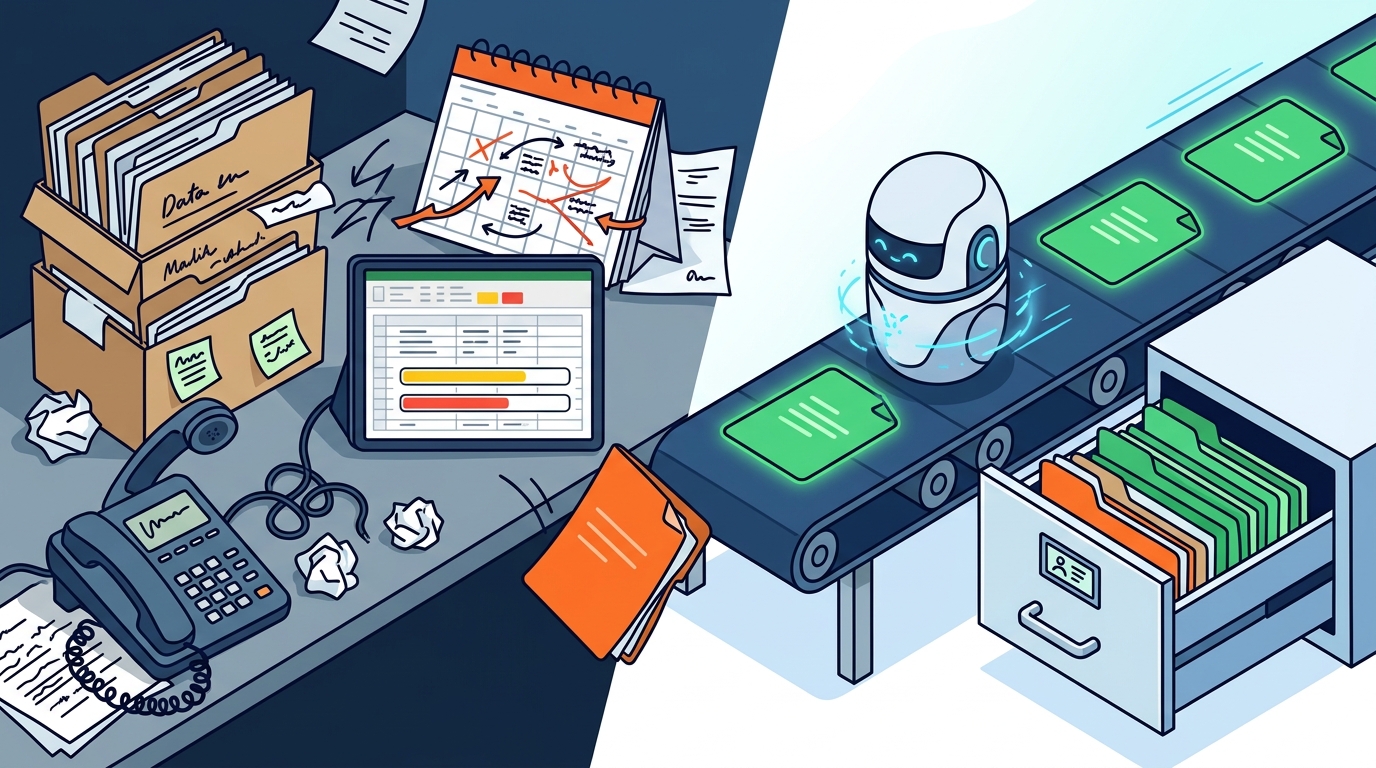
Your reps are spending the majority of their week on tasks that never touch a live deal. According to a Salesforce study, sales teams spend 70 percent of their time on non-selling activities — data entry, lead research, follow-up scheduling, and manual qualification. Meanwhile, high-intent buyers slip through the cracks because nobody followed up fast enough.
AI agents change this equation. They sit inside your existing CRM and sales stack, qualify leads around the clock, and hand reps conversations that are actually worth having. This tutorial walks you through the practical steps to integrate them — without ripping out the tools your team already relies on.
Reality Check: What AI Agents Actually Do in Sales Right Now
Forget the hype about full autonomy. The highest-performing sales agent setups in 2026 are not fully autonomous — they escalate exceptions, flag low-confidence decisions, and maintain clear handoff points to human reps. The deployments generating real ROI target high-frequency, rule-governed tasks that consume rep time without requiring deep relationship judgment.
The use cases delivering measurable results right now include:
- Lead qualification and scoring — filtering inbound leads by firmographic criteria, engagement signals, and intent data before handing off to humans.
- Follow-up sequence execution — triggering and personalizing outreach at defined intervals based on prospect behavior.
- CRM data hygiene — automatically enriching and updating contact records so reps work from a single source of truth.
- Meeting scheduling — booking demos on an AE's calendar the moment a lead crosses the qualification threshold.
One B2B SaaS company documented cutting lead response time from 47 hours to 9 minutes after deploying a qualification agent — a 99.6% reduction. Qualified lead volume increased by 215%, and admin time per sales call dropped from 75 minutes to 2 minutes.
Companies using AI agents in sales operations specifically report revenue increases of 3–15% and a 10–20% improvement in sales ROI. Organizations deploying agentic systems report an average ROI of 171%, with US-based companies averaging 192%.
Prerequisites — Get These Right Before You Deploy
A lead qualification agent is only as good as the data it draws from. If your CRM is inconsistent, outdated, or incomplete, your agent will make bad decisions confidently and at scale. Data quality is the unglamorous prerequisite most teams skip — and the one that kills the most pilots.
1. Clean and Standardize Your CRM Data
Before any AI touches your pipeline, audit your CRM for duplicate records, missing fields, and stale contacts. AI agents need accurate CRM information and well-defined ideal customer profiles to make smart decisions about which prospects deserve attention. Prioritize these fields:
- Company size, industry, and revenue (firmographic)
- Contact job title, seniority, and department (demographic)
- Engagement history — emails opened, pages visited, content downloaded (behavioral)
2. Define Your Ideal Customer Profile and Qualification Criteria
Clearly outline what qualifies as a good lead based on demographics, behavior, and firmographics. The more specific you are, the better your AI agent can identify, prioritize, and distribute high-quality leads. Document this as a machine-readable scoring rubric, not a vague internal wiki page.
3. Map Your Current Sales Workflow End to End
Before automating, you need a clear diagram of every step from first touch to closed-won. Identify the handoff points between marketing, SDR, and AE teams. The goal is to find exactly where agents add value without disrupting the human interactions that close deals.
4. Consolidate Historical Deal Data
Feed your AI system historical data including both successful conversions and lost opportunities. The algorithm needs examples of good and bad leads to learn effectively. Most systems require at least 500–1,000 historical leads for accurate predictions.
Step-by-Step Integration Playbook
Step 1: Start With a Single, Narrow Pilot
Pick a narrow pilot, measure a clear outcome, and validate with real traffic so you see faster contact, cleaner data, and lower qualification cost in weeks, not months. Good first pilots include:
- Inbound web-form leads from a single campaign
- Re-engagement of dormant MQLs sitting in your CRM
- After-hours chat qualification when no reps are online
Step 2: Build Your Lead Scoring Model
The AI reviews all the profile attributes and behaviors that correlate with won deals in your historical data to automatically generate a custom lead scoring model. This gives appropriate weights to elements like job title, download activity, and firmographic data based on predictive impact. Blend deterministic rules (hard disqualifiers such as wrong industry or geography) with probabilistic models (likelihood-to-convert scores).
Step 3: Configure Trigger-Based Activation
Define when agents activate based on CRM updates, prospect behavior, schedules, or external signals from integrated tools. Examples of effective triggers:
- A prospect visits your pricing page twice in 48 hours
- A new form submission arrives outside business hours
- A lead's engagement score crosses your MQL threshold
- A champion at an existing customer changes jobs (tracked via sales intelligence tools)
Step 4: Connect to Your Sales Stack via Native Integrations
Modern platforms connect directly to CRM, marketing automation, and communication tools through pre-built integrations. Instead of disrupting workflows, AI enhances the systems your team already relies on — improving data flow and decision-making without adding operational overhead. At minimum, connect:
- CRM (Salesforce, HubSpot, or your platform of choice) for bi-directional data sync
- Email and calendar for automated outreach and meeting booking
- Enrichment providers (LinkedIn, Clearbit, Apollo) for real-time data append
- Messaging channels (Slack, Teams) for internal notifications and escalation alerts
Step 5: Design the Human Handoff Protocol
This is where most integrations succeed or fail. Set up review processes where sales reps can flag incorrect qualifications or mis-routed leads. The AI learns from this feedback and improves its accuracy over time. Most platforms let you set confidence thresholds — leads below a certain confidence score get human review before routing. Start conservative and loosen restrictions as accuracy improves.
Step 6: Run a Parallel Period
For the first two to four weeks, run the AI agent in parallel with your existing qualification process. Compare AI-scored leads against rep-scored leads. Track where the agent outperforms humans and where it misfires. Use this data to refine scoring weights and trigger thresholds before going fully live.
Step 7: Layer in Orchestration Gradually
Once individual agents are stable and trusted by the team, connect them. An orchestration layer that passes context between your qualification agent, follow-up agent, and CRM update agent creates compounding value — but only after the foundations are solid.
Match the Right Agent Type to Each Pipeline Stage
Not every agent does the same job. Deploy specialized agents for different pipeline stages to maximize impact:
| Pipeline Stage | Agent Type | What It Does |
|---|---|---|
| Top of Funnel | Research Agent | Scrapes firmographic and technographic data; enriches new leads from web forms, LinkedIn, and product usage signals |
| Qualification | Scoring & Qualification Agent | Applies ICP logic and BANT/CHAMP frameworks; assigns scores; routes to the right rep or nurture sequence |
| Engagement | Outreach Agent (AI SDR) | Sends personalized emails, SMS, or WhatsApp messages; books meetings on the AE calendar when qualification thresholds are met |
| Nurture | Follow-Up Agent | Maintains long-term engagement with leads that are not yet sales-ready; re-scores periodically and escalates when intent spikes |
| Voice Qualification | AI Phone Agent | Conducts real-time voice-based qualification with routing logic; handles objections and books demos within the same call |
Platforms like 11x.ai offer autonomous digital workers — Alice for outbound SDR workflows and Julian for inbound phone qualification. Others like Relevance AI support assisted, copilot, and autonomous execution models, letting you choose the level of human involvement per workflow.
Governance and Human-in-the-Loop Design
Only 7% of enterprises had agentic-specific governance policies in place as of early 2026. For sales operations, this creates real and underappreciated risk. Before scaling any AI agent in your sales workflow, your governance framework should address:
- Disqualification authority: Who approves the criteria an agent uses to disqualify a lead — and how often are those criteria reviewed?
- Error escalation: What happens when an agent sends an incorrect or poorly timed follow-up to a high-value prospect?
- Outreach limits: Clear guardrails such as daily email caps, compliance rules, and escalation triggers are essential to ensure agents act in line with your brand and regulations.
- Data security: Look for SOC 2 certification, GDPR compliance, data encryption, and secure hosting. Always review data processing agreements before implementation.
- Transparency in scoring: Ensure your AI's algorithms provide fairness in lead scoring and decision-making. The right tool shows you why scores are what they are, not just the number.
Metrics That Prove It Is Working
AI qualification is measurable from day one. Track these KPIs weekly during your pilot and monthly at scale:
- Lead response time — How quickly high-scored leads receive follow-up (target: under 10 minutes)
- Qualification accuracy — Conversion rates segmented by AI score range
- Sales team adoption — How actively reps use AI recommendations vs. overriding them
- Pipeline velocity — Time from MQL to SQL and from SQL to opportunity
- Cost per qualified lead — Should decrease as automation absorbs Tier-1 SDR workload
- Rep selling time — Percentage of rep hours spent on live prospect conversations (target: increase by 20%+)
Small businesses using no-code platforms and pre-built templates can often see ROI within 60–90 days through improved conversion rates and sales team productivity.
Five Costly Mistakes to Avoid
- Automating relationship-heavy workflows first. Agents handle routine tasks well. They do not handle nuance, seniority-sensitive conversations, or complex deal negotiations. Leading with the wrong use case damages both internal rep trust and external prospect relationships.
- Deploying without clean data. If your CRM is filled with duplicates and stale records, your agent will make bad decisions at scale. Data quality is the prerequisite most teams skip — and the one that kills the most pilots.
- Removing humans from the loop entirely. The best-performing setups in 2026 escalate exceptions, flag low-confidence decisions, and maintain clear handoff points to human reps.
- Skipping the parallel-run period. Going straight to full automation without validating AI scoring against human judgment creates invisible pipeline leaks that are difficult to diagnose after the fact.
- Choosing tools based on feature count instead of fit. Pick AI qualification technology based on what your business actually needs — not the longest feature list. Look for tools that solve your real qualification problems and fit into how you already work.
Key Takeaways
- AI agents integrate into your existing sales stack — CRM, email, calendar, enrichment tools — through native connectors and APIs, not as a replacement layer.
- Start with a narrow pilot on a single inbound channel, measure clear outcomes, then expand.
- Data quality is the single biggest success factor. Clean your CRM before deploying any agent.
- Use specialized agents for each pipeline stage: research, qualification, outreach, nurture, and voice.
- Always maintain human-in-the-loop controls — confidence thresholds, escalation rules, and feedback loops that let reps correct the AI.
- Track lead response time, qualification accuracy, pipeline velocity, and rep selling time from day one.
- Expect measurable ROI within 60–90 days for focused deployments with clean data.
Frequently Asked Questions
Can I integrate AI agents without replacing my current CRM?
Yes. Modern AI agent platforms connect directly to CRM, marketing automation, and communication tools through pre-built integrations. They enhance the systems your team already relies on rather than replacing them. Look for platforms with native connectors for Salesforce, HubSpot, or whichever CRM you use.
How much historical data do I need before deploying an AI qualification agent?
Most AI lead-scoring systems require at least 500–1,000 historical leads — including both won and lost deals — to generate accurate predictions. Information on deals spanning the past two to three years works best for building reliable ideal customer profiles.
Will AI agents fully replace my SDR team?
No. AI sales agents work alongside humans to handle repetitive tasks and free reps to build stronger customer relationships and close deals. The best results come from a hybrid model where agents handle initial qualification and data work while humans manage relationship-sensitive conversations and complex negotiations.
How long does it take to see ROI from an AI lead qualification agent?
Implementation timeframes range from days to weeks depending on complexity. No-code platforms can be operational within hours for basic qualification workflows, while custom implementations may take several weeks. Many teams see measurable ROI within 60–90 days through improved conversion rates and increased sales team productivity.
What frameworks work best for AI-powered lead qualification?
BANT (Budget, Authority, Need, Timeline) and CHAMP (Challenges, Authority, Money, Prioritization) remain useful starting points because they force the right qualifying questions. The key is translating those frameworks into machine-friendly rules so the AI agent can apply them consistently in real-time conversations or scoring models.
How do I ensure my AI agent does not damage prospect relationships?
Set clear guardrails including outreach limits, compliance rules, confidence thresholds, and escalation triggers. Start with conservative automation and expand as accuracy improves. Build feedback loops where reps can flag incorrect qualifications so the AI learns and improves over time. Never deploy agents on seniority-sensitive or high-value prospect conversations without human oversight.