

Sales teams that ignore AI-powered automation aren't just leaving efficiency on the table—they're leaving revenue behind. The data is unambiguous: organizations that operationalize AI agents are pulling ahead in both productivity and revenue growth. This guide breaks down the highest-impact ways to turn AI sales automation into measurable top-line gains.
Why AI Sales Automation Is Now Revenue Infrastructure
Two years ago, AI in sales meant smarter email subject lines and basic lead scoring. Today it has become core revenue infrastructure. Sales reps spend only about 28% of their time actually selling—the rest is administrative overhead that compounds with every new hire and lead. AI is dismantling that overhead entirely.
The numbers back this up. Teams using AI-driven automation are making 23% more calls per day, closing deals 20% faster, and seeing overall efficiency jump by 33% compared to non-automated teams. Meanwhile, 83% of companies using AI consistently report revenue growth.
Gartner projects that by 2026, 35% of Chief Revenue Officers will have GenAI operations and AI agents on their teams. The gap between AI-enabled and non-enabled sales organizations is widening quickly.
Strategy 1: Deploy AI Lead Scoring to Prioritize High-Value Prospects
Static lead scores assigned by hand are a relic. Modern AI platforms analyze historical deal data, engagement patterns, and behavioral signals to forecast which prospects are most likely to convert—and when. Lead scores update dynamically as prospects interact with content, respond to outreach, or trigger intent signals across the web.
The impact is significant: machine-learning lead scoring delivers 75% higher conversion rates compared to traditional methods, with high-performing companies reaching 6% conversion rates versus the 3.2% industry average.
Rather than distributing leads evenly, AI-driven platforms route high-value prospects to the most suitable reps based on deal type, relationship history, and likelihood of close. The result is shorter sales cycles, higher win rates, and more efficient use of your team's time.
Implementation Tip
Connect your CRM, enrichment tools, and intent data providers into a unified scoring model. Platforms like HubSpot—especially when configured by a specialized RevOps partner—allow you to build dynamic scoring properties that update in real time based on multi-channel engagement.
Strategy 2: Automate Personalized Outreach at Scale
Personalization has always been a competitive advantage in outbound sales. The problem is that true personalization takes time—the one resource reps never have enough of. In 2026, generative AI solves this by producing tailored outreach messages, meeting prep briefs, and follow-up sequences based on real conversation data.
Signal-personalized outreach now achieves 15–25% reply rates compared to the 3–5% industry average for cold email. The model where AI handles drafting and humans handle judgment is becoming the standard operating rhythm for high-performing sales operations.
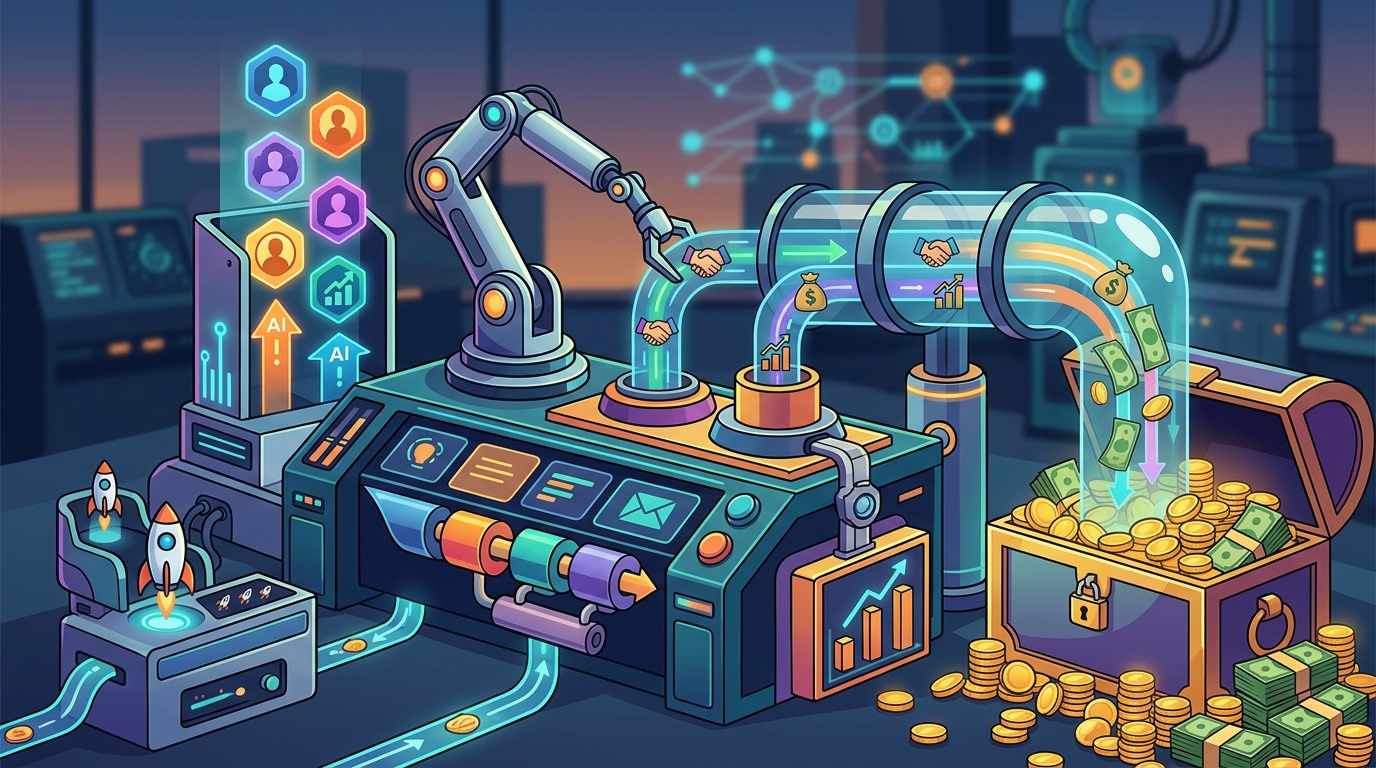
What This Looks Like in Practice
- AI monitors conversations across email, calls, LinkedIn, and messaging platforms
- Every commitment made in a call becomes a tracked task
- Every stalled deal triggers a contextually relevant re-engagement message
- Reps review and approve—then move to the next conversation
Strategy 3: Eliminate CRM Data Decay with AI Enrichment
Bad data is the silent killer of sales automation. AI now automatically updates CRM records, syncs meeting notes, fills missing contact details, and triggers follow-up tasks. By eliminating repetitive updates and double entry, teams save time and maintain consistent, reliable customer data.
This matters because when information flows seamlessly between systems, teams gain a clearer understanding of customer interactions and can make more informed decisions throughout the sales process.
Set 2 Close, for example, builds custom AI agents within HubSpot that handle rapid data extraction, automated data enrichment, and data quality assurance—keeping CRM records fresh so reps always work from accurate profiles. One client grew ARR 40% to $6 million in the first eight months of working with them.
Strategy 4: Use Predictive Analytics to Improve Forecasting and Win Rates
AI applies predictive analytics to detect patterns in pipeline health, engagement trends, and deal momentum. This boosts forecast accuracy, enabling sales leaders to make decisions based on real-time insights rather than spreadsheets or intuition.
The data is compelling: predictive analytics can boost win rates by 14.5% compared to teams without it, and companies that automate lead nurturing campaigns see a 10%+ revenue increase within 6–9 months.
By identifying potential risks and anomalies early, AI helps sales teams mitigate losses and adjust strategies proactively—ensuring more stable and predictable revenue streams.
Strategy 5: Deploy AI Sales Agents to Accelerate the Top of Funnel
AI sales agents handle prospect research, personalized outbound, reply handling, lead qualification, meeting scheduling, and routing high-intent buyers to reps. Most teams start at the top of funnel, then expand usage as they see where automation creates the biggest time savings.
These agents are particularly valuable for companies with long sales cycles where leads require multiple follow-ups and stakeholder buy-in. They remove the operational drag that slows buyers down and keeps sellers stuck doing everything except selling.
Set 2 Close develops custom AI sales agents and offers pre-built agents for prospect research, job application scoring, and more—all integrated within HubSpot to maintain a single source of truth across the revenue team.
Strategy 6: Align RevOps Across Sales, Marketing, and Customer Success
Technology alone isn't enough. The sales teams winning in 2026 aren't the ones with the most tools—they're the ones with connected systems where every signal informs every action and every interaction makes the next one smarter.
This requires aligning sales, marketing, and customer success teams around shared data, shared definitions, and shared revenue goals. A RevOps consultancy can bridge these gaps without the cost of a full-time hire, making it ideal for scaling businesses and project-based needs.
Key Alignment Actions
- Standardize lifecycle stages and lead handoff criteria across departments
- Unify reporting dashboards so every team sees the same pipeline metrics
- Build automated workflows that trigger cross-team actions (e.g., a closed-lost deal triggers a retention campaign)
- Train teams together on the CRM and AI tools they share
Strategy 7: Measure What Matters—Then Iterate
Decision-makers are increasingly replacing productivity as a success metric with direct financial impact. The metrics that matter for AI sales automation ROI fall into three categories:
| Category | Metrics | Timeline |
|---|---|---|
| Efficiency | Time-to-first-contact, admin hours per rep, activity target attainment | 30–60 days |
| Pipeline Quality | MQL-to-SQL conversion, lead-to-opportunity rate, average days in stage | 60–90 days |
| Revenue | Win rate, average deal size, sales cycle length, quota attainment | 90–120 days |
Start by identifying one process where AI can deliver measurable impact within 30 days, then expand from there.
Key Takeaways
- Start with data hygiene. Audit your sales stack for automation gaps and prioritize eliminating manual data entry first—then layer in predictive intelligence as your team's AI literacy grows.
- AI lead scoring transforms pipeline quality. Dynamic, behavior-based scoring delivers 75% higher conversion rates than traditional methods.
- Personalized outreach at scale works. AI-generated, signal-based outreach achieves 15–25% reply rates versus 3–5% for generic cold email.
- Predictive analytics drives revenue. Teams using predictive analytics see 14.5% higher win rates and 10%+ revenue lifts from automated nurturing.
- Humans still close deals. AI handles volume; reps handle relationships. The model where AI drafts and humans approve is the 2026 standard.
- Measure financial impact, not just productivity. Track efficiency, pipeline quality, and revenue metrics on a 30/60/90/120-day cadence.
Frequently Asked Questions
How much revenue lift can AI sales automation deliver?
According to McKinsey research, generative AI can boost B2B sales revenues by roughly 5–15% while returning 20–40% of sellers' time. Companies that automate lead nurturing see 10%+ revenue increases within 6–9 months.
What sales tasks should I automate with AI first?
Start with manual data entry and CRM updates, then layer in AI lead scoring and automated follow-up sequences. Audit your current stack for automation gaps and prioritize eliminating manual data entry first.
Can small businesses benefit from AI sales automation?
Absolutely. Many of the platforms leading sales automation in 2026 are designed to scale down as well as up, with plans suitable for individual sellers and small teams.
How long does it take to see ROI from AI sales automation?
Efficiency metrics improve within 30–60 days. Pipeline quality metrics follow in 60–90 days. Revenue indicators like win rate and average deal size typically show movement in 90–120 days.
Does AI replace human sales reps?
No. AI sales agents remove the operational drag that slows down buyers and keeps sellers stuck doing non-selling activities. The best results emerge when AI handles volume work and humans focus on relationships, discovery, and closing.
Ready to Turn AI Into Revenue?
Set 2 Close combines holistic B2B sales strategies with customized CRM development, AI selling technologies, and revenue operations expertise to help scaling businesses boost sales productivity and grow revenue. Whether you need a HubSpot migration, custom AI sales agents, or a full revenue system design, their team moves fast—most programs are implemented in three months or less.
Book a free consultation to see how AI-powered sales automation can work for your organization.